FL Studio
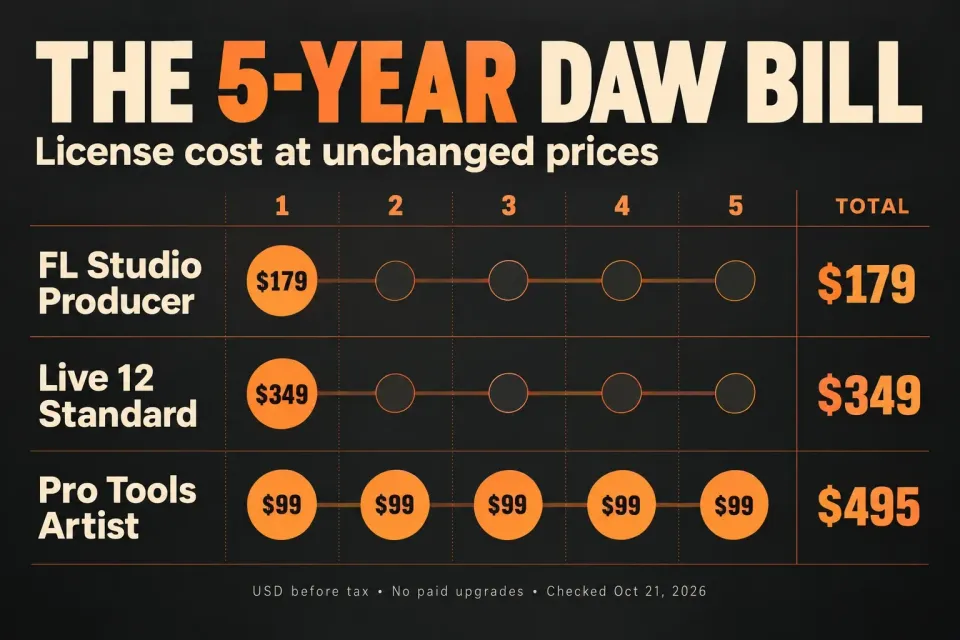
In the October 2026 price snapshot, five years of FL Studio Producer costs $179 with no extra purchases. Ableton Live 12 Standard costs $349 if you keep that major version, Cubase Pro 15 costs $579.99, and Pro Tools Artist costs $495 on an unchanged $99 annual subscription. Those totals describe license spending, not equal feature sets or a complete studio budget. Use the calculator to compare your own purchase price, billing plan and optional updates.
I’d separate two decisions before comparing the numbers: do you need the version you buy to keep working, or do you want access to future releases too? FL Studio includes Lifetime Free Updates to your edition. Other licenses use different update windows, and a subscription buys access for the period you pay for. A low first payment can therefore tell you very little about the five-year bill.
DAW cost calculator: compare two plans
Choose two presets, then replace the prices with your actual USD quotes if needed. The default is a five-year comparison with zero optional paid upgrades. To budget for updates, enter the price and number of purchases you choose to make within the period. The calculator doesn’t predict release dates or future prices.
The interactive calculator needs JavaScript. The 1-, 3- and 5-year comparison table below gives the same baseline prices and assumptions.
All amounts are before tax. Annual plans charge a full year upfront: a 13-month horizon therefore includes two annual payments, even though part of the second year falls outside your chosen period. Trials, promotional discounts, hardware, plug-ins, sample subscriptions and financing charges are excluded. An existing license is a sunk cost; enter $0 upfront when comparing only what you will spend from today.
What seven DAWs cost over 1, 3 and 5 years
The table uses publicly displayed US prices for new standard licenses or subscriptions from the October 21–22, 2026 price snapshot. Every future total holds the recurring price constant. Perpetual-license rows assume you keep an entitled version and make no additional paid purchases. These are calculated scenarios, not quotations for future renewals.
| DAW / license | Price used | 1 year | 3 years | 5 years |
|---|---|---|---|---|
| FL Studio Producer | $179.00 once | $179.00 | $179.00 | $179.00 |
| Ableton Live 12 Standard | $349.00 once | $349.00 | $349.00 | $349.00 |
| Cubase Pro 15 | $579.99 once | $579.99 | $579.99 | $579.99 |
| Cubase Artist 15 | $329.00 once | $329.00 | $329.00 | $329.00 |
| Cubase Elements 15 | $99.99 once | $99.99 | $99.99 | $99.99 |
| Fender Studio Pro — perpetual | $199.99 once | $199.99 | $199.99 | $199.99 |
| Fender Studio Pro — Pro+ annual plan | $179.99 / year | $179.99 | $539.97 | $899.95 |
| Fender Studio Pro+ — monthly | $19.99 / month | $239.88 | $719.64 | $1,199.40 |
| Logic Pro for Mac — one-time | $199.99 once | $199.99 | $199.99 | $199.99 |
| REAPER — discounted license | $60.00 once | $60.00 | $60.00 | $60.00 |
| REAPER — commercial license | $225.00 once | $225.00 | $225.00 | $225.00 |
| Pro Tools Artist — annual | $99.00 / year | $99.00 | $297.00 | $495.00 |
| Pro Tools Artist — monthly | $9.99 / month | $119.88 | $359.64 | $599.40 |
| Apple Creator Studio — annual | $129.00 / year | $129.00 | $387.00 | $645.00 |
| Apple Creator Studio — monthly | $12.99 / month | $155.88 | $467.64 | $779.40 |
Cubase gets one row per edition: Elements 15 at $99.99, Artist 15 at $329.00 and Pro 15 at $579.99, each kept at version 15. The Fender rows show three ways to pay for Fender Studio Pro, which is built on PreSonus’ Studio One platform: a $199.99 perpetual license, that license sold with a Pro+ annual plan, or a Pro+ monthly plan.
The REAPER rows buy the same software; eligibility determines the license price. Apple Creator Studio is included as another way to access Logic Pro, but its row charges the entire creative-app bundle. The comparison does not assign a fictional share of that bill to Logic or treat the bundle as identical to the standalone Mac app.
On these assumptions, FL Studio Producer costs $316 less than five annual Pro Tools Artist payments. That is a cash difference, not proof that the two editions can replace each other. Artist has its own track and feature limits; Live Standard is not Live Suite. Choose an adequate edition before using price to break the tie.
Keeping a version and keeping it current are different budgets
FL Studio: edition updates included, extra products separate
Image-Line’s Lifetime Free Updates policy covers the FL Studio edition and the included plug-ins you purchase. It doesn’t promise every future separately sold instrument or a higher edition for free. Producer is the comparison point here because the current edition table includes audio recording in Producer, while Fruity does not. Our FL Studio editions guide addresses which bundle fits your work.
For a producer who wants FL Studio’s workflow and continuing edition updates, that makes the recurring DAW-update budget straightforward: $0 under the current policy. Buying a higher edition, FL Cloud services or other plug-ins is a separate decision. Add those only when they belong in your actual plan.
Ableton Live: major upgrades are optional purchases
Ableton’s upgrade policy distinguishes free updates within a major version from paid upgrades to a newer major version or a higher edition. Your account determines the upgrade offer. A $349 Live Standard row therefore does not claim that every future major release is included. An important exception is Ableton’s Live 13 upgrade offer: purchases of Live 12 Intro, Standard or Suite from November 10, 2026 until Live 13’s release in early 2027 include the equivalent Live 13 edition free on release. Enter $0 for that included upgrade; budget separately for later upgrades your purchase does not include.
If you want a budget for those releases, put an actual available upgrade quote into the calculator and choose a purchase count. For example, a hypothetical $150 upgrade bought twice changes a $349 purchase into $649. The $150 and two purchases are a sensitivity example, not an Ableton quote or release forecast.
REAPER: the update entitlement ends at a version number
A new REAPER license includes free upgrades through version 8.99. That is not a guarantee of five years of new releases. The $60 or $225 baseline keeps an entitled version; it does not budget for a later purchase beyond that window. Add a future-license allowance only as an explicit assumption.
The discounted-license conditions cover personal use, educational or nonprofit organizations, and qualifying commercial use where yearly gross revenue does not exceed $20,000. If your commercial use does not qualify, compare the $225 license. Calling the $60 option “the professional price” without checking eligibility can change the conclusion by $165 before any updates enter the calculation.
Cubase: the next major version is a paid update
Steinberg’s grace-period policy describes new major Cubase versions as paid updates. A license redeemed shortly before such a release can qualify for the new version free; otherwise the jump costs money. The Cubase rows therefore keep version 15 with no later purchase. Moving from Elements or Artist to Pro is also a separate purchase, so the $99.99 Elements figure only stays your five-year cost while Elements still covers your sessions. The current grace-period table lists Cubase 16 for Cubase 6 and later, with a grace-period start of October 7, 2026. Eligibility depends on when the Download Access Code is redeemed, so check that entitlement before budgeting a paid move from Cubase 15 to 16.
Fender Studio Pro: one year of feature releases, then optional upgrades
Fender’s store lists the perpetual license at $199.99 with one year of new feature releases that you keep. After that year, a $99.99 upgrade license adds 12 more months of feature updates, and Studio One Pro owners use the same upgrade path. A hypothetical upgrade every other year, two in five years, turns $199.99 into $399.97. That count is a sensitivity example, not a Fender release schedule.
Logic Pro: a one-time Mac purchase is still available
The US Mac App Store lists standalone Logic Pro at $199.99, and Apple says its standalone Mac apps remain available as one-time purchases. The flat cost row assumes that purchase with no later paid purchase. I wouldn’t turn Apple’s history of updates into an unconditional promise that every future release or feature will be included forever.
Logic’s standalone Mac price also assumes you already have a compatible Mac. If buying one is part of the decision, compare that hardware cost separately. A cheaper software license cannot erase a computer purchase.
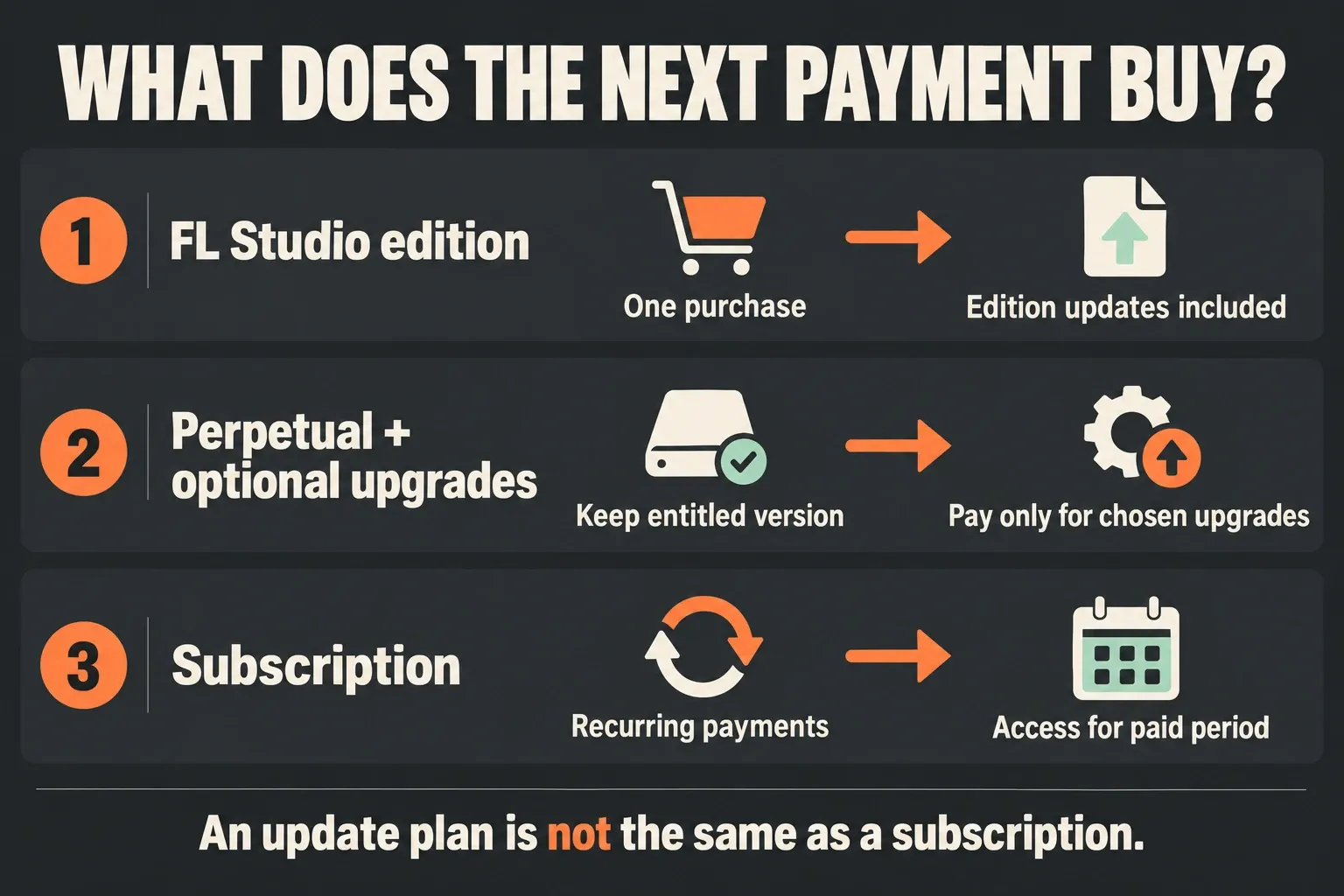
Bitwig illustrates the distinction clearly even though it is outside this USD price table: its 12-month Upgrade Plan policy says the perpetual license keeps working after the plan expires. Renewing gets access to further releases; it is not a compulsory payment to keep the entitled version. The same “buy plus chosen renewals” calculation can model a quote you already have.
When does a subscription cost more?
Apple lists Creator Studio at $129 per year or $12.99 per month. Ignoring trial credit, the annual route costs $129 for the first 12 months, then $258 once you buy the second year. That second payment takes its cash total past the $199.99 standalone Logic Mac purchase. At the monthly rate, 15 payments cost $194.85; 16 cost $207.84.
That crossover is useful if Logic on Mac is all you need. It says much less if you also use the bundle’s other apps or its Mac and iPad access. If you already pay for Creator Studio for those tools, the incremental subscription charge for adding Logic to that workflow may be $0. Keep the full-bundle cost and the incremental decision separate.
At the baseline standard rates, Pro Tools Artist costs $99 annually or $9.99 monthly. Twelve monthly payments total $119.88, versus $99 for a year paid upfront. Across five unchanged years, that is $599.40 monthly versus $495 annually. A short project can favor the monthly route because the annual plan charges the full year; continuous multi-year access favors the annual price under these inputs.
A subscription row counts the cost of maintaining paid access throughout the chosen period. It does not produce a perpetual Artist license at the end. Avid also sells different perpetual offerings, so the Artist subscription row should not be relabeled as the cost of owning Pro Tools Studio.
Fender’s $19.99 monthly plan reaches $219.89 at month 11, compared with the $199.99 one-time license. The $179.99 annual plan totals $899.95 over five annual payments, but it includes a perpetual DAW license as well as annual Pro+ access. That five-year row budgets uninterrupted Pro+ extras; it is not the minimum cost of keeping Fender Studio Pro. I’d compare both perpetual purchase routes before paying for repeated annual terms. At these listed prices, the first annual term is $20 cheaper than the standalone license; check its renewal and cancellation terms before choosing it.
How the cost study is calculated
For a horizon of M whole months, the model adds the upfront payment, recurring bills and any optional purchases you enter:
Total = upfront + ceil(M ÷ billing period) × recurring price + purchase count × optional purchase price
The billing period is 1 month or 12 months. A zero recurring price adds no recurring bills. A horizon ending at month 12 includes one annual payment; month 13 includes two. The average monthly figure is total divided by the chosen months, not a vendor’s installment offer. Currency inputs are calculated in cents.
Our downloadable DAW cost data and assumptions contains the exact prices, billing periods, 1-, 3- and 5-year totals, checked dates and source URLs. The fifteen presets cover seven DAWs, three Cubase editions, two REAPER license levels and alternative subscription billing routes. They are deliberately not averaged into an “average DAW price”: a bundle, a discounted license and a particular edition are different purchases.
Prices can change by country, tax location, promotion and eligibility. This snapshot excludes educational, crossgrade, upgrade-only and hardware-bundle offers. Existing owners should replace the new-license price with their actual incremental quote. Optional purchase counts are selected assumptions; there is no invented timetable for future Ableton, REAPER or other releases.
The totals exclude computers, interfaces, storage, optional instruments, learning time, resale proceeds, inflation and financing. Keeping a perpetual license also does not guarantee compatibility with every future operating system. This is a reproducible comparison of software-license cash outlay, rather than a forecast of your entire cost of making music.
Best-value DAW for beginners over five years
At the snapshot’s $179 price, I’d start with FL Studio Producer for a beginner who wants one DAW for years. Its five-year total stays $179 because edition updates are included, and it records audio, which the $99 Fruity Edition doesn’t. Image-Line’s pricing page calls Producer the best choice for beginners. My reason is simpler: it’s the cheapest FL edition you won’t outgrow the first time you record a vocal.
With closer to $100 to spend, Cubase Elements 15 at $99.99 is the cheapest one-time license in the table after REAPER’s $60 discounted tier. Check that Elements covers the sessions you plan to build, because the step up to Artist or Pro is another purchase. Fender Studio Pro costs $199.99 and suits a beginner drawn to its workflow; I’d just budget a $99.99 upgrade for the day its first year of feature releases runs out and you want what came next.
What I would choose on a tight long-term budget
If FL Studio Producer already covers your work, I’d budget around its one-time price and included edition updates. That removes a recurring DAW-upgrade line from the plan. I’d move to Signature or All Plugins only for tools I need, rather than treating the largest bundle as the default.
REAPER has the lowest new-license entry price in this selected paid set when you qualify for its discount. Logic’s standalone Mac purchase deserves a close look if you already own the computer and mainly need Logic. Live Standard remains a reasonable purchase when that workflow earns its place; budget only for major upgrades your purchase does not include. The Ableton versus FL Studio workflow comparison handles that choice in more detail.
For a temporary subscription need, calculate the months you’ll use. For a DAW you expect to keep for years, look at the five-year total and what happens when payments stop. I’d make that decision before buying extra plug-ins to solve a problem the chosen edition already covers.