FL Studio
FL Studio Desktop does not run natively on ChromeOS. FL Studio Mobile can run on a compatible Chromebook through Google Play. Those are different applications, not two ways to install the same desktop program. Before paying for anything, check which app your Chromebook can actually install and which project workflow you need.
If you want to make a beat with Mobile's instruments, record ideas and export audio, a compatible Chromebook is an option. If you need a particular Windows plugin or a collaborator's Desktop project, do not assume Mobile will replace that setup. A supported Windows or Mac computer is the more direct choice for Desktop.
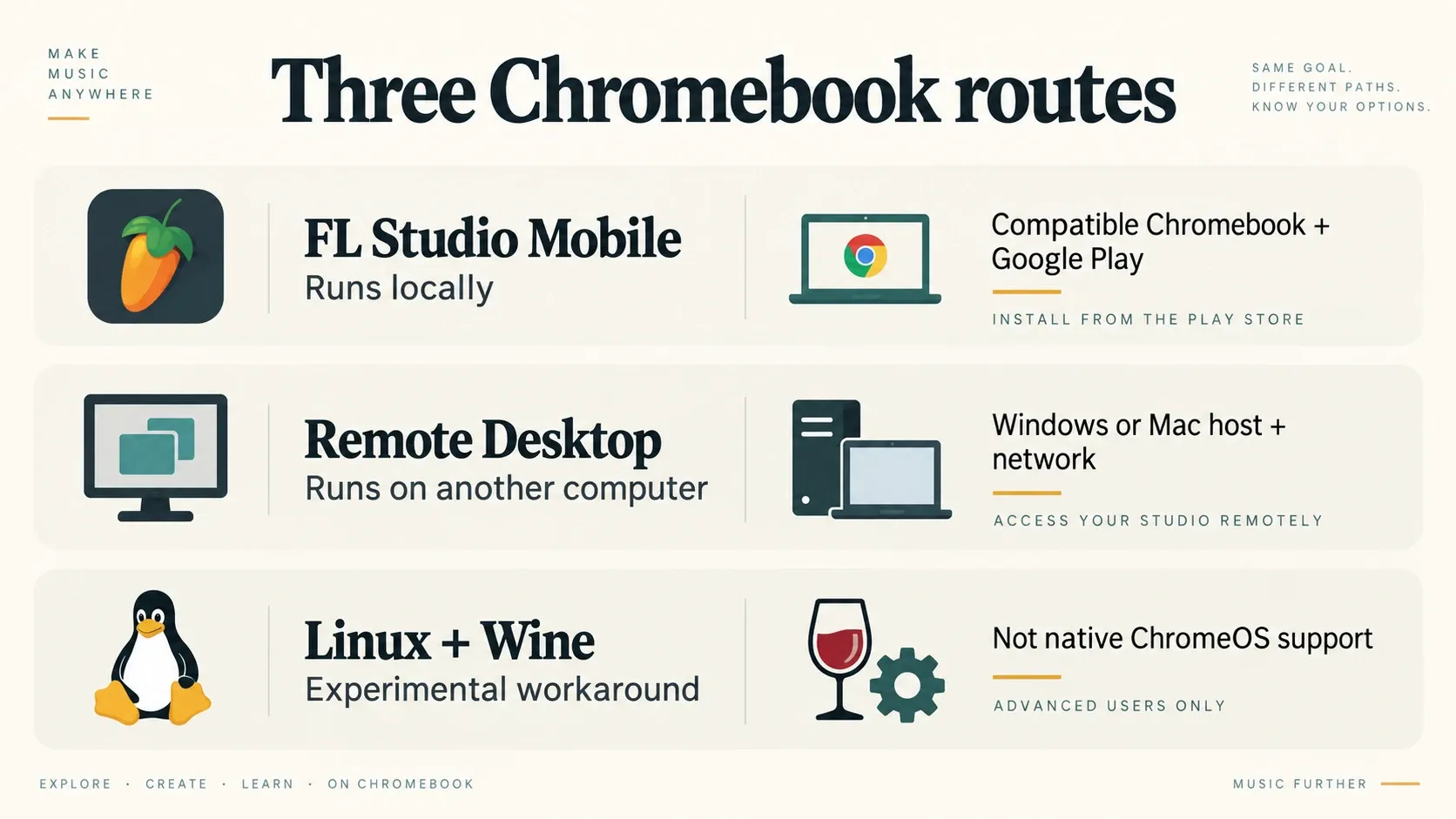
The three ways people mean “FL Studio on Chromebook”
Image-Line's ChromeOS support answer distinguishes Desktop from Mobile. That distinction explains why one guide says “yes” while another says “no”: they may be talking about different products.
| Route | Where the music app runs | What to check |
|---|---|---|
| FL Studio Mobile | Locally on a compatible Chromebook | Google Play access, exact device compatibility and whether Mobile covers your needs |
| Remote access to Desktop | On a separate Windows or Mac host | Host availability, permissions, network, audio routing and response time |
| Linux and Wine | Through additional compatibility layers | An experimental setup, not native or guaranteed ChromeOS support |
A fast processor does not change which operating system an installer supports. Image-Line's official Desktop installers target Windows and macOS. Downloading the Windows installer onto a Chromebook does not make it a ChromeOS application. Check our Desktop system requirements guide when choosing the computer that will actually run it.
What Mobile gives you—and what it does not
FL Studio Mobile is a music-production app with its own instruments, effects, arrangement tools, recording and automation. It is not simply a remote control for Desktop. You can work on a song locally and export the result without having Desktop open on another computer.
But “FL Studio” in the name does not mean a Desktop tutorial's plugin, menu or project will behave identically. Mobile uses its own environment; do not buy it expecting to install your Windows VST collection. Our Mobile versus Desktop comparison covers the wider workflow differences. Here the practical question is narrower: can your Chromebook run the app you need?
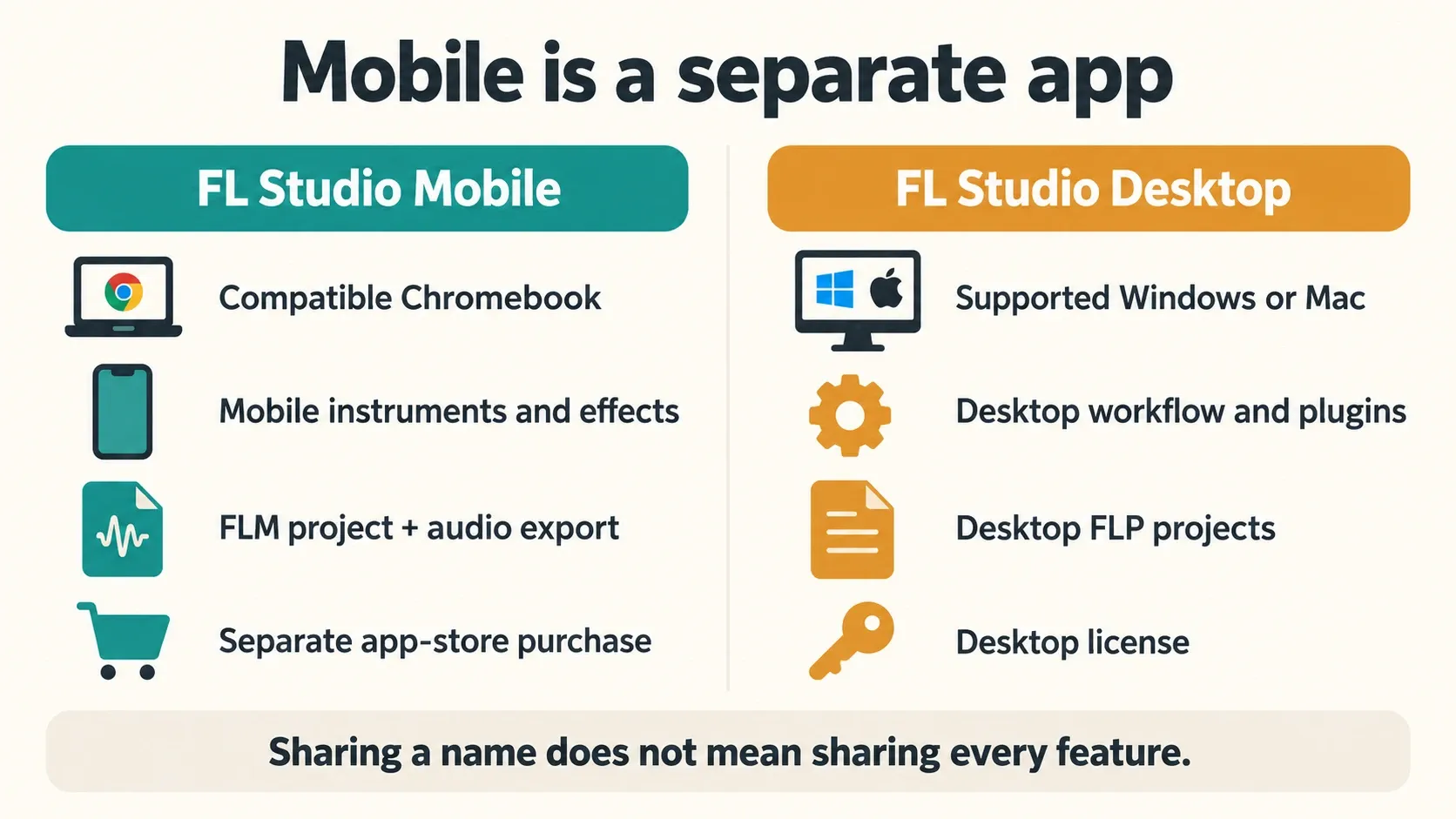
Mobile's app-store purchase is separate from a Desktop edition. The free Mobile plugin for FL Studio Desktop is a different way to use Mobile projects inside the host; it is not the Chromebook app-store license. Check the price shown to your own Google account before purchase; a price quoted in a video may reflect a different region or date. Buying a higher Desktop edition does not add native ChromeOS support.
Check your Chromebook before buying Mobile
Open the official FL Studio Mobile listing by Image-Line on the Chromebook you intend to use. A public listing viewed on another computer is not confirmation that this device can install the app.
Google's Android app instructions for Chromebooks explain that only some Chromebooks support Android apps and that not every Android app is compatible with every device. Start by updating ChromeOS. In Settings, check Apps and the Google Play preferences available on your machine. Labels can change with ChromeOS updates; use Google's current instructions if yours differ.
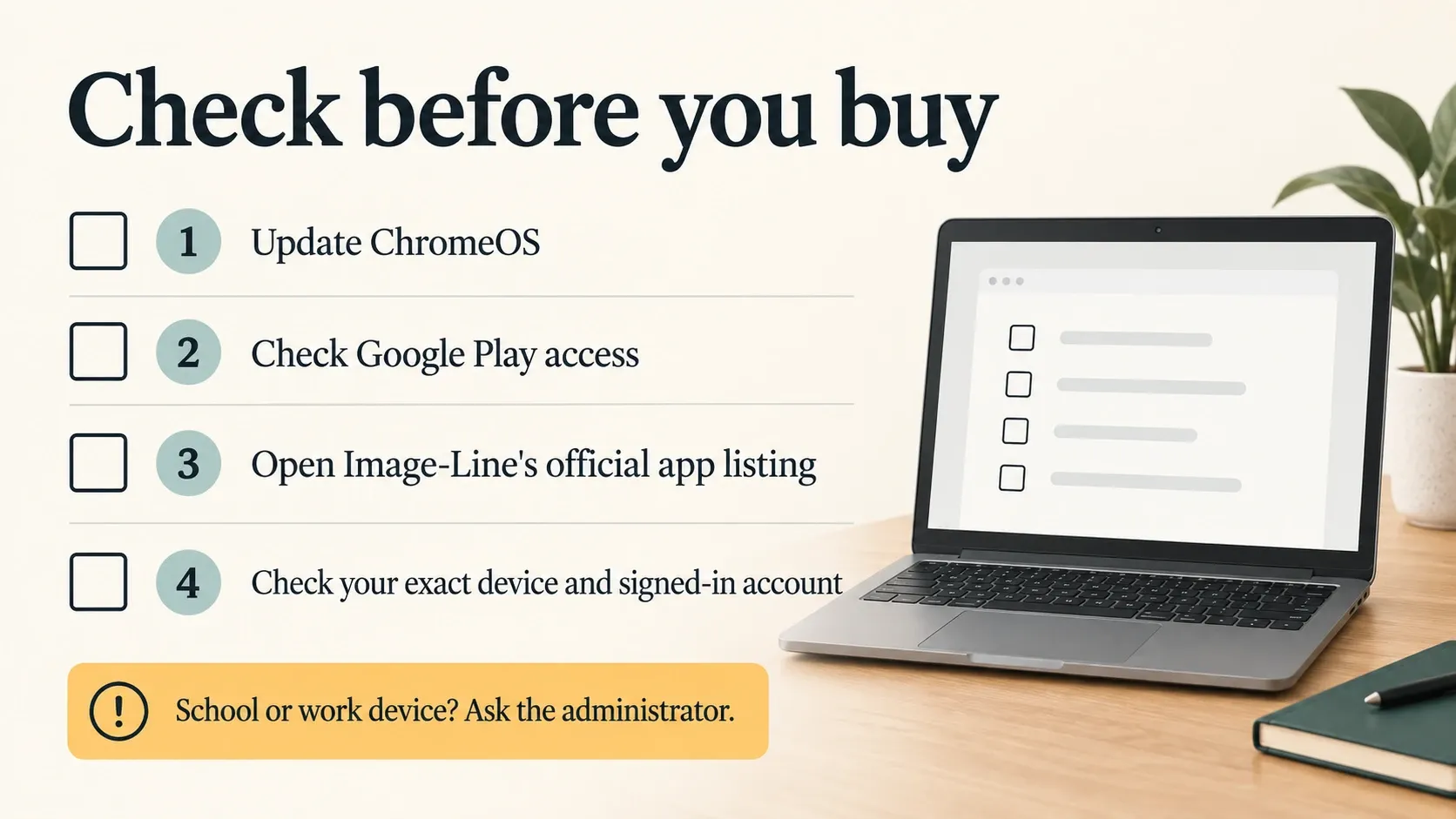
Also check the signed-in account. Google says Play Store apps are available to the first account signed in on the Chromebook. A missing installation option can therefore be an account or device issue, not evidence that the app has disappeared.
On a school or work Chromebook, the administrator may restrict Google Play, individual apps or Linux. Ask for the approved route. Do not remove management, enable developer mode or install an unofficial APK to get around those restrictions. If the required app is unavailable on that managed machine, use an authorized compatible device.
Check your first Mobile project in eight steps
Do this with a short project before bringing in a large sample library or relying on the Chromebook for a deadline. These are checks to perform on your equipment, not results from a hardware benchmark.
- Update ChromeOS. Install available system updates and restart if prompted. Keep existing work backed up before making system changes.
- Check Google Play compatibility. Use the intended Chromebook and signed-in account to confirm that Image-Line's official FL Studio Mobile app is available. Resolve managed-device restrictions with the administrator.
- Install the official Mobile app. Review the store price and device eligibility before purchase. Do not substitute the Windows installer or a third-party APK.
- Start a short project. Open Mobile and create a small arrangement using an included instrument or sound. Keep the first check simple enough that you can identify which part fails.
- Test sound and any required input. Play the arrangement through your intended output. If you need recording or a MIDI controller, check that connection in the app too; built-in playback alone does not validate external hardware.
- Save a named FLM project. Use the Home panel's song-saving options to keep a native Mobile project. Give this test a distinct name so it cannot overwrite something valuable.
- Close and reopen that FLM. Confirm the saved project returns with the expected arrangement and sounds. Do not delete the project or uninstall the app as part of this check.
- Export and play a WAV. Export audio from the Home panel, locate the resulting file and play it outside Mobile. Then keep a separate backup of the project and any samples you need.
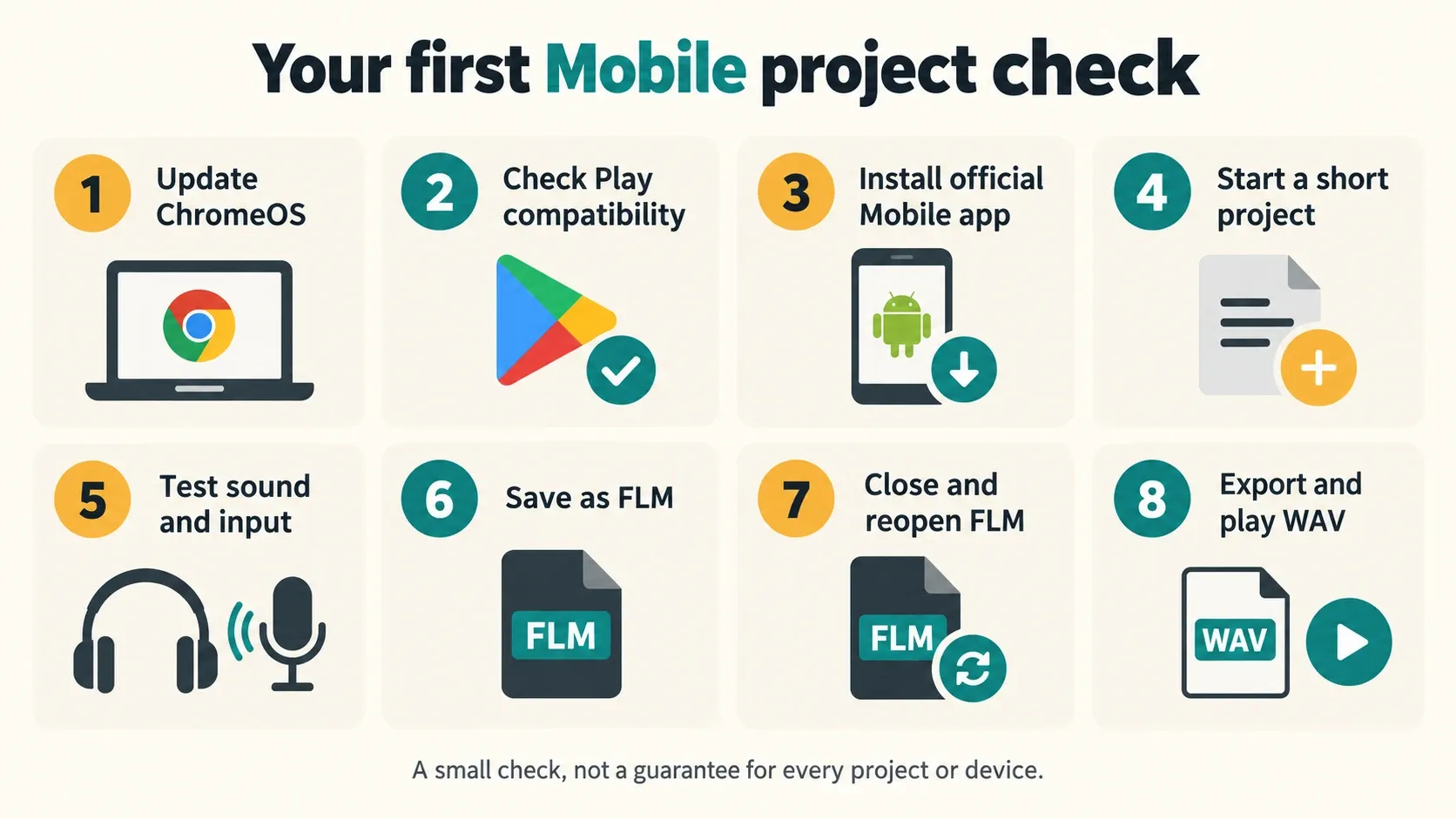
The Mobile Home panel manual documents the project and export formats. Passing this small check gives you a useful starting point; it does not establish that every large project, USB device or later app update will behave the same way.
Import samples, then protect the project files
For your own audio, use Mobile's file-import controls and the system file picker. Google explains that Android apps can access Chromebook downloads when the appropriate file permissions are granted. If a sample is not visible, check its location and the app's permissions before treating it as a broken audio file.
Follow the Mobile file-management instructions rather than copying an old Android storage path from a tutorial. Storage access differs between operating systems and Android versions; a hard-coded folder path is not a universal import method.
Back up before uninstalling Mobile, turning off Google Play or resetting the Chromebook. Image-Line warns that deleting the app removes its local files. Google also warns that turning off Play Store erases Android app data and settings. Reinstalling an app is therefore not a harmless first troubleshooting step when your only copy of a song is inside it.
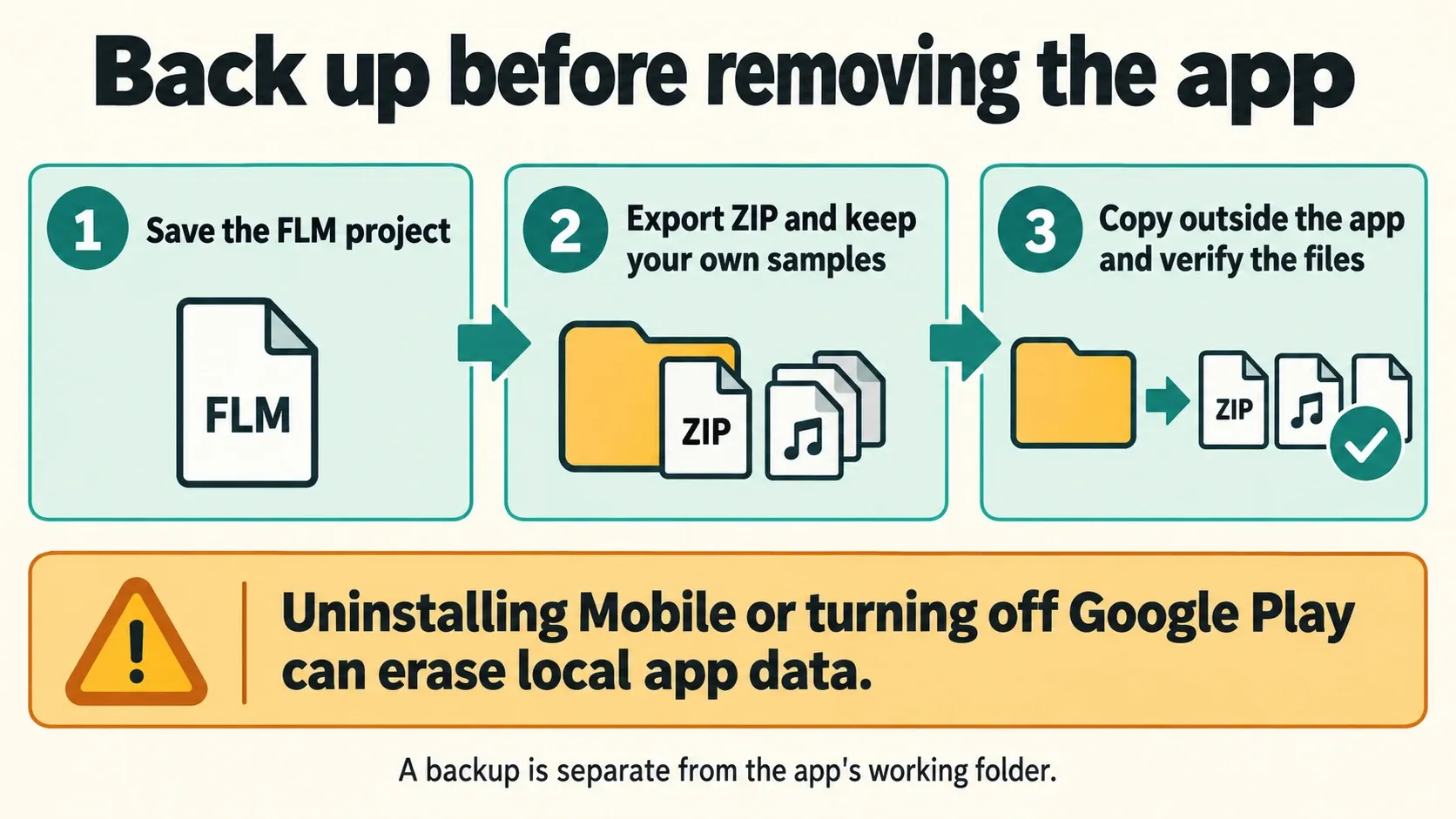
Keep the FLM project, export a ZIP where appropriate, and copy your backup somewhere separate from the app's working folder. Check that the files are actually present and usable. A filename in a cloud folder is not, by itself, evidence that every sample your song depends on has been preserved.
Moving a Chromebook project to Desktop
Choose the file for the job. You are not supposed to convert through every format in sequence.
| File | What it is for | Important limit |
|---|---|---|
| FLM | Saving and reopening the native Mobile project | Keep this original even when exporting something else |
| ZIP | Bundling a project with the used samples | The manual excludes purchased shop content from this bundle |
| FLP | Exporting for Desktop using Mobile Rack instruments | Not a promise of unrestricted interchange with every Desktop project or plugin |
| WAV | Keeping rendered audio to listen to or arrange elsewhere | Audio does not retain the original editable instrument and note structure |
| MIDI | Transferring notes, tempo and supported basic controller data | It does not contain the sound; the manual limits full-project export to the first 16 tracks |
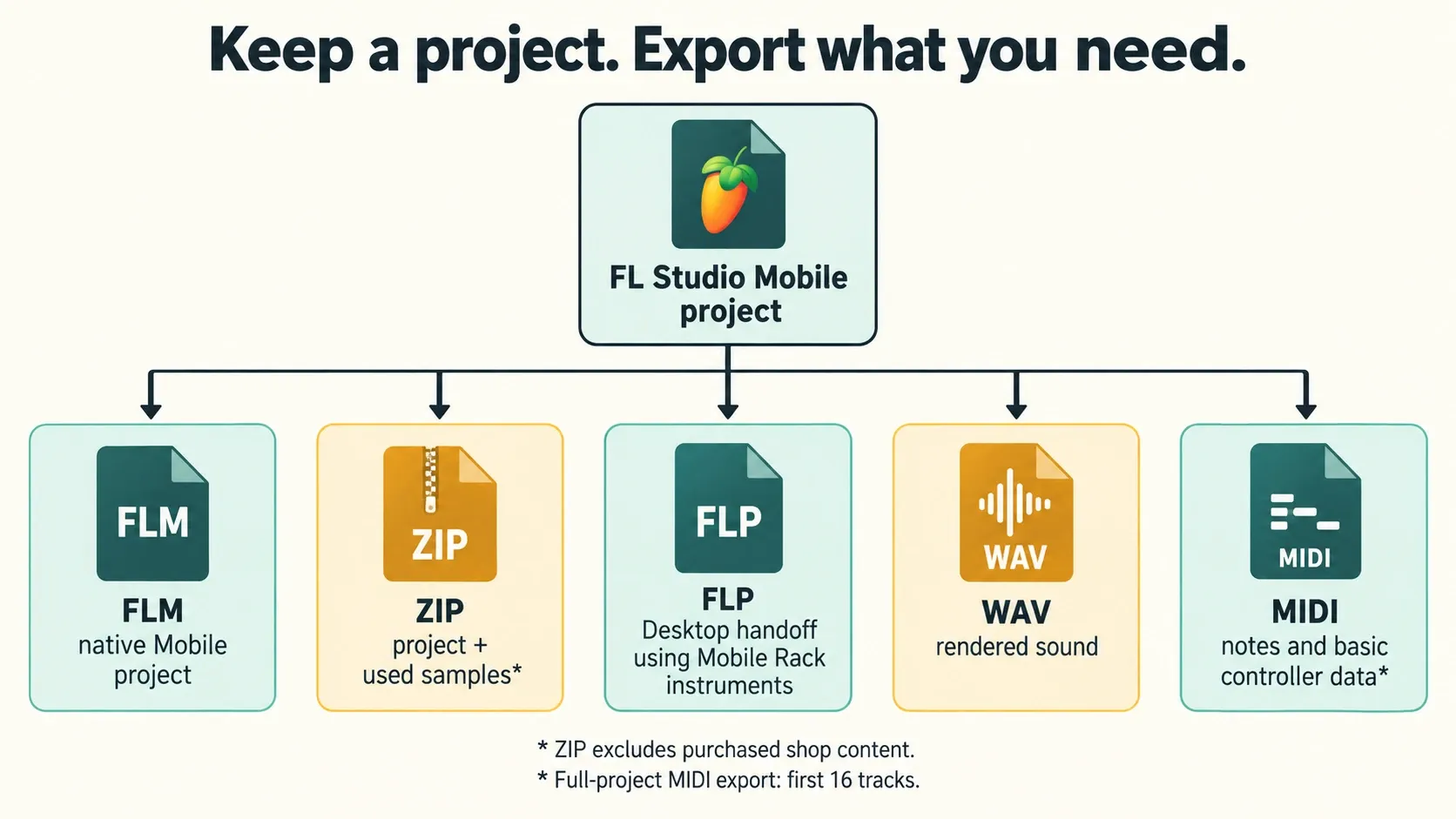
The current Home panel manual explicitly documents FLP export using Mobile Rack instruments. Save your FLM first, then check the export options in your installed Mobile version. If an older build does not show the documented option, check official updates and the manual before assuming an unrelated online conversion tool is necessary.
On the destination computer, open the exported project and compare its playback with a reference audio export. Keep your source project and samples until you have checked the transfer. For note-based handoffs, our MIDI export guide and MIDI import guide explain the Desktop side; their menus are not Mobile instructions.
One licensing trap matters here: the Desktop trial cannot reopen saved project files until unlocked. Do not confuse that restriction with the Mobile save-and-reopen check above. Plan the destination license before depending on repeated Desktop project recall.
Audio interfaces and MIDI controllers need a device check
The official Play listing advertises USB audio-interface support and class-compliant MIDI-controller support. That is not a guarantee for every Chromebook, adapter, controller or connection. Before buying accessories, establish that your exact combination is recognized and works in Mobile.
Test the task you intend to do: hearing a song is different from recording a microphone, and entering notes is different from playing comfortably while monitoring. Start with a simple project and one required device. If the connection fails, check power, cables, permissions and the device's own documentation before adding more equipment.
Our Desktop audio-settings guide becomes relevant if you move to a Windows or Mac host. Do not copy its ASIO instructions into ChromeOS or assume its buffer advice describes Mobile's available controls.
Remote Desktop: the Chromebook is the client
You can use a Chromebook to access another computer through a remote-access service. Google's Chrome Remote Desktop instructions cover the browser client, host setup and access requirements. FL Studio Desktop still runs on the host—not natively on the Chromebook—and you still need the appropriate software license.
The usefulness of that arrangement depends on the network, response time and audio routing. It may suit some editing tasks, but timing-sensitive playing and monitoring need their own check. Do not assume that a remote session carries audio or forwards your local interface exactly as you expect. For recording, using the host and its local audio setup avoids depending on the remote link for that part of the session.
The host must be available, and school or workplace policies may restrict remote access too. This route makes sense only if you already have, or plan to maintain, another suitable computer; it is not a way to turn a Chromebook into that computer.
Why Linux and Wine are not the default recommendation
Google's Linux-on-Chromebook instructions describe a development environment available on supported devices. Enabling it does not turn ChromeOS into Windows. Wine is a compatibility layer for Windows applications, with further questions about the CPU, audio, drivers and plugins.
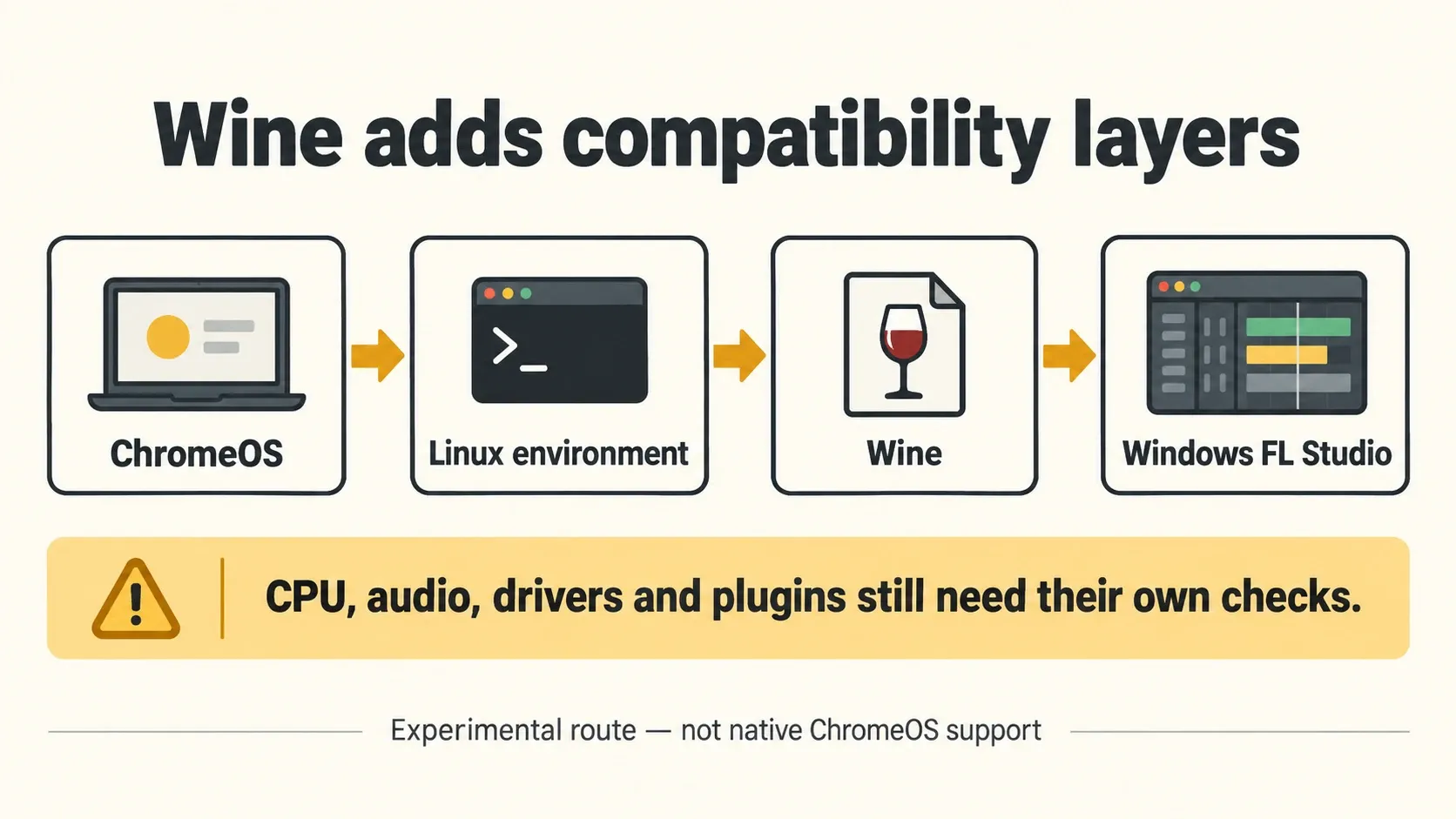
A video of one installation is not evidence that your model, ChromeOS version and plugin collection will work the same way. Treat this as an experiment if you deliberately want to investigate it, not the basis for promising a reliable recording setup. We have not tested a Wine installation or measured latency on your Chromebook.
Keep the deeper workaround questions in our FL Studio on Linux guide. If the goal is simply to use Desktop, follow the Windows or Mac installation guide on a supported host instead.
Which route should you choose?
If you already own a compatible Chromebook and want a local music app, check Mobile's store compatibility and workflow first. If a particular Desktop plugin or project is essential, choose the supported host around that requirement. Use remote access when a separate host is already part of your setup and the connection suits the task.
For the next platform decision, use the Platforms & Mobile hub. If you are about to spend money, the Compare & Buy hub helps separate the app, edition and computer decisions. Buy the product that fits the work you need to do—not just the familiar name on its icon.
Frequently asked questions
Can I install FL Studio Desktop directly on ChromeOS?
No. Image-Line provides Desktop installers for Windows and macOS, not a native ChromeOS installer. FL Studio Mobile is the separate local option for compatible Chromebooks.
Does every Chromebook support FL Studio Mobile?
No. Check Google Play availability and the official Image-Line app listing on your exact device and signed-in account. Android-app support alone does not guarantee that a particular app is compatible.
Can I use FL Studio on a school Chromebook?
Only through a route your administrator permits and your device supports. Google Play, individual apps, Linux or remote access may be restricted. Ask the administrator rather than bypassing device management.
Does buying FL Studio Desktop include the Chromebook app?
Mobile is a separate app-store purchase. Check its current listing and your device eligibility before paying; a Desktop edition does not provide native ChromeOS support.
Can FL Studio Mobile use my Windows VST plugins?
Do not plan on installing your Windows VST collection in Mobile. It uses its own instruments and effects environment rather than replacing the Desktop plugin workflow.
Can I move a Mobile project to FL Studio Desktop?
The current Mobile Home panel manual documents FLP export using Mobile Rack instruments. Keep the original FLM, preserve needed samples and check the exported project on the destination setup. This is not unrestricted compatibility with every Desktop project or plugin.
Does MIDI export preserve the sound of my Mobile song?
No. MIDI transfers notes, tempo and supported basic controller data, not the instruments' rendered sound. The Mobile manual limits full-project MIDI export to the first 16 tracks; use an audio export when you need to preserve how the song sounds.
Will reinstalling Mobile keep all my projects?
Do not assume so. Image-Line warns that deleting the app removes local files, and Google says turning off Play Store erases Android app data. Back up your projects and needed samples outside the app before removing it.
Is remote Desktop the same as running FL Studio on Chromebook?
No. The application runs on another host, while the Chromebook accesses the session. Network response and audio routing affect suitability, especially for timing-sensitive playing or monitoring.
Is Linux and Wine an officially supported Chromebook installation?
No. It is an experimental compatibility route, not native ChromeOS support. A successful setup on one device does not establish compatibility for another device, audio interface or plugin collection.