FL Studio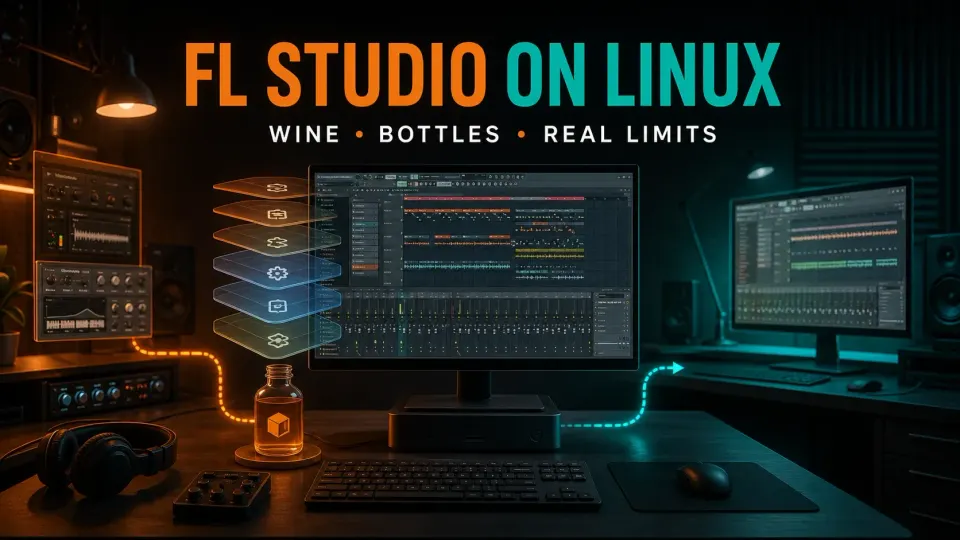
FL Studio has no native Linux installer. You can try its Windows version through Wine, often managed with Bottles, but that is an unofficial setup. A successful launch does not tell you whether your interface, plugins, license or saved projects will work. If those are essential to a deadline, keep a supported Windows or Mac setup available.
The useful question is not just “does FL Studio run on Linux?” It is whether your particular setup can do the work you need. Investigate that with copies of your projects and separate backups of the originals. Below, we work through the checks, including the trial's project-reopening restriction. We have not benchmarked a Linux rig or verified your hardware combination.
Choose between four different routes
The official FL Studio download page provides Windows and macOS builds. A Linux distribution with plenty of RAM does not change that platform boundary. Start with the supported system requirements before buying a computer around the application.
| Route | Where FL Studio runs | What you are accepting |
|---|---|---|
| Wine or Bottles | The Windows application through Wine on Linux | An unofficial compatibility experiment |
| Dual boot | Windows on the same computer | Restarting into another OS and maintaining it |
| Separate host | A supported Windows or Mac computer | Another machine, with remote access only if useful |
| Native Linux DAW | A different application on Linux | A different workflow and project-transfer process |
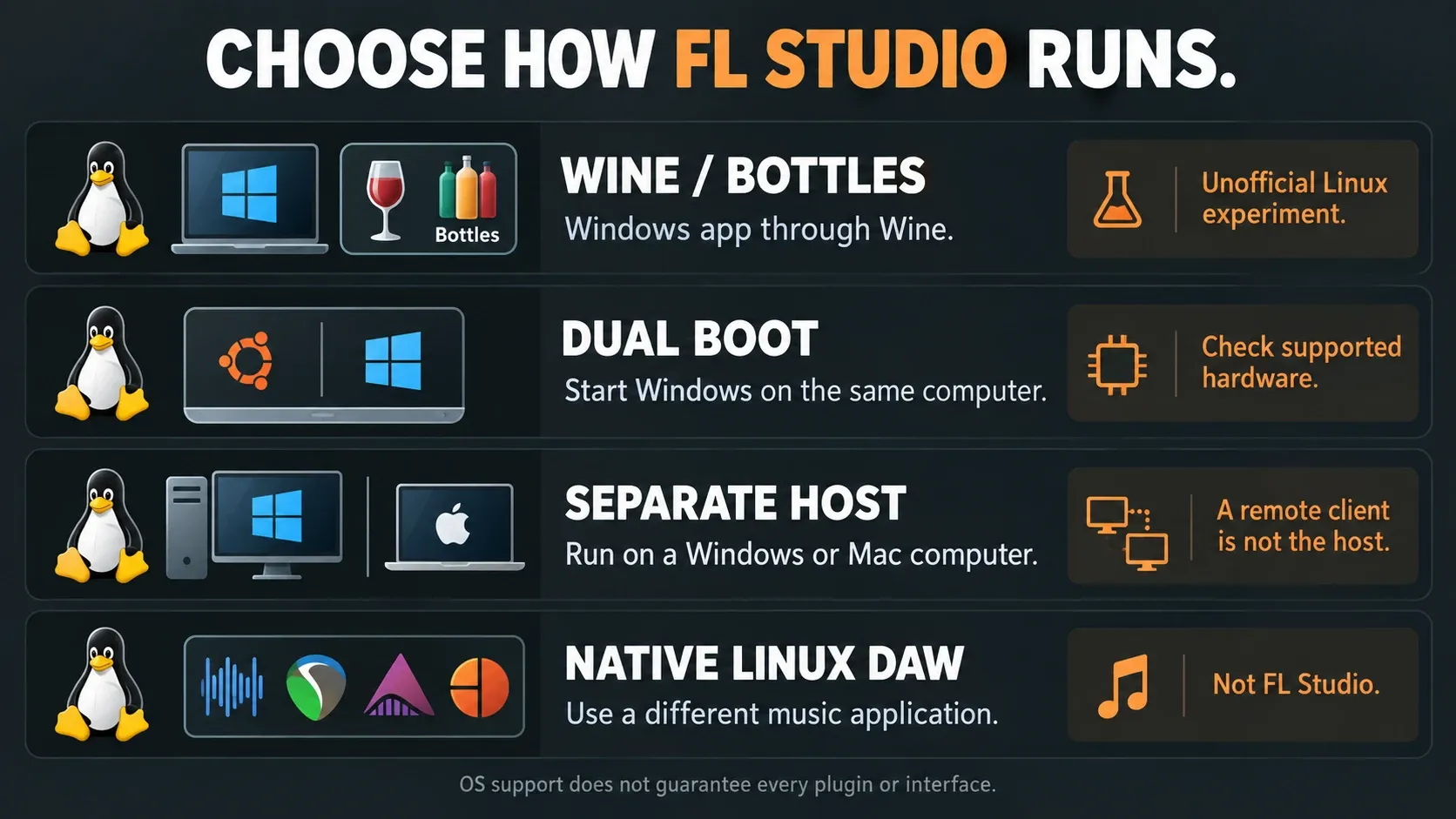
Supported Windows or macOS removes the Wine layer; it does not guarantee that every old plugin or interface works. Check those dependencies separately. If you keep Linux for other work, using another supported host is a platform choice, not a failure to configure Linux properly.
Wine, Bottles, prefixes and runners
Wine is the compatibility layer. Bottles manages environments that use it. A prefix holds a Windows-like directory and configuration; a runner is the Wine-based implementation selected for that environment. System76's Bottles introduction makes the key limitation clear: an application still has to work with Wine. The manager does not certify it.
Use a dedicated bottle for the FL Studio experiment, separate from games and unrelated programs. Record the Linux distribution, CPU architecture, graphics session, audio setup, runner and FL Studio build. That record is more useful for troubleshooting than “latest Wine,” which can mean something different on another machine.
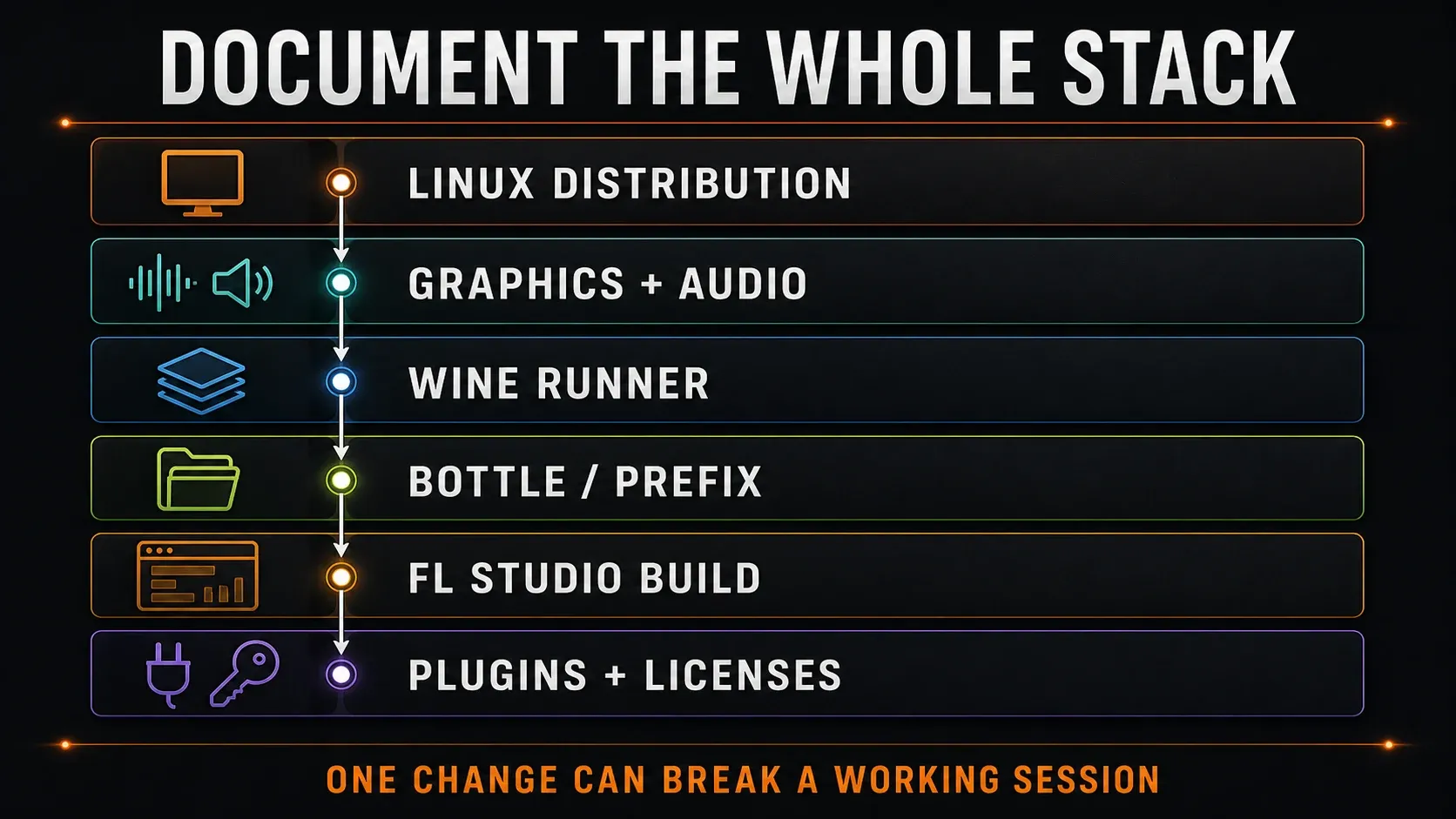
The Bottles environment presets collect settings and dependencies; they are not a ranking of FL Studio compatibility. Do not treat an old recommendation for Gaming, Application, DXVK or a particular runner as universally correct. Keep the starting configuration identifiable and change one thing when you have a specific problem.
Decide what must work before installing
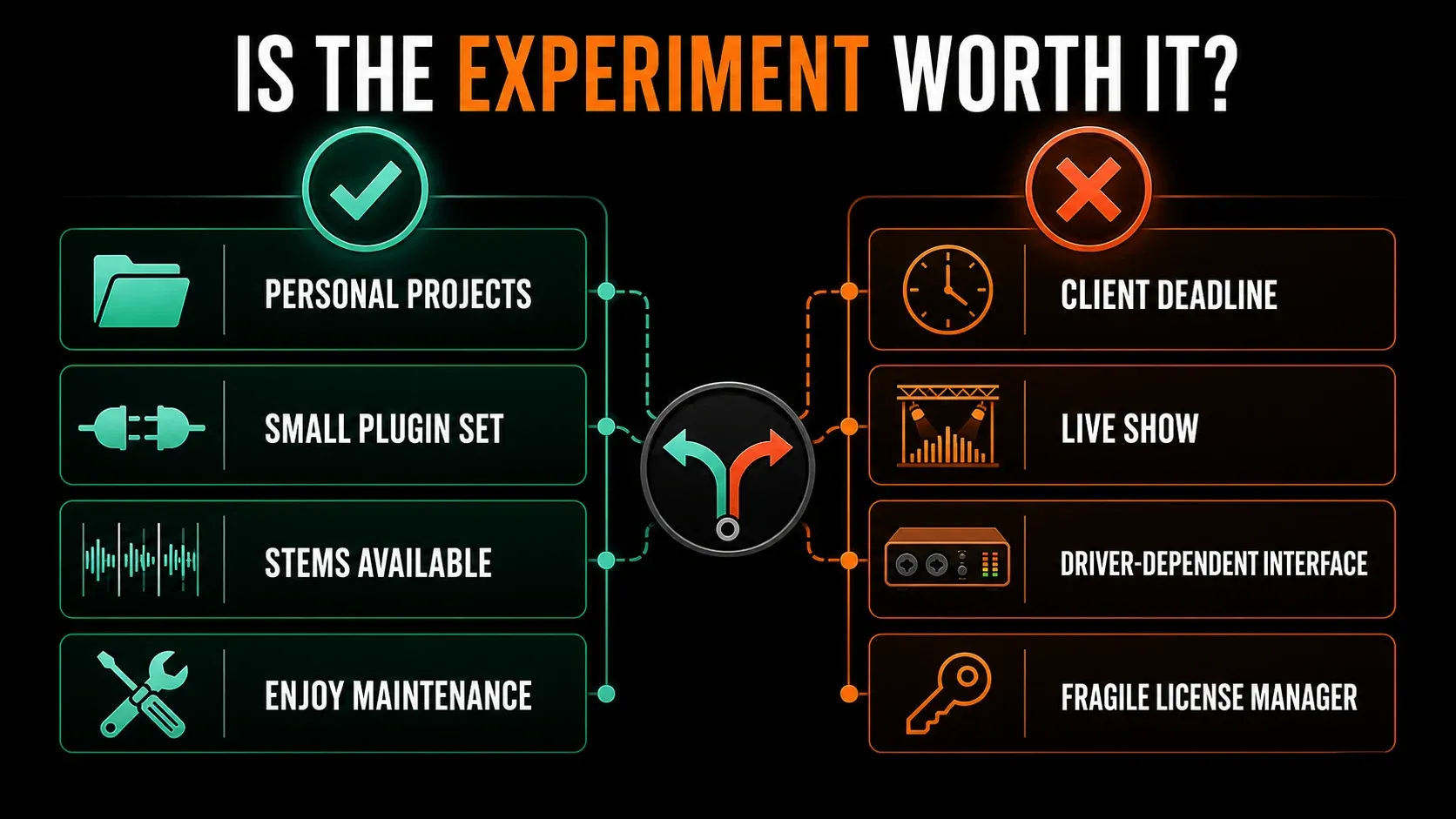
Write down the jobs you cannot give up: a microphone input, a particular MIDI controller, an instrument library, a license manager or dependable recall of a collaborator's project. Give each one a small check. If a required item fails, a smooth-looking Playlist does not compensate for it.
A personal sketch with a few replaceable sounds is a reasonable place to investigate. A client delivery or live performance is not the place to discover whether an untested update broke authorization. Keep a supported alternative and your original files available before depending on the experiment.
Test FL Studio in eight steps
These steps describe a bounded trial, not a tested installer recipe for every Ubuntu, Mint, Fedora or Arch machine. The Bottles installation documentation directs users to its Flatpak distribution. Use the official project or your distribution's instructions for setup; do not run an abandoned “fix everything” script.
- Back up your projects. Keep the originals and their samples outside the proposed bottle, with another independent copy. Do not use irreplaceable work for the first experiment.
- Install official Bottles. Follow its current installation instructions and your distribution's Flatpak setup. Finish that setup before adding FL Studio.
- Create a dedicated bottle. Give it a recognizable name and record the environment and runner. Keep unrelated programs out of this test.
- Run the official Windows installer. Download it from Image-Line, select the intended bottle and use Run executable to select the installer. Stop if installation or signature verification fails; do not modify signed files.
- Check playback and required inputs. Start a short stock-instrument project. Test your intended output and any required MIDI input. If you need microphone recording, choose a trial edition that includes recording, then check that input separately.
- Export a WAV before closing. Render the short sketch, locate the file outside FL Studio and play it. Do this before saving or closing the trial session.
- Save a copy and respect the trial limit. You can save the project, but the standard trial cannot reopen it. If you already have the required license unlocked, close and reopen the copy and check its sounds. Otherwise record recall as not tested.
- Back up and record the setup. Preserve the bottle and independent project files, along with the versions and checks completed. Do not mark untested hardware, plugins or recall as working.
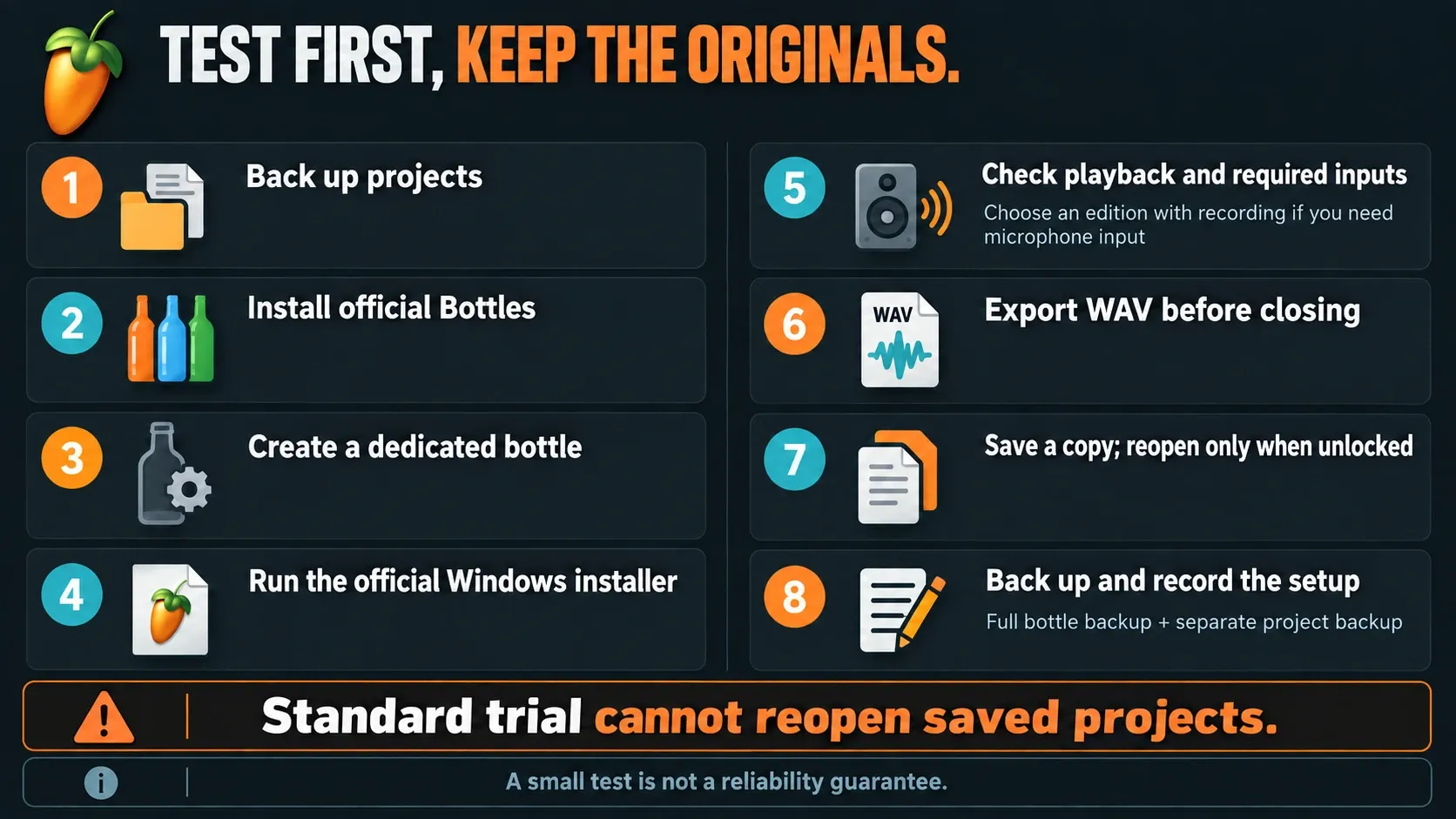
The Run executable documentation explains that the selected program runs in the chosen bottle. The FL Studio trial rules separately explain saving, exporting and reopening. A project that cannot reopen in trial is not, by itself, a Wine regression. Do not buy a license solely to finish a compatibility checklist if the earlier checks already failed.
No sound, missing inputs or uncomfortable monitoring?
First establish that the interface works in Linux itself. Then check the audio path presented to FL Studio under Wine. Hearing a stock instrument only verifies part of the job: a microphone input, channel routing and responsive monitoring need their own checks. Start quietly, especially before changing input or monitoring routes.
WineASIO is an ASIO-to-JACK driver for Wine. Its installation paths vary, and its documentation requires registration in each relevant prefix. Installing it into one prefix does not establish that a separate Bottles environment can use it. It is not the same thing as installing your interface vendor's Windows driver.
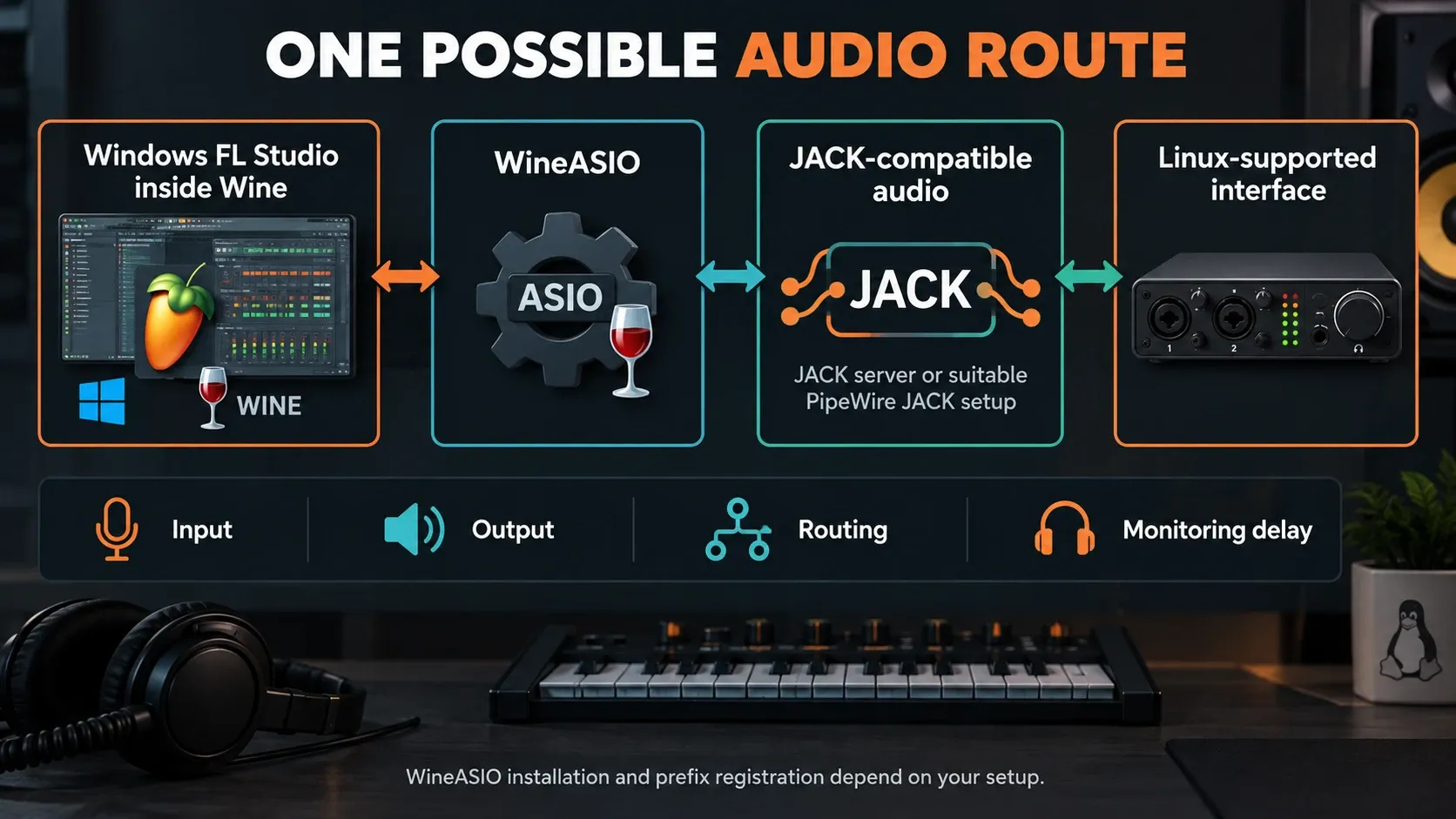
PipeWire can supply JACK-compatible client libraries, as its JACK compatibility documentation explains. That does not make every WineASIO, Flatpak, device and distribution combination automatically work. Follow the documentation for the audio setup you actually have, rather than stacking commands from different guides.
If playback works but monitoring feels late, check the complete route and the controls available in that setup. There is no universal buffer number that proves recording readiness. Our Desktop audio-settings guide explains the supported-host side; its Windows driver menus are not a Linux installation recipe. If a small stock project works and a larger project struggles, the high-CPU checks can help separate project load from an already broken audio path.
Install one essential Windows plugin at a time
Run a plugin's official Windows installer in the same environment as Windows FL Studio. Installing it in your default Wine prefix while FL Studio lives in a different bottle can leave the host without the files, registration or supporting components it needs. Follow the vendor's installer instructions; copying one plugin file is not always a complete installation.
Image-Line's Plugin Manager instructions document installation and scanning. Add one required plugin, scan it, check its interface, play a short part and export audio. Check project recall only when FL Studio and the required plugins are properly unlocked. A passing stock project does not establish compatibility for another vendor's graphics, content service or authorization system.
Native Linux plugins are a different case. Do not assume a Linux build of a VST will load into Windows FL Studio. Yabridge bridges Windows plugins into Linux plugin hosts; that is not the same direction as putting Linux plugins into Windows FL Studio. Our plugin installation guide and missing-plugin checks provide the normal host workflow, not a guarantee of Wine compatibility.
When Bottles cannot see samples or the export folder
A missing folder is not necessarily a corrupt project. The Bottles Flatpak is sandboxed. Its directory-access instructions explain portals and explicit access for folders outside the sandbox. Grant access to the specific project or sample directories you need; the documentation advises against exposing the entire home directory or system.
Before importing a library, test one sample and one export in the intended locations. Check that you can find and play the exported file from Linux too. Record how Windows-style paths map to your actual storage, especially for removable drives. A path that exists in one bottle is not evidence that another bottle sees the same files.
Authorization and version-specific failures
Image-Line's official unlock instructions cover account and offline methods. The current offline process can require a validation file from the target computer; do not assume a key from another setup will work. A cloned bottle may still need legitimate activation checks. Keep account details, license files and validation files private.
For a concrete historical example, Torbuntu's unofficial Linux setup guide reports an August 2026 WinTrust certificate-verification problem with FL Studio 26.1.4. That is the maintainer's report, not our reproduced test or an Image-Line notice. It does not establish the status of your current build and runner.
If the installer or application reports a certificate error, record the exact message and versions. Do not disable verification, replace signed files or fetch a modified installer. Check current project reports for a legitimate fix. Trying an older build is a separate decision with its own compatibility risks, not a universal next step.
A settings backup is not a complete bottle backup
The Bottles backup options distinguish a configuration copy from a full archive of the bottle directory. A configuration copy is useful for documenting settings; it does not contain all the installed files. A full archive also does not replace a separate backup of projects and samples stored outside that directory.
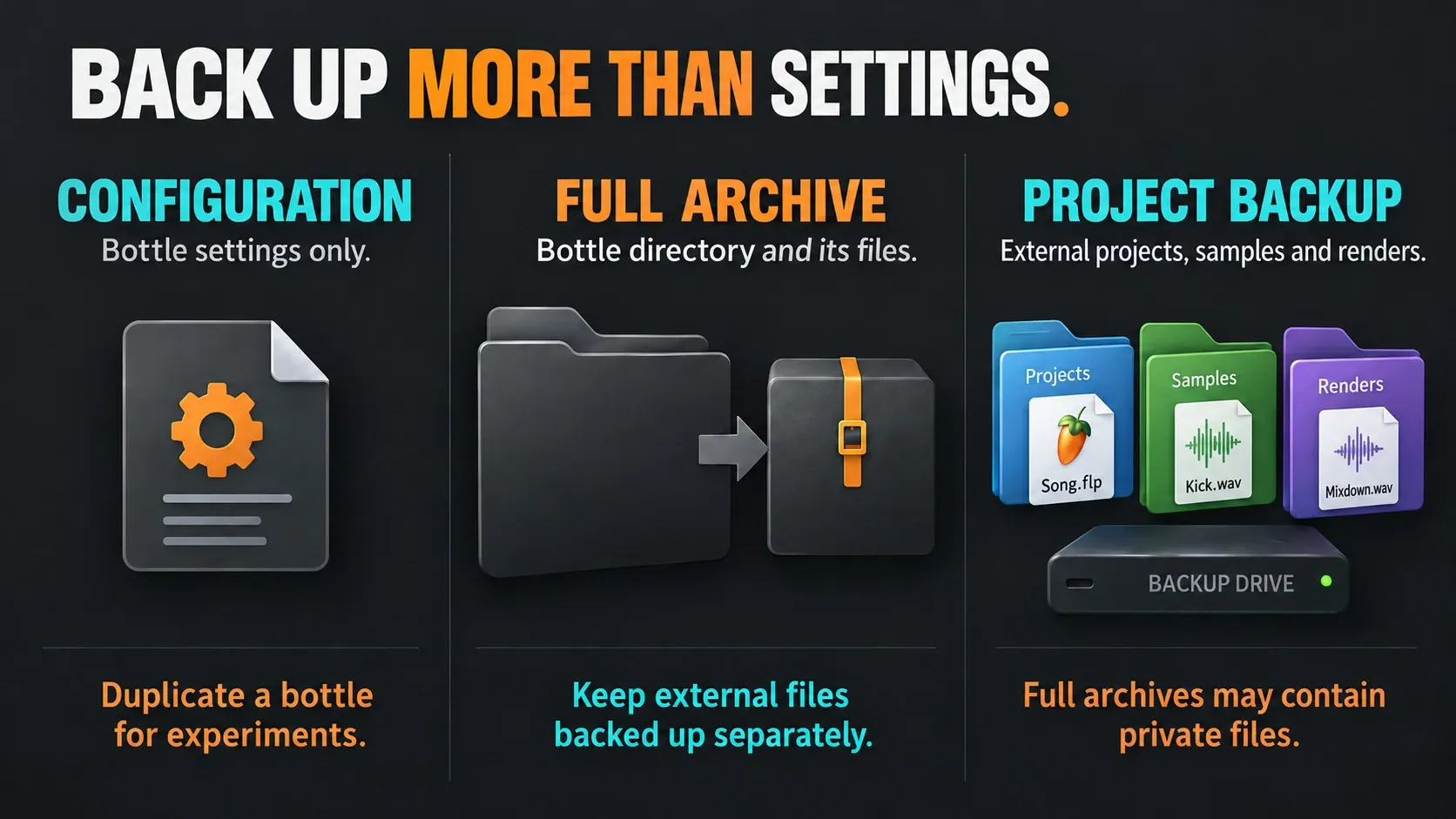
Use a duplicate bottle for an update experiment and copies of representative projects. Keep the original working environment untouched until the new one has passed the tasks you need. A duplicate that uses the same external project folder can still alter those projects, so duplicate the test files as well. A full archive can contain private files; do not post it publicly as a troubleshooting attachment.
After changing the application, runner or plugins, repeat playback, required inputs, export and licensed recall. Record what changed and what you checked. Our autosave and project-backup guide protects project versions; it is not a replacement for the compatibility environment's backup.
Find the first failure instead of changing everything
| Symptom | First distinction to check |
|---|---|
| Installer does not start | Official file, exact runner and error message; do not bypass verification |
| No sound or missing input | Linux device operation, selected audio path and routing |
| Sample or export folder is missing | Actual location and Flatpak access to that specific folder |
| Saved project will not reopen | Trial/license restriction before assuming a Wine failure |
| Stock project works, plugin project fails | That plugin's installer, environment, authorization and dependencies |
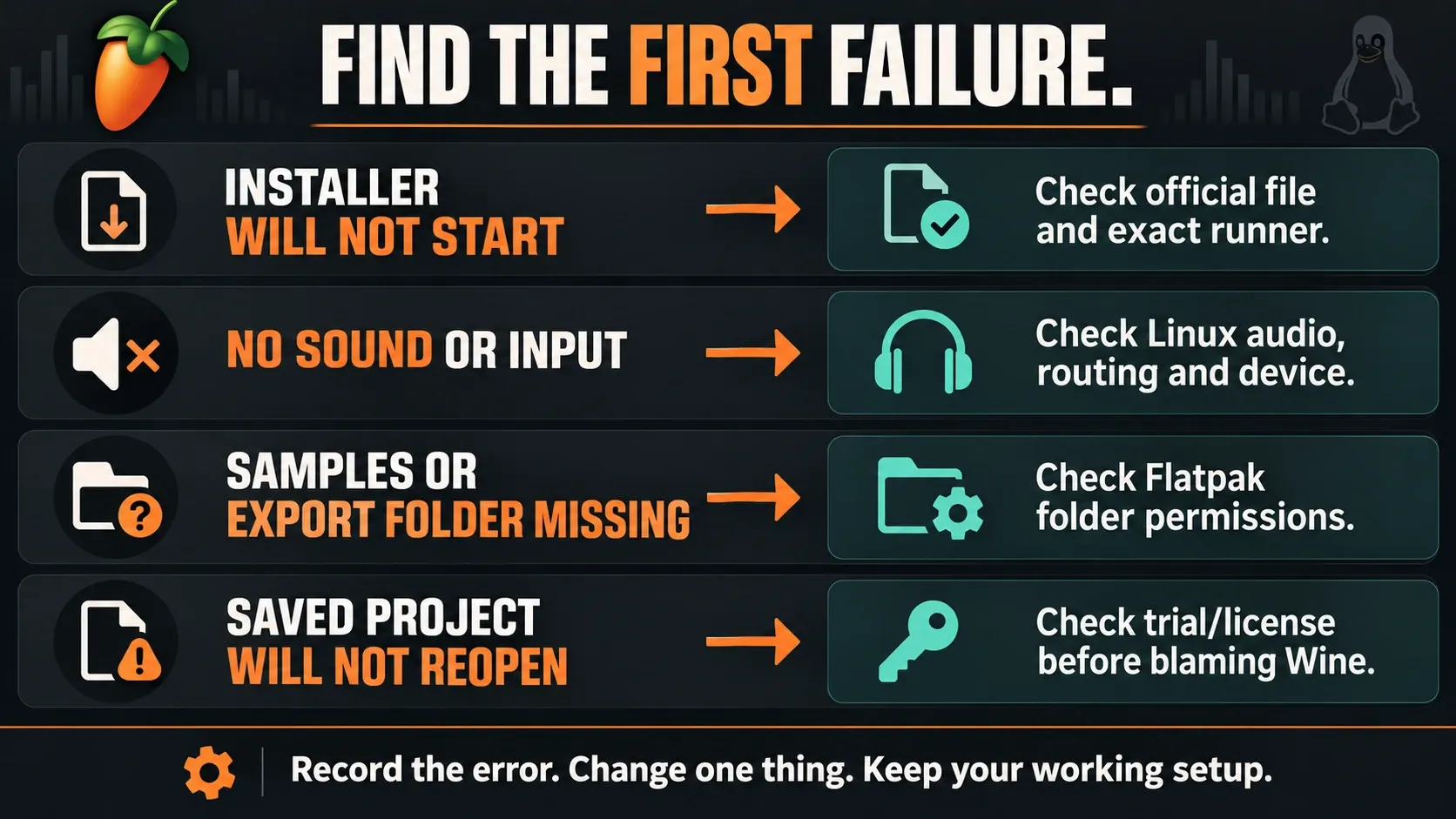
For a useful problem report, include the distribution, CPU architecture, graphics session, audio setup, runner, FL Studio build and affected plugin version. Say which small test passed and which failed. Remove account information and private project content from logs before sharing them. A report with one reproducible failure is easier to act on than a list of unrelated tweaks.
When to choose a supported host or a native Linux DAW
Choose supported Windows or macOS when keeping FL Studio's workflow and required plugins matters more than running everything locally on Linux. Dual boot is one option, but partition and bootloader work deserves its own backup plan; it is not a quick troubleshooting step in this guide. Remote access to another computer may help with some tasks, but network response and audio routing need separate checks.
If native Linux is the priority, REAPER provides Linux builds. That is a different DAW, not a native edition of FL Studio. Our FL Studio versus REAPER comparison covers the wider writing and recording decision. Keep source projects and use rendered audio, MIDI and tempo notes where useful for a handoff; do not assume another application will recreate every instrument and automation choice.
The Chromebook guide handles ChromeOS and its additional constraints, while the Mobile versus Desktop comparison covers the separate app decision. Return to Platforms & Mobile for the supported-machine route, or Compare & Buy before paying for a setup that does not fit your work.
Frequently asked questions
Is there an official FL Studio Linux download?
No native Linux installer is offered on Image-Line's Desktop download page. Running the Windows application through Wine or Bottles is an unofficial compatibility route.
Can FL Studio work on Ubuntu, Mint, Fedora or Arch?
Some Wine setups can run it, but a distribution name does not establish compatibility. Check the exact runner, FL Studio build, audio hardware, plugins and license workflow you intend to use.
Does Bottles make FL Studio officially supported?
No. Bottles manages environments and runners; the Windows application must still work with Wine. Use a dedicated environment and record its configuration.
Why will my trial project not reopen?
The standard FL Studio trial can save projects but cannot reopen them until unlocked with a purchased license. Export a reference before saving or closing the trial session, and do not mistake that restriction for a Linux-specific bug.
Is WineASIO the same as my interface's Windows driver?
No. WineASIO connects an ASIO application under Wine to JACK-compatible audio. Its installation and registration depend on the actual setup; the interface must also work through the Linux audio path.
Can Windows FL Studio load my native Linux plugins?
Do not assume so. The plugin must match the host environment. Yabridge's Windows-plugin-to-Linux-host route is not a way to load Linux plugins into Windows FL Studio.
Why can Bottles not see my sample folder?
Flatpak sandbox permissions can restrict access outside the app's directories. Check the real folder location and grant only the specific access needed, following Bottles' directory-access documentation.
Does a Bottles configuration backup preserve everything?
No. It copies the configuration. A full archive includes the bottle directory and its files, while projects and samples stored outside that directory need independent backups.
Should I disable certificate checks when FL Studio will not start?
No. Keep the official installer intact, record the error and versions, and look for a legitimate compatibility fix. A historical report about another build is not proof that bypassing verification is appropriate.
What should I test after updating Wine or FL Studio?
Use a duplicate environment and copied projects. Recheck playback, required audio and MIDI inputs, essential plugins, export and project recall where licensed. Keep the known-good environment and separate backups until those checks pass.