FL Studio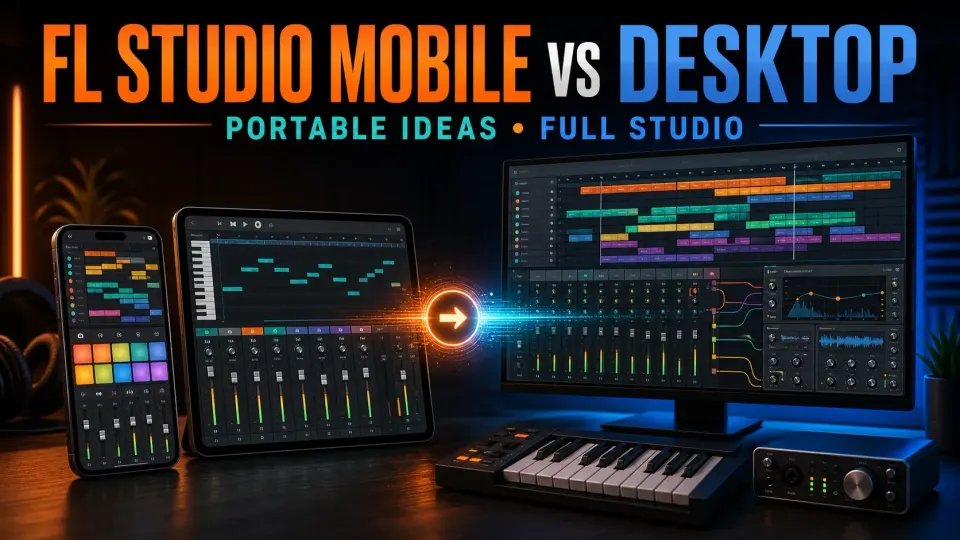
FL Studio Mobile vs Desktop comes down to where you work and which tools the next project needs. Choose Mobile for touch-first writing on a phone or tablet, or Desktop for computer plugins, detailed editing and larger recording setups. Both can produce a complete song, but Mobile is a separate app—not a Desktop edition—and moving editable work needs care. This comparison follows Image-Line’s documentation rather than a measured device benchmark.
The short FL Studio Mobile vs Desktop answer
| Decision | FL Studio Mobile | FL Studio Desktop |
|---|---|---|
| Best role | Portable writing and complete touch-first projects | Detailed arranging, computer plugins and larger recording setups |
| Current platforms | iOS, Android and compatible Chromebooks; Mobile also has desktop/plugin forms | Windows and macOS |
| Instruments and effects | Curated Mobile instruments, effects, sounds and optional content | Edition-dependent stock tools plus supported VST, VST3, AU on Mac, CLAP and native plugins |
| Audio recording | Capable, but dependent on the mobile device, OS and interface | Producer Edition or higher; input and driver compatibility still matter |
| Project format | FLM for native Mobile work; can export FLP, audio and MIDI | Exported Mobile FLP uses Desktop Mobile Rack; FLM opens inside the whole Mobile plugin |
| Choose it when | Portability and immediacy matter most | Computer-only plugins, detailed editing or recording inputs are essential |
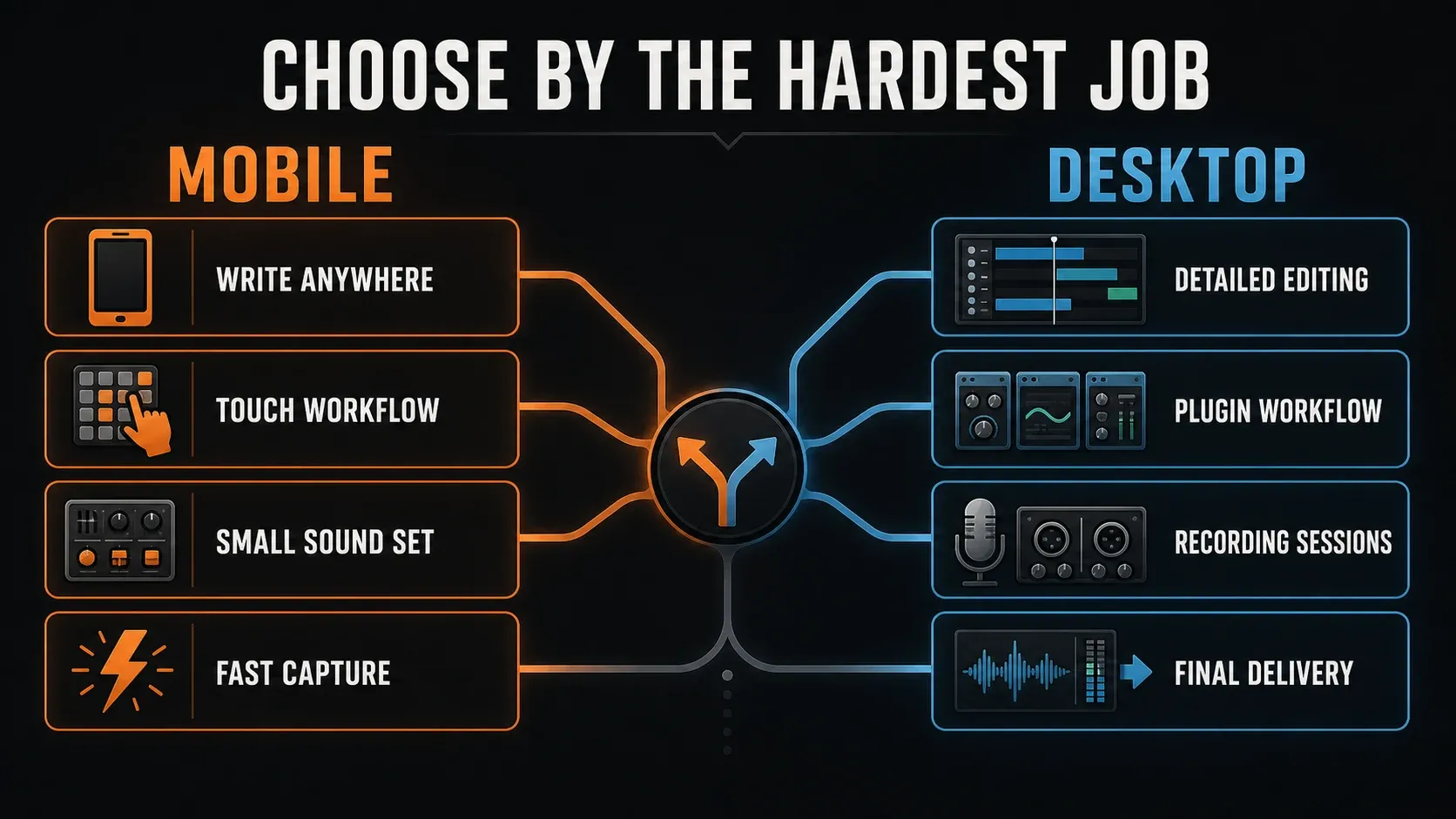
Image-Line’s current FL Studio Mobile page lists iOS, Android and Chromebook availability and describes audio recording, automation, an advanced mixer and FLP export. Desktop’s supported computer baseline belongs in the system requirements guide; the Chromebook guide explains why Mobile support on ChromeOS does not turn the Windows/macOS application into a Chromebook app.
They share a name, not the same production surface
Mobile is designed around touch, smaller displays and device-limited resources. Its Playlist, Piano Roll, rack, mixer and automation tools are arranged so a song remains editable without a mouse and multiple floating windows. The current product page advertises eight instruments, more than 1,000 sounds and over 30 effects. Those counts describe the current Mobile offer, not the complete Desktop plugin list.
Desktop is built for a keyboard-and-mouse workstation with larger storage, more ports and more room for plugin windows, mixer routes and detailed arrangement. Its exact stock-tool set depends on the edition. Use the edition comparison before buying; do not compare a Mobile feature list with “Desktop” as if every Desktop edition unlocks every Image-Line plugin.
This difference is not a verdict on sound quality. A careful Mobile arrangement can render a strong mix, and a careless Desktop session can sound poor. The practical divide is scale: how many edits, routes, external devices, third-party tools and recall dependencies the project can carry comfortably.
Choose Mobile when capture speed matters most
Mobile makes sense when the alternative is losing the idea. A phone can hold a drum pattern, chord progression, sung reference, bass line and rough arrangement before a computer is available. A tablet gives the same project more screen space. A compatible Chromebook can be a useful low-friction Mobile host, provided its Android-app and audio behavior suit the job.
It is also a reasonable complete environment when your music fits its included instruments, effects and touch workflow. The official app supports audio recording, editable automation, a mixer, custom samples and several export formats. You do not need Desktop merely to finish a short beat. You do need to test the exact phone, tablet, USB interface, headphones and storage path before promising a vocal session.
- Use Mobile for commuting, travel, couch writing, quick field capture and touch performance.
- Keep the sound palette deliberately small when the song will later move to Desktop.
- Name tracks and save versions while the arrangement is still readable on a small screen.
- Export a reference WAV whenever the current balance or sound choice matters.
Choose Desktop when the project must grow
Desktop is a practical choice when the project depends on third-party instruments, several recording inputs, detailed take editing or large sample libraries. More screen space helps you inspect a Playlist, Mixer and plugin window together. It does not guarantee that a particular interface, old plugin or driver will work: check each required component before moving a deadline-sensitive session.
A beginner with a suitable computer should not buy Mobile merely to “unlock” Desktop later. Follow the installation guide and try a small representative session with the beginner workflow. Under the current Desktop trial rules, the edition you select determines the available functions. Export a listening copy before closing: you can save a trial project, but reopening it requires purchasing and unlocking FL Studio. Audio recording requires Producer Edition or higher. A plugin outside your licensed edition can also remain in trial; do not reopen and overwrite its only project copy before unlocking it.
Desktop plugins are the biggest capability boundary
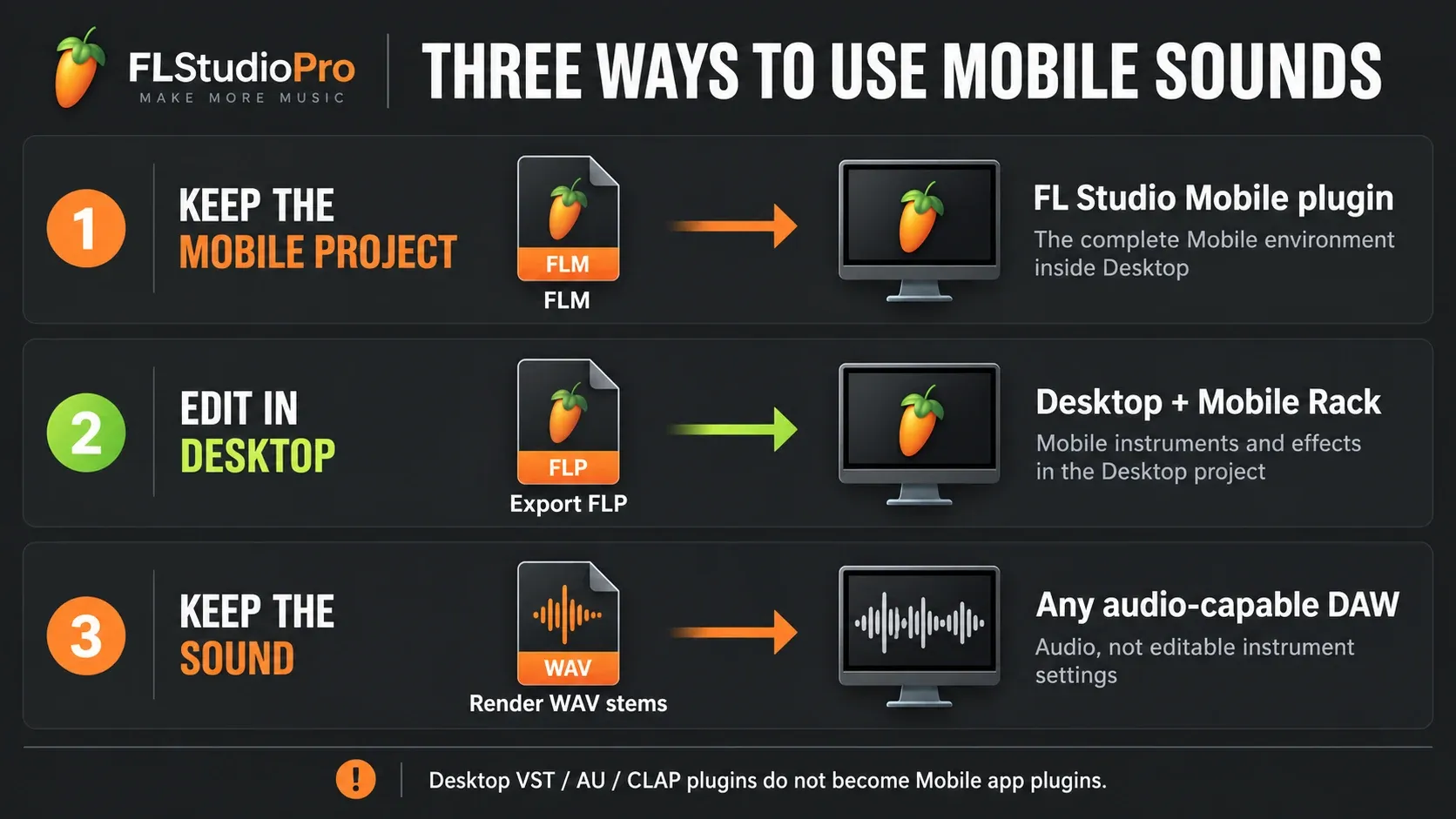
Image-Line’s Desktop plugin format list includes VST, VST3, CLAP and native plugins on Windows and macOS; macOS also supports 64-bit Audio Units. Mobile does not provide that general computer-plugin host. Its instruments and effects run in the app’s own rack. The documented iOS IAA/Audiobus options are inter-app connections, not permission to install a Windows VST on an iPhone.
If a specific computer synth is essential to your song, start that part on Desktop. If you only need its musical role while writing, use a Mobile instrument and decide later whether to replace it. Keep a rendered copy before changing an important sound. The plugin installation guide applies to Desktop, not the Mobile app.
Recording and mixing depend on the whole device chain
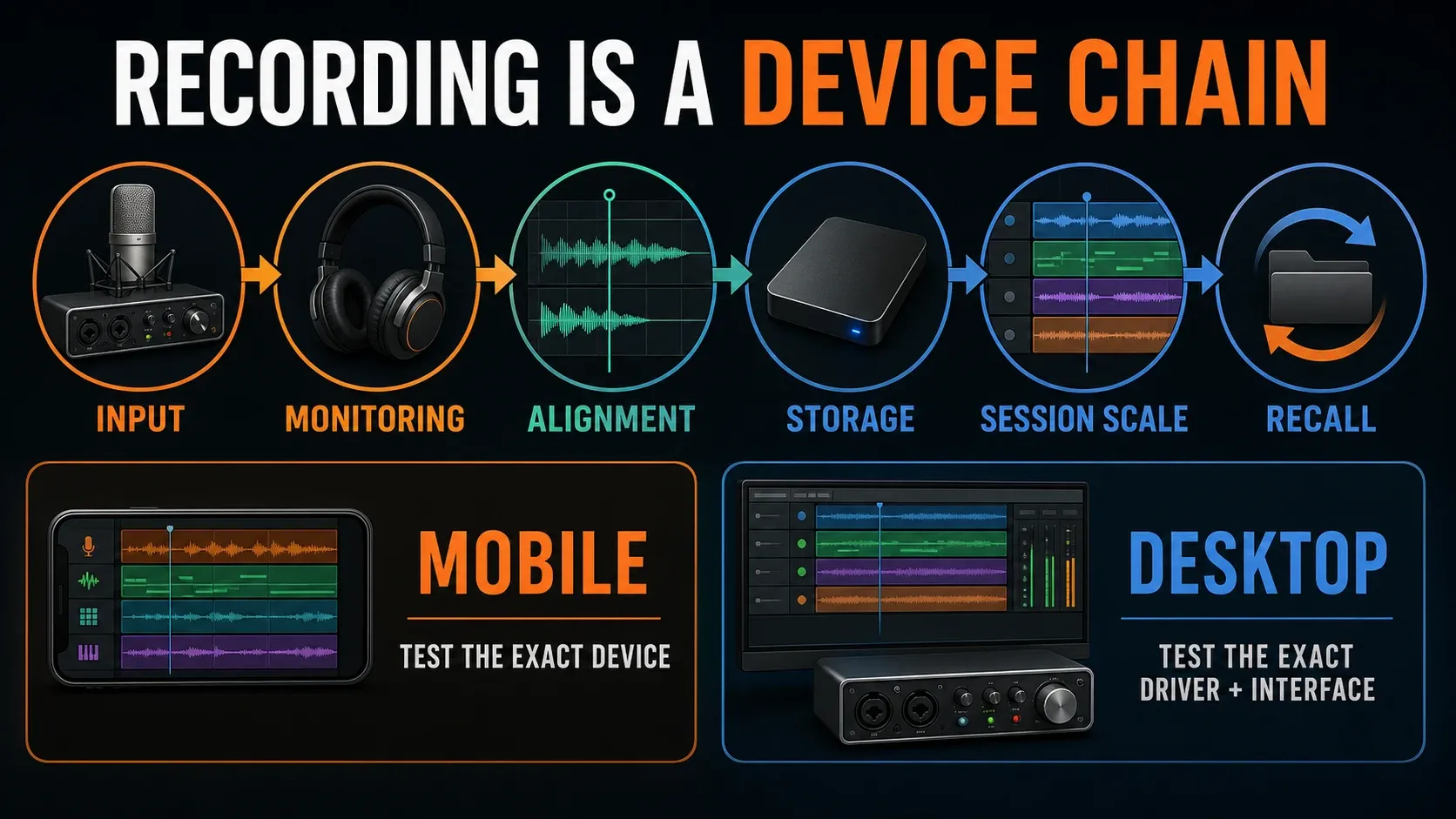
Mobile can record vocals and instruments; its current product page also lists Pitcher 2 for real-time pitch processing. Before committing to a take, test the microphone or interface with the actual device, listen through headphones, and check that the recording lands in time. An app feature list cannot tell you whether your particular USB adapter supplies enough power or whether your monitoring feels comfortable.
For several microphones or repeated take editing, Desktop offers a more spacious working environment. Check that your edition supports recording and that your interface exposes the inputs you need. Run the audio settings workflow with a real input before the session. A laptop does not remove monitoring delay by itself.
Mobile has automation, effects and mixer controls, including grouped FX routes. Moving to Desktop is worthwhile when your mix needs a particular computer-only meter, processor or editing workflow, not simply because it has buses. Try completing one arrangement with the tools you already have before deciding that another screen will fix the mix.
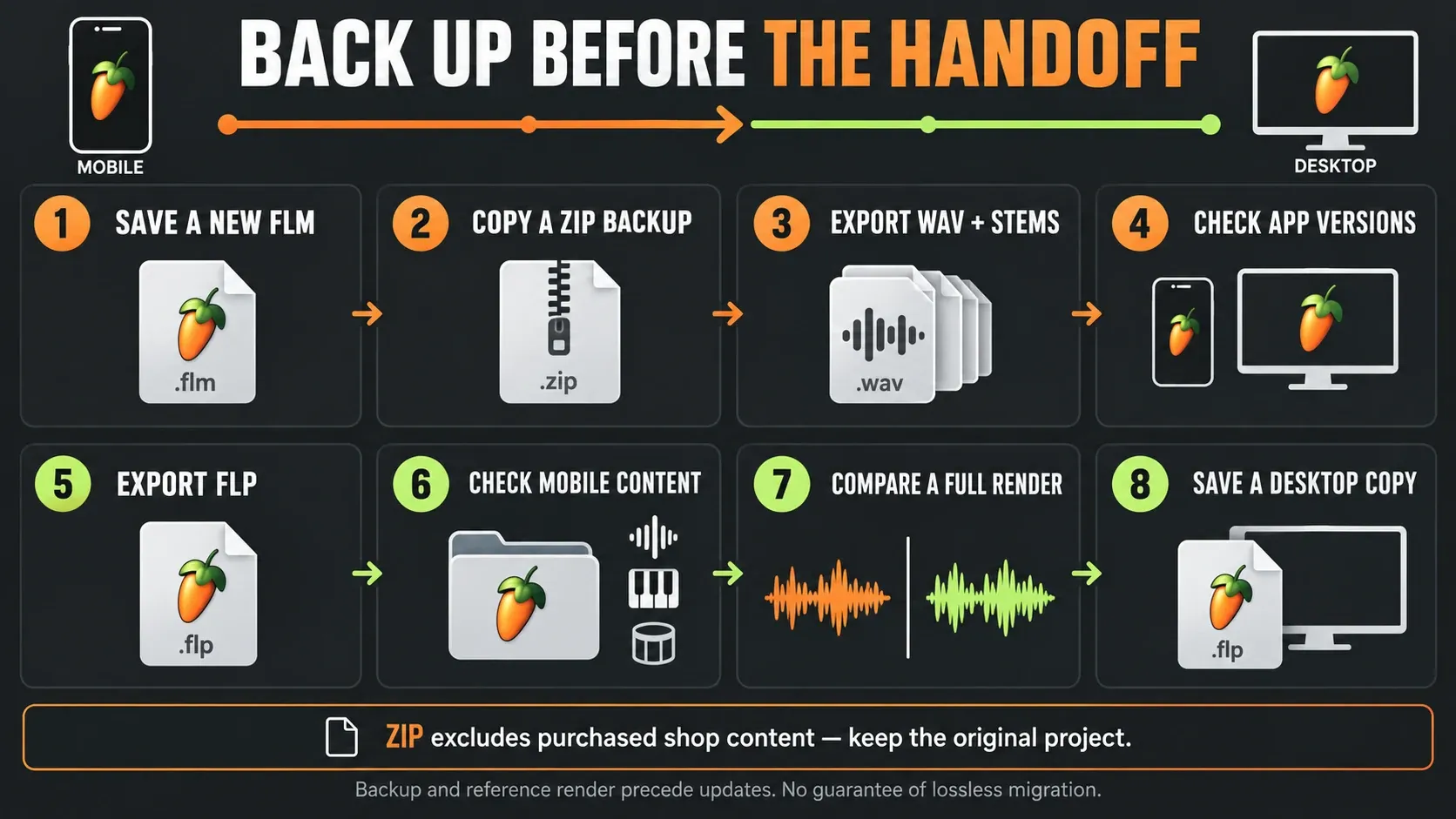
Move a Mobile project to Desktop in eight steps
The current Mobile save-format manual distinguishes native FLM, exported Desktop FLP and a Mobile ZIP archive. Use separate copies throughout this handoff. The checks below are precautions, not a promise that every project will transfer unchanged.
- Save a new FLM. Keep the original untouched and give the working copy a distinct name.
- Copy a ZIP backup. Save a Mobile ZIP and copy it outside the device. It bundles the project and used samples, but excludes purchased shop content.
- Export WAV and stems. Preserve a reference mix and separate parts using Split mixer tracks. Listen to the exported files before proceeding.
- Check app versions. With those backups secured, check the current Mobile app and Desktop build. Update a working copy’s environment if needed; do not make the only project your update test.
- Export FLP. Choose FLP in Mobile’s save formats, transfer the export to the computer and open that copy in Desktop.
- Check Mobile content. Confirm the required instruments, purchased content, custom samples and recordings are available. Investigate missing sounds before replacing them.
- Compare a full render. Listen against the Mobile reference, checking timing, automation, balance and the ending. A file opening without an error is not a complete listening check.
- Save a Desktop copy. Branch the project under a new name. With the host and required plugins unlocked, reopen and check it before further editing. Trial users should retain exports and defer saved-project reopening until licensed.
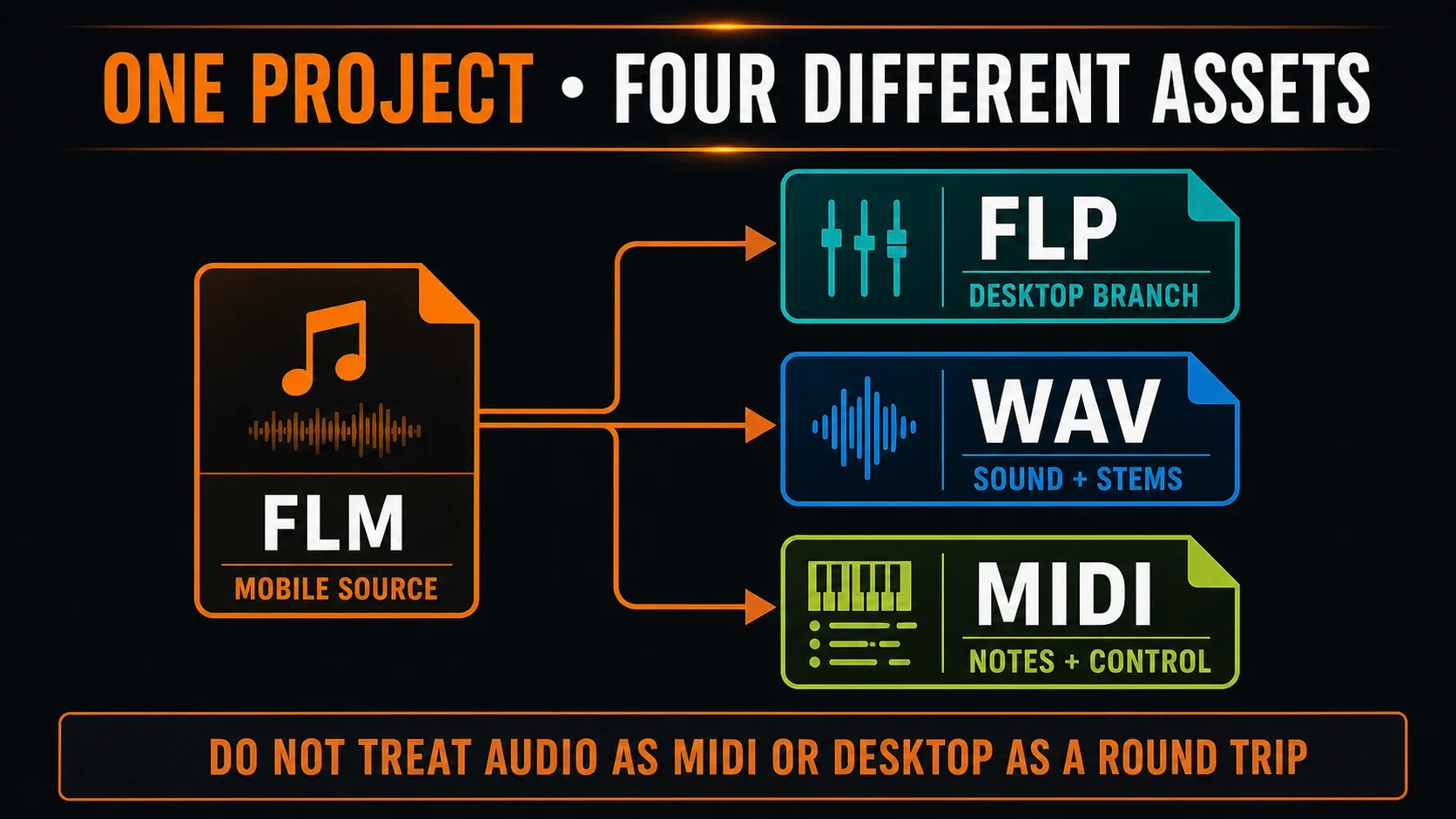
For notes alone, Mobile MIDI export covers the first 16 tracks; export additional tracks separately or reorder and make further exports. MIDI does not contain the sounds. The MIDI export guide and Desktop MIDI import guide explain the distinction when rebuilding a part with another instrument.
Know what survives—and what still needs checking
There are two editable Desktop routes. An exported FLP opens in Desktop using Mobile Rack instruments and effects. A native FLM instead opens inside the whole FL Studio Mobile plugin, which hosts the Mobile environment within Desktop. That older plugin page still contains a blanket compatibility warning: read it as guidance for native FLM, not a reason to ignore the newer documented FLP export.
The whole Mobile plugin can exchange its FLM work with the app; additions made outside it in Desktop are not part of that Mobile project. Image-Line’s sharing instructions also warn that the plugin initially has a limited library, so transfer the required Mobile content. Network sharing and sync are not substitutes for a separate backup. Package the resulting Desktop branch with its audio using the zipped loop package workflow; this is distinct from saving a Mobile ZIP.
Budget for two products, not one universal license
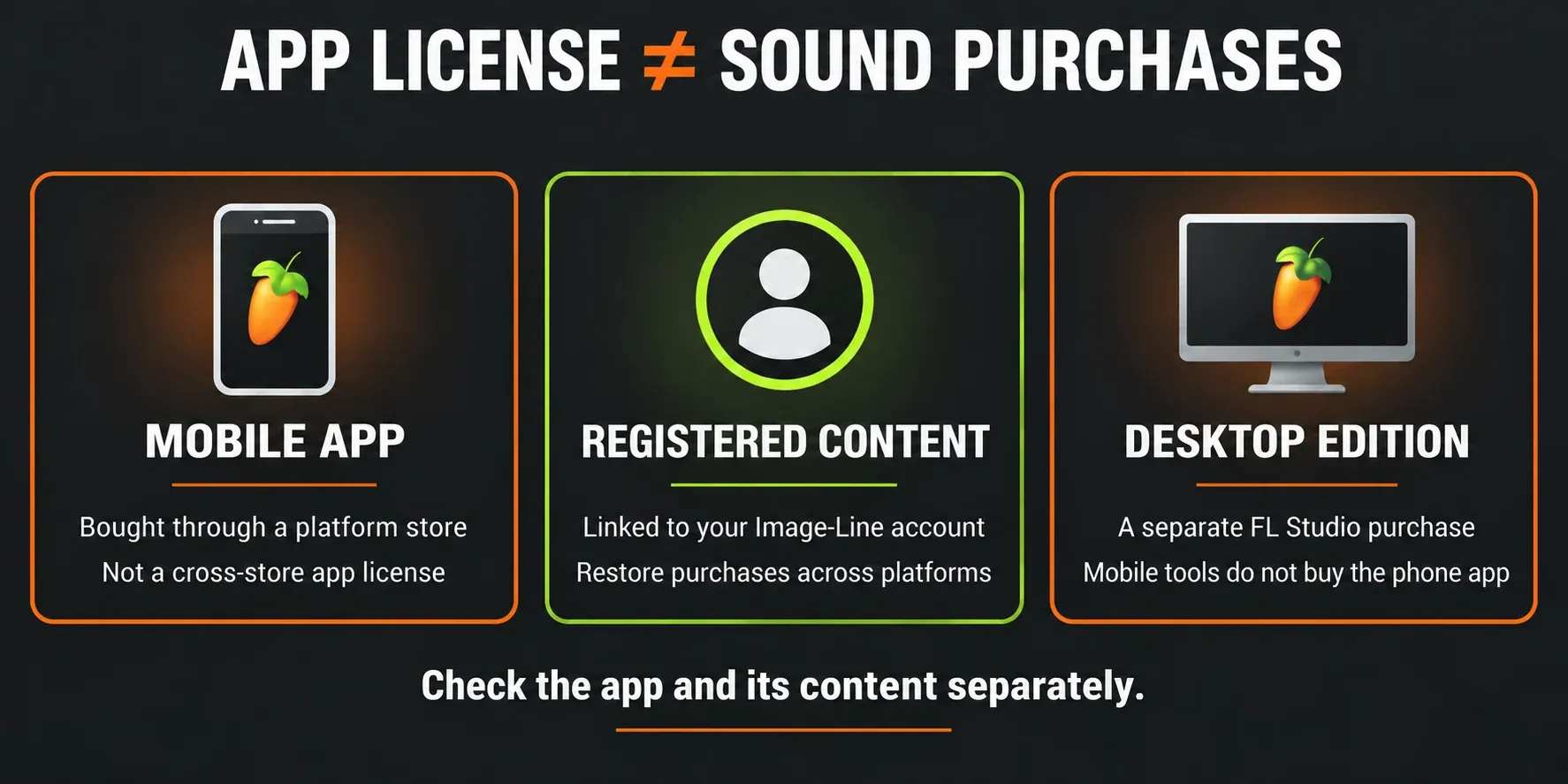
Budget separately for the Mobile app and a Desktop edition. A Mobile store purchase does not unlock Desktop, and the included Desktop Mobile tools do not buy the phone app. Image-Line’s cross-store licensing explanation says an app purchase cannot transfer between Android, iOS and Windows stores. That rule must not be extended to all purchased sounds.
For additional content, the current SHOP restoration instructions say to register the app and content to your Image-Line account, then use Home → Shop → Restore purchases. Registered content can be unlocked across platforms. The app license and its sound purchases therefore need separate checks. On Desktop, Mobile Rack supplies the Mobile instruments and effects, but sample-library availability still matters.
Store prices and regional taxes can change, so compare the live checkout screens on the day you buy. If Desktop is the real destination, choose its edition by recording and plugin needs, not by the Mobile price. The Compare & Buy hub keeps those purchasing decisions separate from this platform comparison.
Use a two-stage workflow when both fit
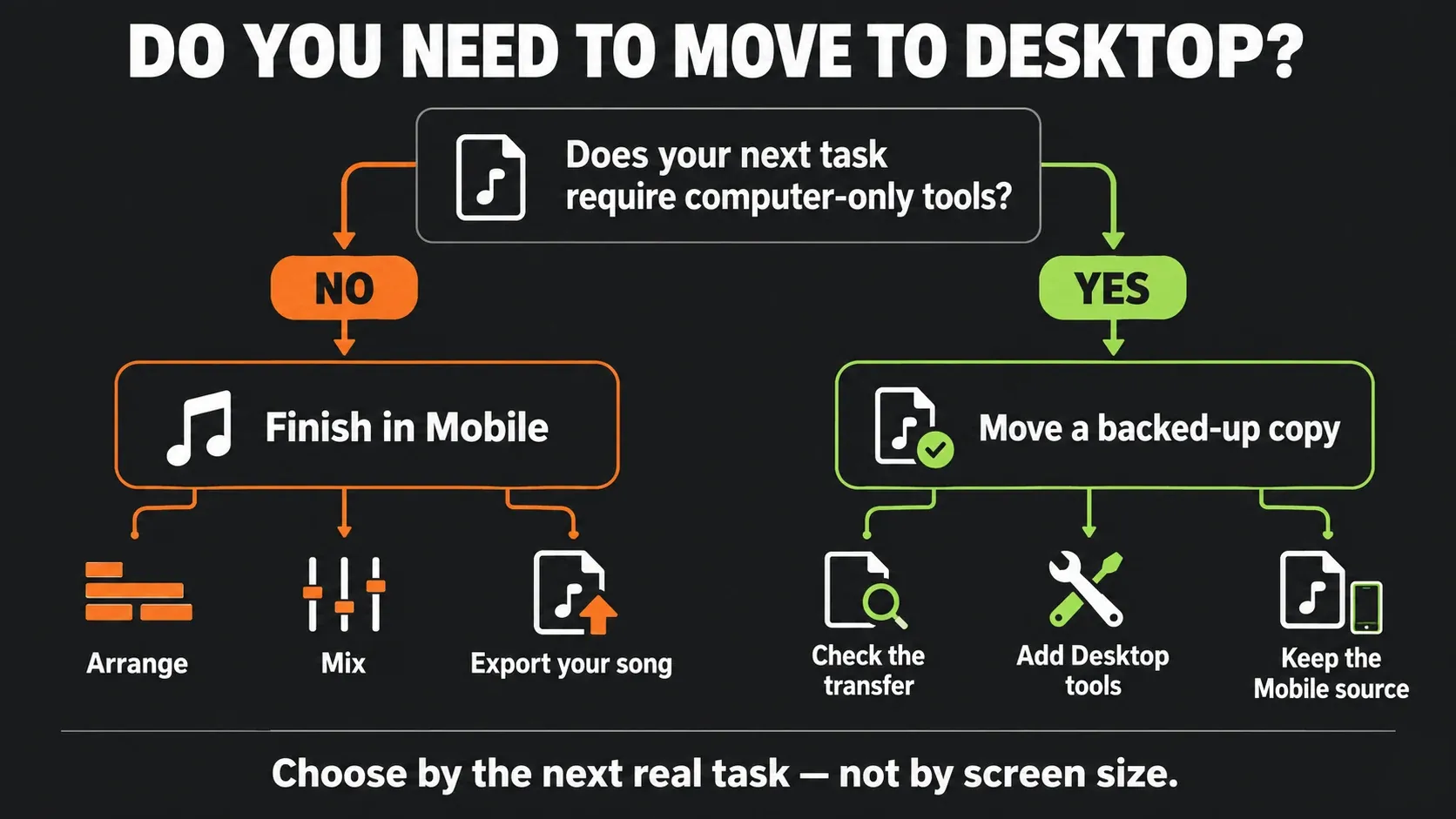
You can keep a song in Mobile through its final export. If you do want computer-only tools, move a copy while there is still time to compare the result. For example, an eight-bar sketch is a manageable transfer test before committing a whole arrangement. That is a practical starting point, not a track-length limit.
If you want one environment only, choose the one that handles your hardest recurring task. A musician who travels with a tablet and uses the included rack may reasonably stay in Mobile. A producer whose songs depend on third-party plugins and detailed vocal editing should start on Desktop. The Platforms hub is the next stop for device-specific decisions; the Start Here hub continues into the first complete Desktop project.
FL Studio Mobile vs Desktop FAQ
Is FL Studio Mobile the same as FL Studio Desktop?
No. Mobile is a touch-first music production app with its own FLM project environment, instruments, effects and store distribution. Desktop is the Windows/macOS DAW with edition-dependent tools and broad plugin hosting. They can exchange projects, but they are not the same product.
Can FL Studio Mobile make a full song?
Yes. Mobile supports sequencing, audio recording, automation, mixing and exports including FLP, WAV, MP3, AAC, FLAC and MIDI. Whether it is the right finishing environment depends on the project’s recording, plugin, routing and delivery needs.
Can FL Studio Mobile use VST plugins?
No general VST/VST3, AU or CLAP hosting like Desktop is provided by the Mobile app. Its own rack and documented iOS inter-app connections are different. Use Desktop for a project that requires computer plugins.
Can I open an FL Studio Mobile project on Desktop?
Yes: export FLP to use the project with Desktop Mobile Rack, or load native FLM inside the whole FL Studio Mobile plugin. These are different routes. Keep backups and compare the result with a rendered reference.
Can a Desktop FLP go back to FL Studio Mobile?
An expanded Desktop FLP is not a Mobile project you can simply send back. The whole Mobile plugin can share its own FLM work with the app, but Desktop-only additions stay outside that Mobile project. Use audio or MIDI deliberately when moving individual parts.
Does buying FL Studio Desktop include the Mobile app?
No. Desktop’s included Mobile tools do not include a purchase of the separate store app. Registered Mobile sound content can be restored across platforms through the Image-Line account; this does not transfer the app license.
Is FL Studio Mobile good for recording vocals?
It can record vocals and includes pitch tools, but the practical result depends on the device, microphone or interface, monitoring, storage and alignment. Test the complete chain with headphones before relying on it for a long or deadline-sensitive session.
Should a beginner start with Mobile or Desktop?
Start with Mobile when a phone, tablet or Chromebook is the device you will actually use. Start with Desktop when you have a suitable Windows/Mac computer and expect third-party plugins, detailed recording or larger mixes. Choose for the next real project, not an abstract idea of professionalism.
Choose the environment that handles your next real session, and keep a separate source copy if you move the project. For device-specific choices, continue with Platforms & Mobile.