FL Studio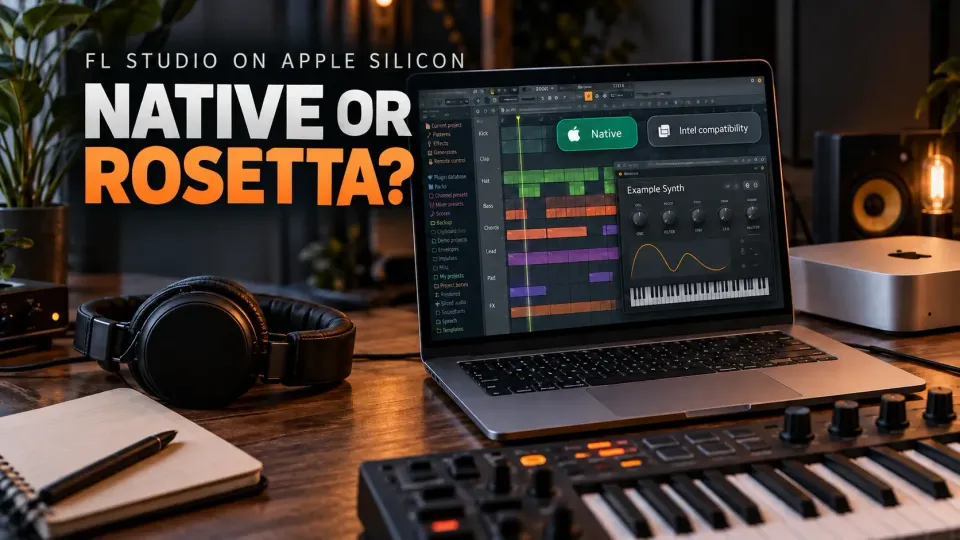
For new projects, use native FL Studio with current Apple Silicon or Universal plugins. For an older project, keep the working setup intact and test a copy. An Intel-only plugin may work through translation without putting the whole application into Rosetta mode; if that path fails, compare the project in Rosetta before replacing anything.
There is one easy trap here: having Rosetta installed is not the same as running FL Studio through Rosetta. You can install the translation component and still launch the native host. That distinction matters for legacy plugins and for a documented Plugin Manager error affecting some older FL Studio builds.
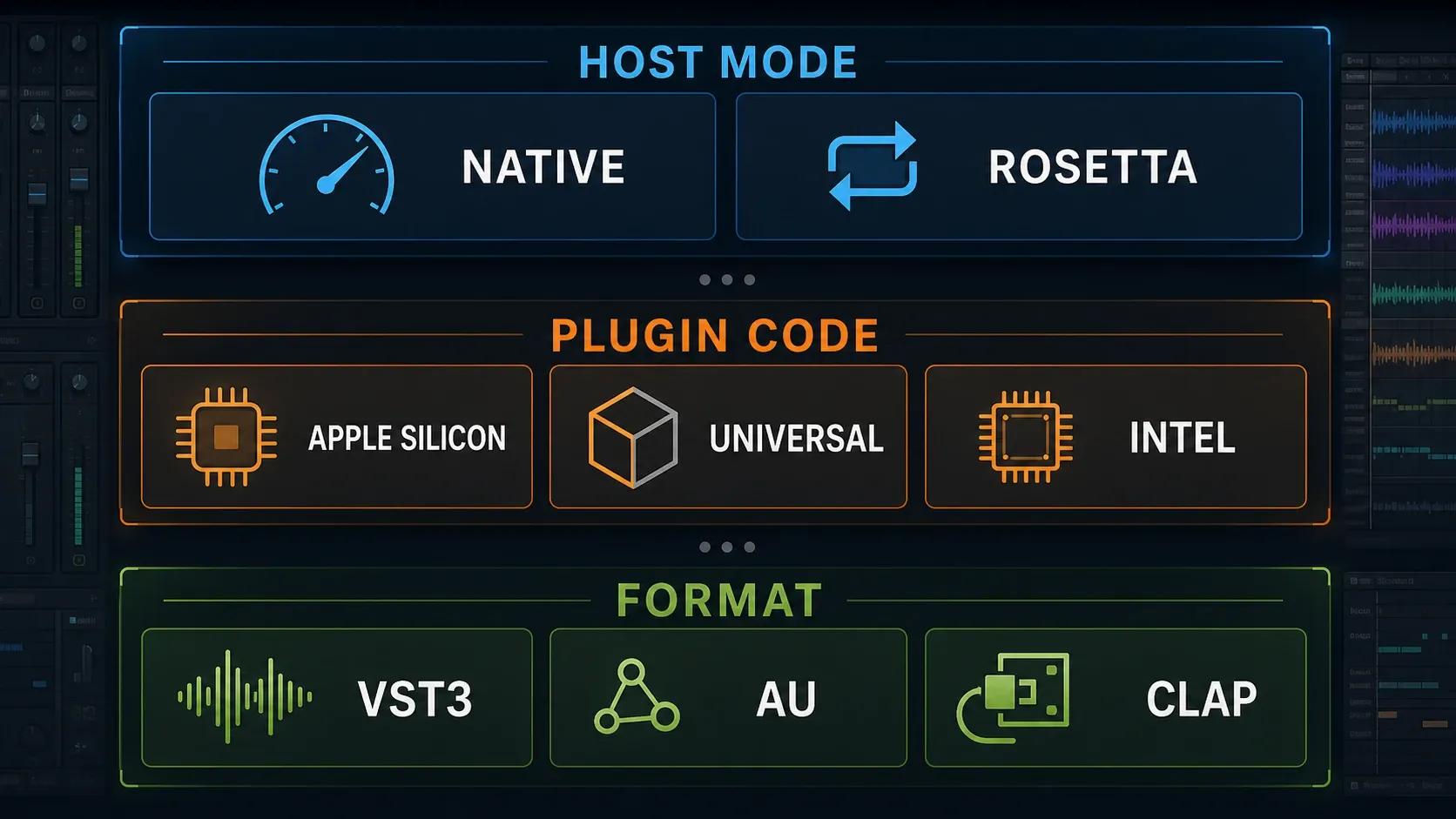
Check the host, plugin build and format separately
FL Studio has supported Apple Silicon natively since 20.8.4. On 9 September 2026, the official Mac download lists version 26.1.6.5406. Check that page when updating; a version number in an old tutorial is not a reason to install an old build.
Record three things before troubleshooting: the mode shown in FL Studio, the architecture of the exact plugin you installed, and the format saved in your project. VST3, AU and CLAP are interface formats, not Apple Silicon compatibility badges. FL Studio for Mac needs 64-bit plugins, but “64-bit” alone does not tell you whether the component contains Intel or ARM64 code. Use the Mac build: Rosetta is not a way to load a Windows-only VST file.
A Universal build contains support for Intel and Apple Silicon; an Apple-Silicon-only build does not become Intel-compatible when you change the host mode. Check the vendor's download notes for the exact product version, format and supported macOS. A standalone app, installer and plugin component can have different requirements.
For example, Arturia's architecture guide explains how its plugin About panel identifies ARM64 or Rosetta builds and lists legacy exceptions. That is useful build-level evidence, not permission to assume every product from a brand behaves alike. Use the FL Studio plugin installation guide if the component has not been installed yet.
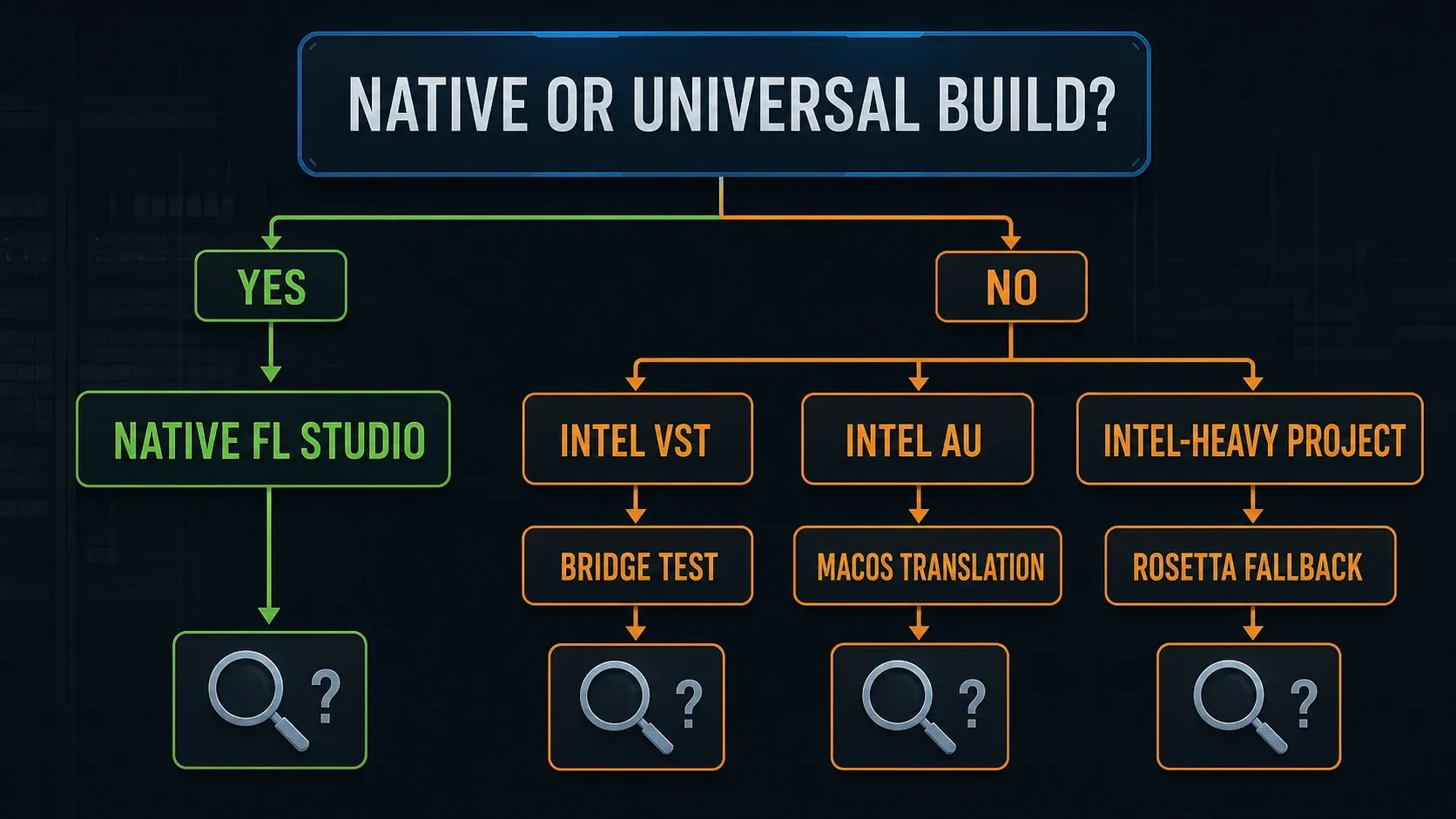
Native or Rosetta: choose from the dependency
| What you need | First test | What a pass means |
|---|---|---|
| Current Apple Silicon or Universal plugin | Native FL Studio and the native component | It loads, plays and recalls correctly in a licensed test project |
| Intel-only VST | Native host with FL Studio's automatic process bridge; compare Rosetta if unreliable | The interface, automation and sound survive reopening |
| Intel-only AU | Native host with macOS handling Intel translation | The exact AU instance recalls; translation has not made it native code |
| Legacy project that fails in native mode | Copied project in Rosetta, with Intel-compatible versions of its dependencies | The whole project is stable enough to finish or archive |
| Intel-only CLAP | Check the vendor's host-specific support and seek a native build | Do not assume the documented Intel VST bridge covers CLAP |
Image-Line's installation manual distinguishes these runtime paths: native FL Studio bridges Intel VSTs, while macOS handles Intel AUs. In full Rosetta mode, Apple handles Intel VST and AU execution, without FL Studio adding that bridge. These are compatibility paths, not guarantees for every old plugin.
A bridge may add overhead, and a project with several Intel plugins can run better in full Rosetta than through separate bridges. Equally, staying in Rosetta after replacing those plugins can be unnecessary. Let a controlled test decide the legacy project's mode; do not treat it as the default for the next song.
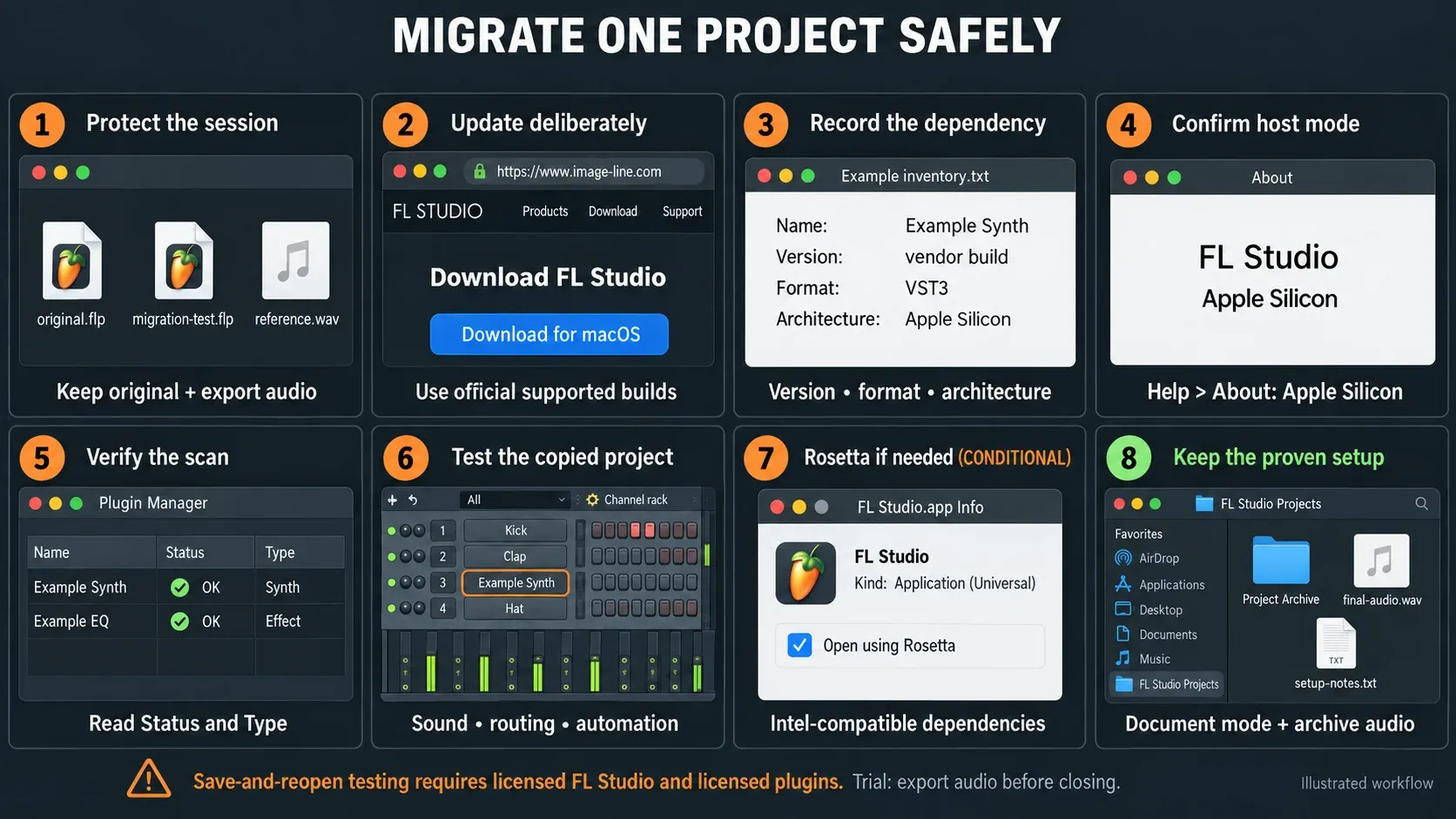
Migrate plugins in eight controlled steps
Before closing anything: FL Studio Trial can save but cannot reopen projects until purchased. Render important audio while the session is still open. Also check plugin licenses: an unowned native trial plugin can disappear on reopening, and re-saving before unlocking it can lose its settings. That is a licensing problem, not an architecture test. The save-and-reopen steps below assume a licensed host and appropriately licensed plugins.
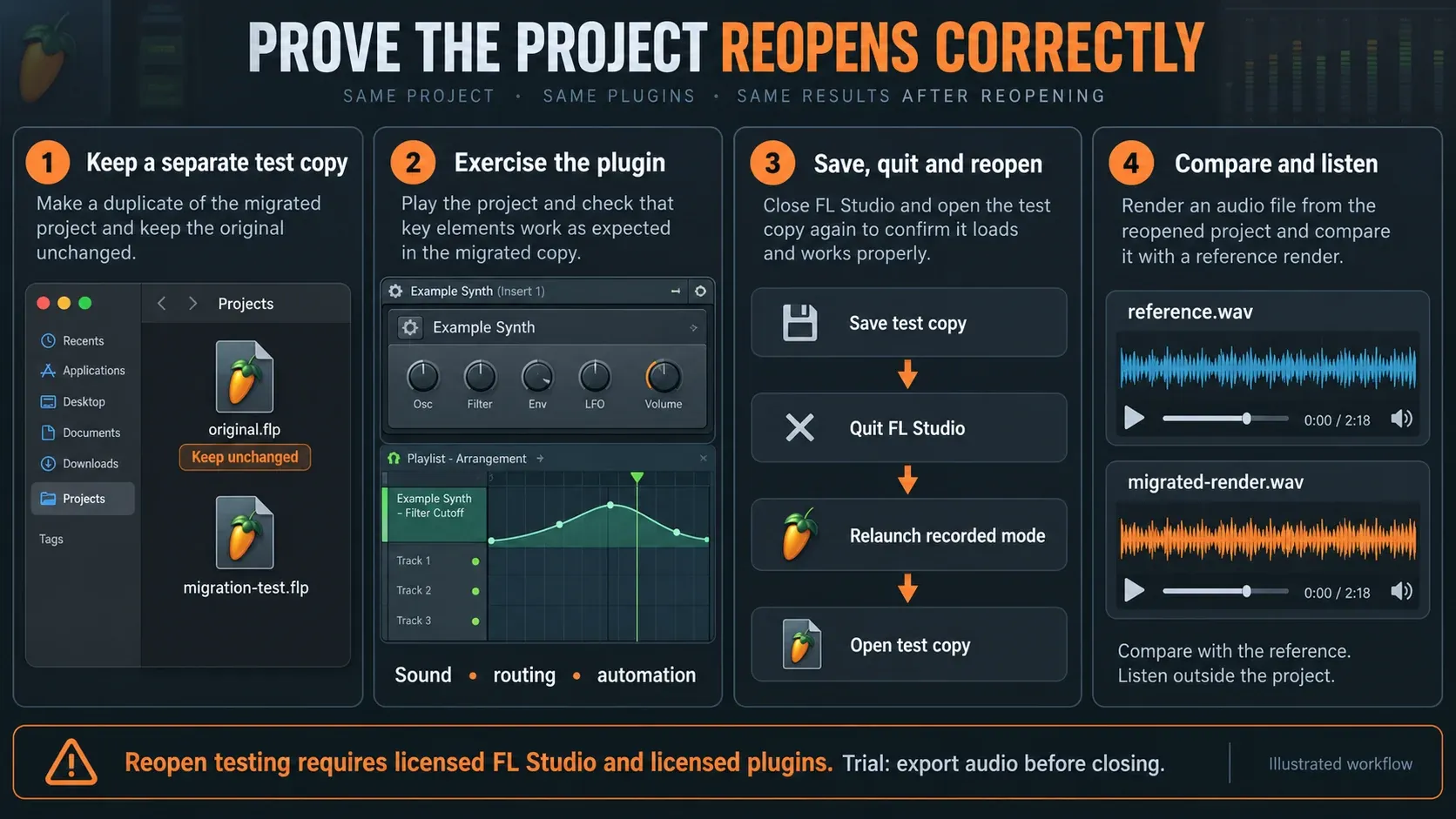
- Protect the working session. Save a separately named copy, keep the original untouched, and render a reference plus useful stems before updating or switching modes. Trial users should preserve audio and defer the reopen test.
- Update deliberately. Obtain FL Studio and the plugin's supported build from their developers. Keep a record of the working versions; do not combine an operating-system upgrade with this test.
- Inventory the exact dependency. Note plugin name, version, VST/VST3/AU/CLAP format, architecture, authorization and any required sample library. Preserve the format expected by the old project.
- Confirm native host mode. Check Help > About for Apple Silicon. If changing the setting, close FL Studio first, change Finder's Open using Rosetta checkbox, relaunch and check About again.
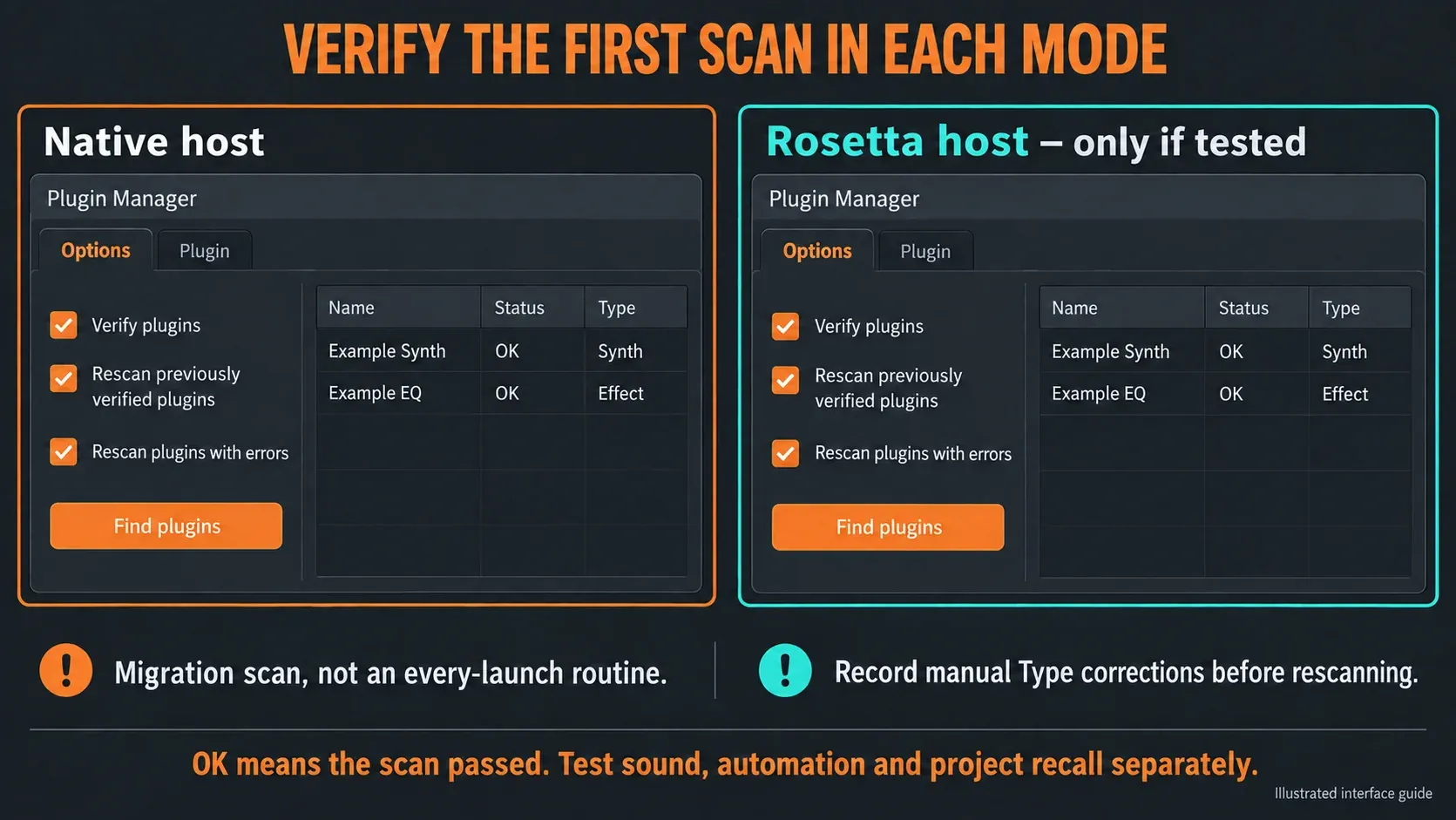
- Scan for the mode you are testing. In Plugin Manager, enable Verify plugins and the two migration rescan options. Read Status and Type, respond to legitimate plugin prompts, and investigate errors before loading the project.
- Test a copied project. Load the exact instance, play audio or MIDI, exercise automation and routing, then save, quit and reopen the licensed copy. Compare its sound and state with the reference.
- Compare Rosetta only when needed. For a failing Intel dependency, switch the closed host to Rosetta, perform its first verified scan, and repeat the same test with Intel-compatible components.
- Keep the proven setup and an audio archive. Record the working mode and versions. Prefer native for new work; document any remaining Intel dependency and replace or render it before losing access to its working environment.
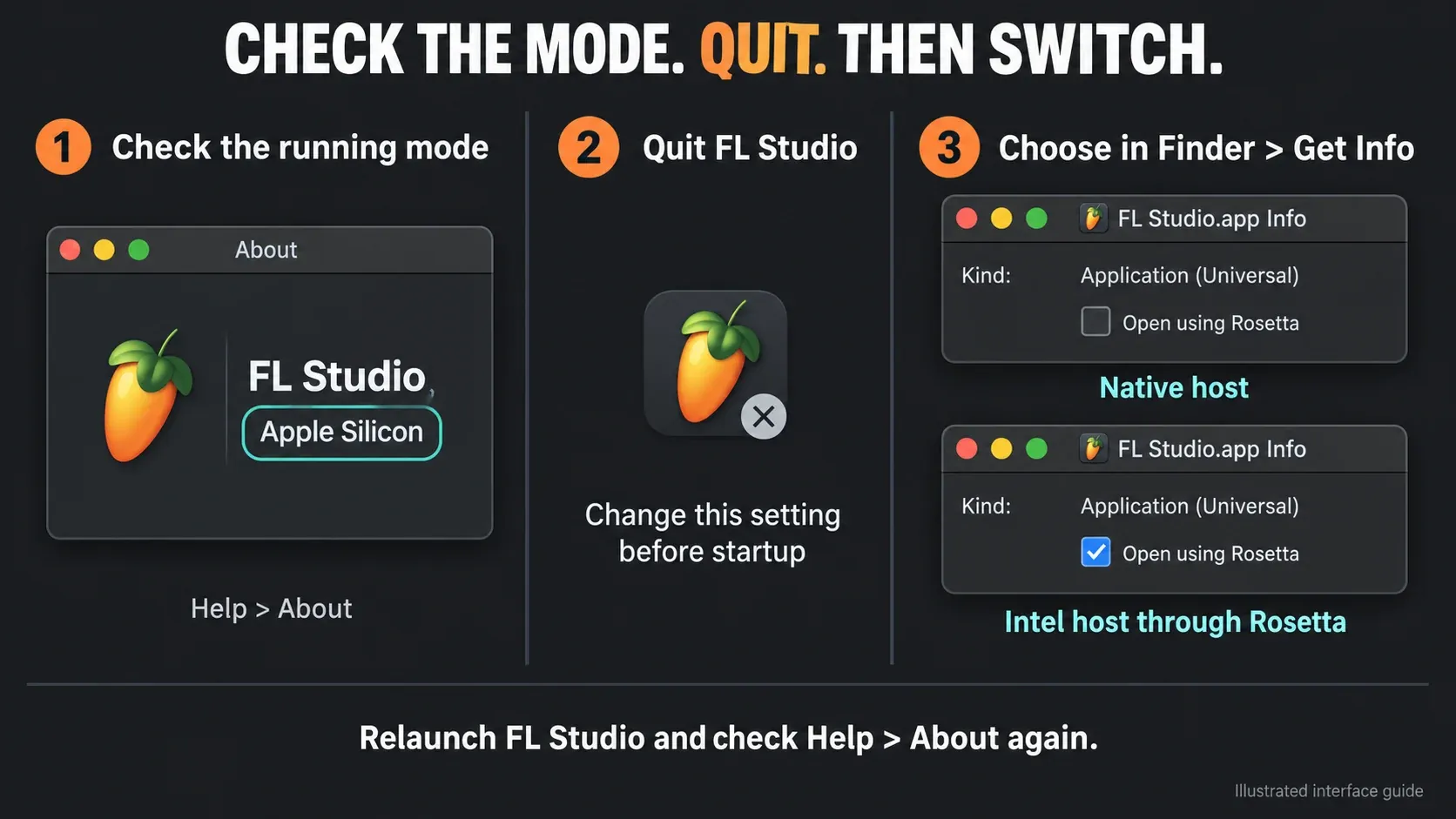
Check and switch FL Studio's mode
Open Help > About and read Intel or Apple Silicon. For the switch, quit FL Studio, locate the actual application in Finder's Applications folder, right-click it and choose Get Info. Select Open using Rosetta for the Intel host; clear it for native Apple Silicon, then relaunch.
The Image-Line mode-switch instructions warn that a later installation may preserve your previous Rosetta choice. Check the running mode rather than assuming an update reset it. In Apple's Get Info terminology, Universal describes what an application can run as; it is not proof of the mode currently running.
If the checkbox is absent, confirm you selected the application itself and check its Kind and current developer guidance. Do not change permissions or hunt for an unofficial replacement build to make the checkbox appear. An Apple-Silicon-only application has no Intel version for that switch to select.
Rescan after the first switch into each mode
Open Options > Manage plugins, or reach Manage plugins through File settings. Enable Verify plugins, Rescan previously verified plugins and Rescan plugins with errors for the migration scan, then click Find plugins. Image-Line calls for a verified scan the first time you use each host mode because the available results can differ.
The Plugin Manager controls distinguish successful scan Status from Synth/Effect Type. Neither is a guarantee that an old project will recall its presets or automation. Allow the scan to finish and respond to legitimate installer or authorization prompts instead of hiding every popup.
These rescan settings are for a reason, not a ritual before every launch. Once the migration is settled, ordinary new-plugin scans need not revisit every previously verified result. If you manually corrected a known working plugin's Type, record that first: rescanning can overwrite the correction. A plugin missing only from a favorite menu belongs to the Plugin Database categories and favorites workflow, not automatically to Rosetta troubleshooting.
A specific exception: native scan errors in older builds
Image-Line's Plugin Manager Error advisory names FL Studio 26.1.3 and earlier: on some Macs, scanning in native mode can fail when Rosetta is not installed. That is narrower than “native FL Studio needs Rosetta.” Check your version and update first; the advisory is not evidence that every later build has the same fault.
For the documented case, Image-Line's workaround is to close FL Studio, use Get Info's Rosetta option to trigger installation if needed, then clear the checkbox and return to native mode. Rescan with Verify plugins and both rescan options enabled, with the VST/VST3 combining option disabled. The advisory calls it “Combine VST and VST3 versions of a plugin”; the File settings manual uses “Combine presets for VST and VST3 versions of a plugin.”
Apple explains the Rosetta installation prompt: opening an Intel application can request the component when it is absent. Installing it does not force all compatible applications to run in Intel mode. If the same error remains, inspect the plugin's installation, license and vendor support rather than repeatedly flipping the host setting.
Preserve the old project's plugin identity
Installing a native AU beside an old VST does not automatically replace that VST instance. Keep the original project and exact format available while testing a supported update. Check sound, preset state, automation, tempo sync, sidechain inputs and required libraries. A plugin can open an interface yet still load the wrong sound or miss a library.
For Windows collaboration, Image-Line recommends matching VST-format dependencies on both systems; AU is Mac-only. Its supported-format list also includes CLAP on Windows and macOS, but support for a format alone does not promise automatic substitution or identical project recall. Agree on the actual plugin version and format, then exchange a small test project before moving the session.
Do not rename plugin binaries, replace the only working preset, or overwrite a project after a missing-plugin warning. If discovery itself is failing, the plugin-not-showing diagnostic covers scan paths and classification. Here, the question is whether the same dependency survives an architecture change.
Compare performance on the same project
Use the same project copy, audio device, buffer, sample rate and playback section for native and Rosetta tests. Keep plugin quality settings and open interfaces comparable. Image-Line's performance guidance favors native host and native plugins, but warns that unnecessary bridging adds work. There is no universal CPU saving to promise for your collection.
Use Plugin performance monitor to locate a heavy instance, and treat macOS Activity Monitor as a different system-level view—not an interchangeable FL Studio audio-load percentage. A setup that plays one loop with a lower meter but loses automation on reopen has failed the migration test.
Do not disable the bridge required to run an Intel VST inside the native host. Remove an unnecessary forced-bridging setting only for a compatible native component. If problems remain with native plugins, continue with FL Studio high CPU troubleshooting or crackling and underruns; buffer, device and sample-rate issues are separate possibilities.
Use the symptom to choose the next check
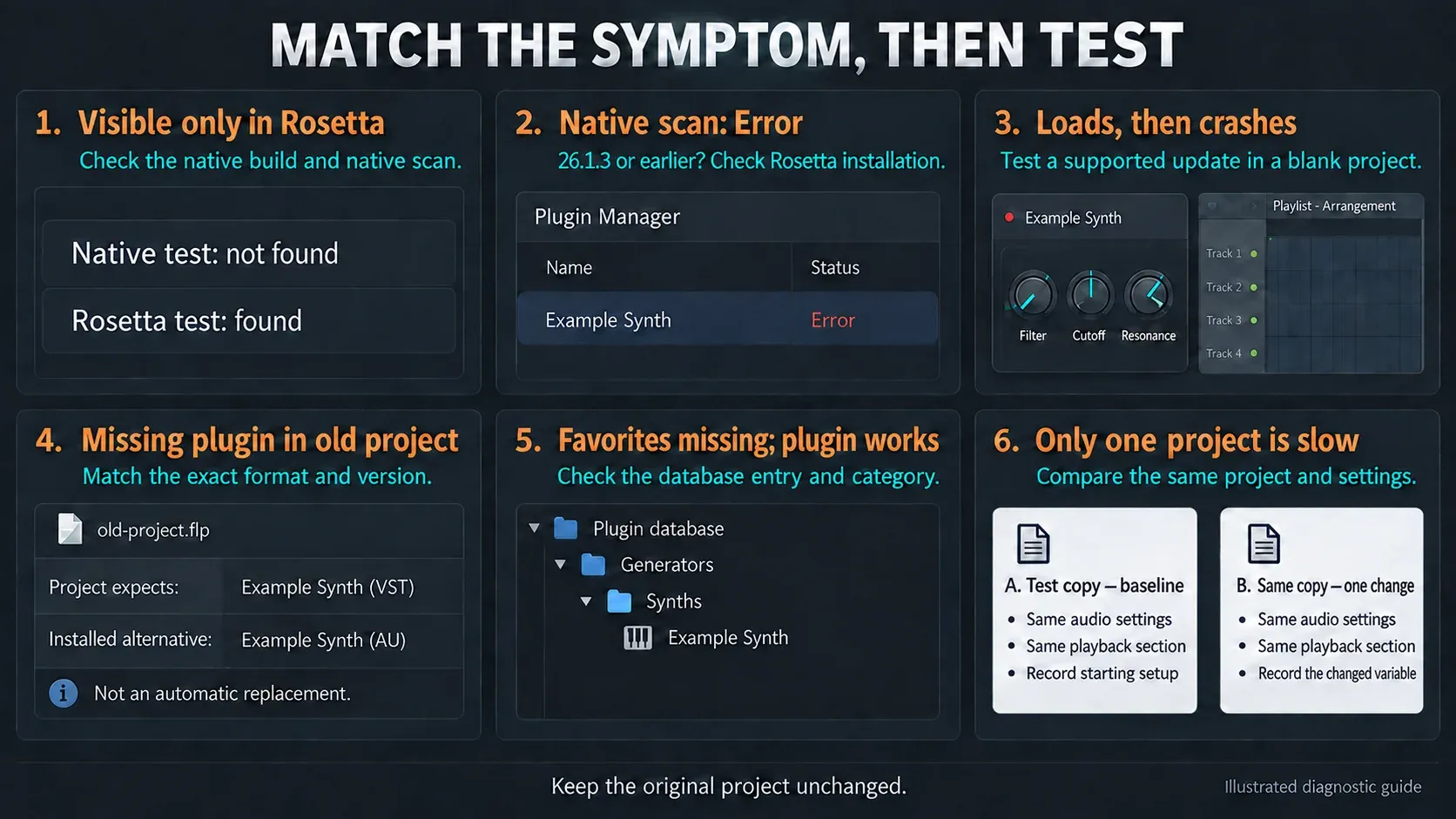
- Visible only in Rosetta: check the installed component's architecture and native-mode scan. The product name alone does not identify the build.
- Native scan reports Error: check version and the specific older-scanner advisory above before assuming the plugin is Intel-only.
- Loads, then crashes: test the updated component in an empty project. Try another vendor-supported format there, without replacing the old project's instance blindly.
- Old project reports a missing plugin: match its exact format, version and authorization. A new AU is not automatically the missing VST.
- Favorites missing, plugin works: check its database entry and category. Browser starring and plugin-menu favorites are different features.
- Only one project is slow: compare that project's routing, settings and dependencies. Do not change every project's architecture to address one unexplained meter reading.
If the plugin is found but its samples are missing, use the Browser and content-navigation guide alongside the vendor's library instructions. Rosetta does not install a missing sample library or grant a license.
Prepare old projects before Rosetta's support narrows
As checked on 9 September 2026, Apple's published Rosetta timeline keeps general availability through the forthcoming macOS 27. From macOS 28, the remaining functionality is limited to certain older, unmaintained games using Intel-based frameworks. That exception is not a promise that Intel audio plugins will keep working.
Plan the transition before upgrading a working studio to a system that cannot run its dependencies. Keep useful rendered audio, installer/version records and license information with your project archive. Ask the vendor about a maintained native replacement while you can still compare the old sound; do not assume a full-host Rosetta switch is a permanent fallback.
For a smaller new-project collection, start with FL Studio stock instruments and effects that your license includes. Use the Vital setup guide for that specific synth, not as proof about unrelated plugins. Hardware selection belongs in FL Studio system requirements; buying a higher FL Studio edition does not rebuild a third-party Intel binary.
Finish with a licensed project's reopen test
Save a named test copy, quit FL Studio, relaunch in the recorded mode and open that copy. Compare the actual sound, routing and automation with your reference; also listen to the rendered file outside the project. Keep the original unchanged until the migrated copy is dependable. If neither mode works, preserve the evidence and contact the plugin vendor instead of stacking compatibility tools.
The Plugins hub takes you from installation to a usable collection. If the migration exposes a wider device or playback fault, use the Troubleshooting hub to pick the appropriate next test. You are done with this migration when the project recalls correctly—not merely when a scan turns green.
FL Studio Apple Silicon plugin FAQ
Does FL Studio run natively on Apple Silicon?
Yes, native support began with FL Studio 20.8.4. Use a current supported Mac build and check Help > About for Apple Silicon. The host's support does not prove that every installed third-party plugin is native.
Does installing Rosetta make FL Studio run in Intel mode?
No. Installation adds the translation component. The Universal FL Studio application's Open using Rosetta setting selects the host mode; clear it and relaunch to use native Apple Silicon. Some Intel dependencies can still require translation.
Can native FL Studio load an Intel VST?
FL Studio can attempt to load it through an automatic process bridge. Check interface behavior, audio, automation and licensed-project reopening. A successful scan does not guarantee a stable plugin.
Are Intel AU plugins native when they load in native FL Studio?
No. macOS handles the Intel AU translation; the binary has not become Apple Silicon code. Installing a current native or Universal component removes that particular legacy dependency when the vendor supports it.
Why can plugins scan as Error in native mode?
There are several causes. Image-Line specifically documents some Macs using FL Studio 26.1.3 and earlier failing when Rosetta is absent. Update first; for that case, install Rosetta, return to native mode and follow the advisory's verified-rescan settings. Do not apply the diagnosis to every Error result.
Why does a plugin appear in only one host mode?
The installed build and scan results can differ by mode. Verify the exact component's architecture and complete the first verified scan in the mode you intend to use. A missing favorite menu entry is a separate database issue.
Should I use VST3, AU or CLAP on an M-series Mac?
Choose a vendor-supported native or Universal component and preserve the format expected by existing projects. The format name does not prove its CPU architecture. For Windows collaboration, match plugin versions and formats; AU is Mac-only, and a different format is not an automatic replacement.
Can I do the save-and-reopen test in FL Studio Trial?
Not fully: Trial saves projects but cannot reopen them until FL Studio is purchased. Export important audio before closing. Check plugin licenses too; do not mistake an unowned native trial plugin's recall limitation for an Apple Silicon fault.
Will Rosetta keep Intel-only audio plugins working indefinitely?
No. Apple's published plan keeps general availability through macOS 27, then limits macOS 28 functionality to certain older unmaintained games. Preserve audio and migrate important Intel-only plugin dependencies before upgrading beyond their working environment.
Is native FL Studio always faster than Rosetta?
Native host with native plugins is the preferred starting point, not a fixed performance promise. A legacy project using several bridged Intel VSTs can behave differently. Compare the same settings and project section, and include stability and recall in the result.