FL Studio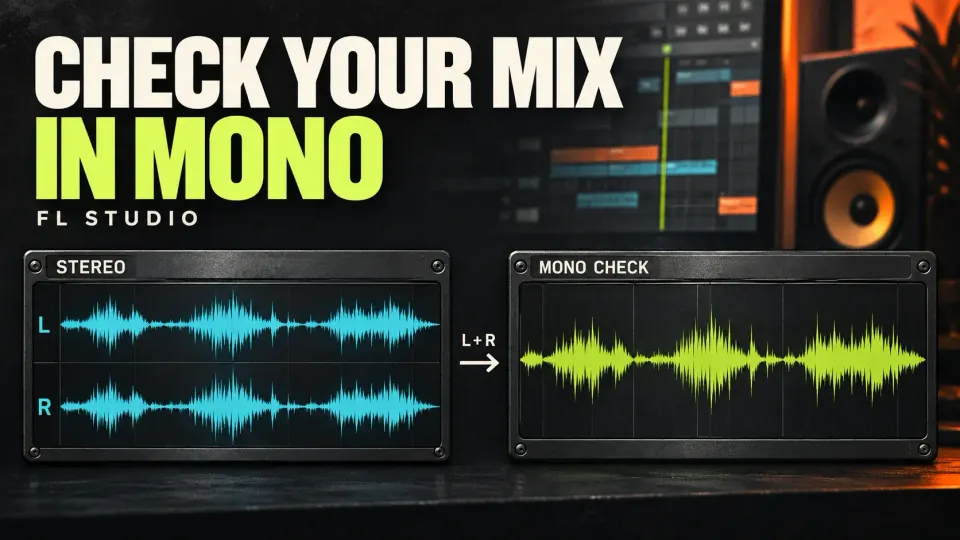
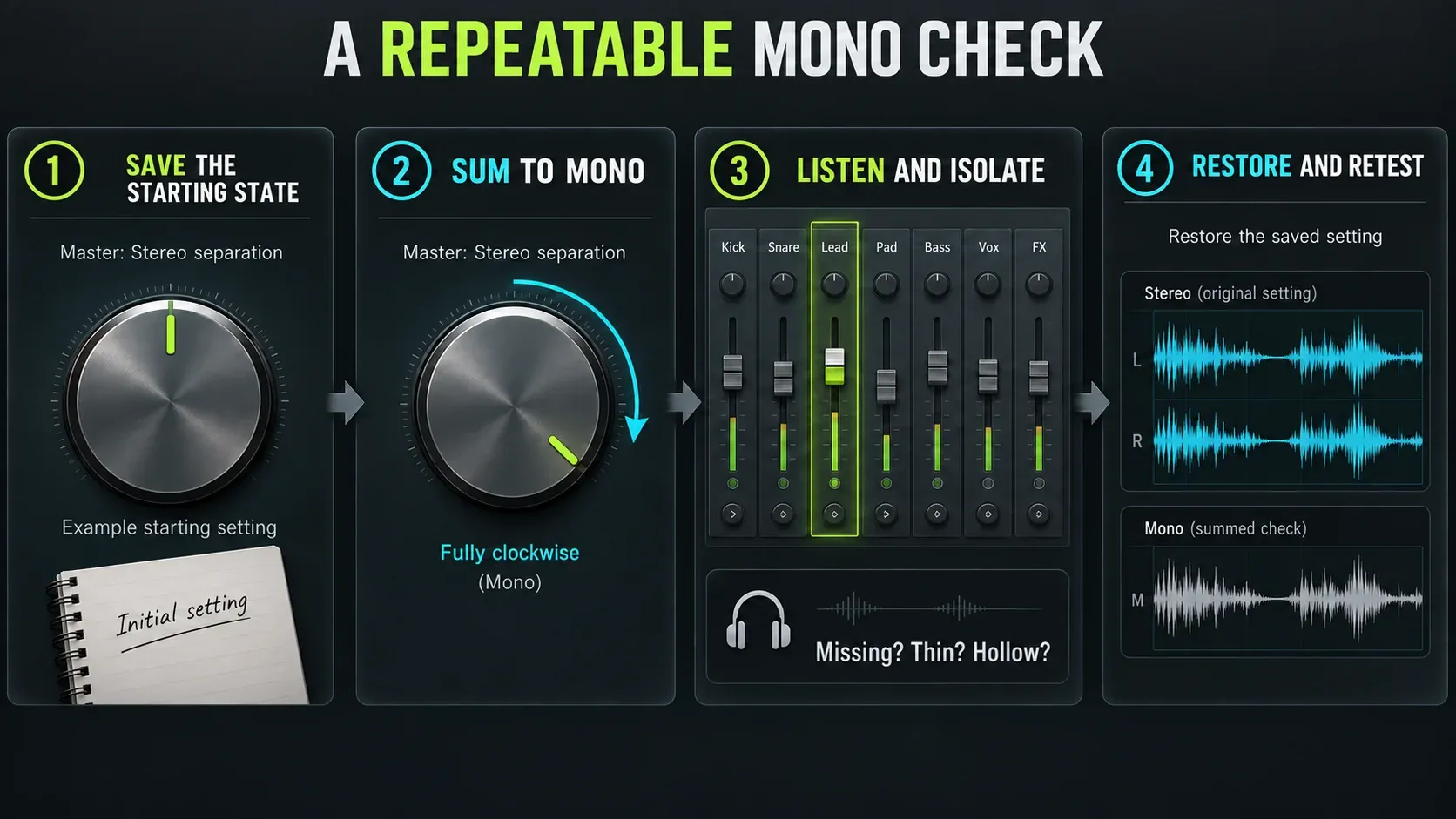
To check mono compatibility in FL Studio, select the Master Mixer track and turn Stereo separation fully clockwise. Listen to the same busy passage in stereo and mono: does the lead disappear, the bass lose weight, or the groove become hard to follow? Note the control’s starting position first and restore it after the test. The job is to find damaging changes, not make mono sound as wide as stereo.
Keep a saved copy of the project before changing timing, polarity or routing. The illustrations below are instructional reconstructions, not captures of a measured mix. Their waveforms explain the decisions; your listening comparison determines whether a repair works.
Check mono compatibility in eight steps
- Save the starting state. Note the Master Stereo separation setting and keep a project copy before making diagnostic changes.
- Loop a useful passage. Choose a section with the lead, kick, bass and main effects. Start at a comfortable listening level.
- Sum the Master to mono. Turn Stereo separation fully clockwise. Do not use the pan control or listen to only one headphone channel as a substitute.
- Name the audible failure. Write down a missing part, hollow tone, weak low end or changed balance. Reduced width alone is expected.
- Isolate the path. Compare groups, tracks and returns, then test suspect layers alone and together. Restore unrelated mute states.
- Compare effects carefully. Bypass one suspect effect at a time, working backward through its chain. Check level changes before blaming phase.
- Check the measurement point. Use Wave Candy’s Vectorscope to inspect stereo at its slot; a Master-slot instance is before the Master Stereo separation control.
- Repair, restore and retest. Keep the smallest useful change, compare at similar loudness, restore the saved Master setting and replay a short stereo export.
Use the Master control without changing the mix by accident
Image-Line’s Mixer documentation identifies fully clockwise as the mono setting. The middle position leaves stereo separation unchanged; turning left enhances existing stereo differences. Counter-clockwise is therefore not the direction for this test. Expand the Mixer or change its layout if the control is hidden; the Mixer walkthrough explains the track controls.
Center is the right setting to restore only if that was your starting point. If you deliberately narrowed or widened the Master, return to that saved position. If automation moves the control during playback, carry out the test in a project copy without recording over the automation, and check that the mono setting stays put for the passage.
This check covers audio reaching the Master. If an Insert goes directly to a hardware output and bypasses the Master, that separate path is not folded by the Master control. Check your routing before judging the whole playback from one knob.
A stereo source does not need to become a mono file to pass. Keep the stereo piano, room recording or return if it still works after summing. For creative widening and narrowing, use the separate Stereo separation guide; this page is about diagnosing what gets lost.
What should survive when the width disappears?
The stereo image folds inward. Reverb may feel smaller, panned instruments share the center, and their apparent levels can change. As iZotope’s mono-versus-stereo explanation makes clear, the useful comparison concerns both audible content and balance. Can you still follow the vocal or melody, feel the kick and bass, and recognise the groove?
A quieter pad is not automatically faulty. A lead that almost vanishes or a bass note that becomes hollow deserves investigation. If every part remains healthy when soloed but competes in the full mono mix, the problem may be masking or balance rather than cancellation inside one sound. Try a small level or arrangement change before reaching for a phase tool.
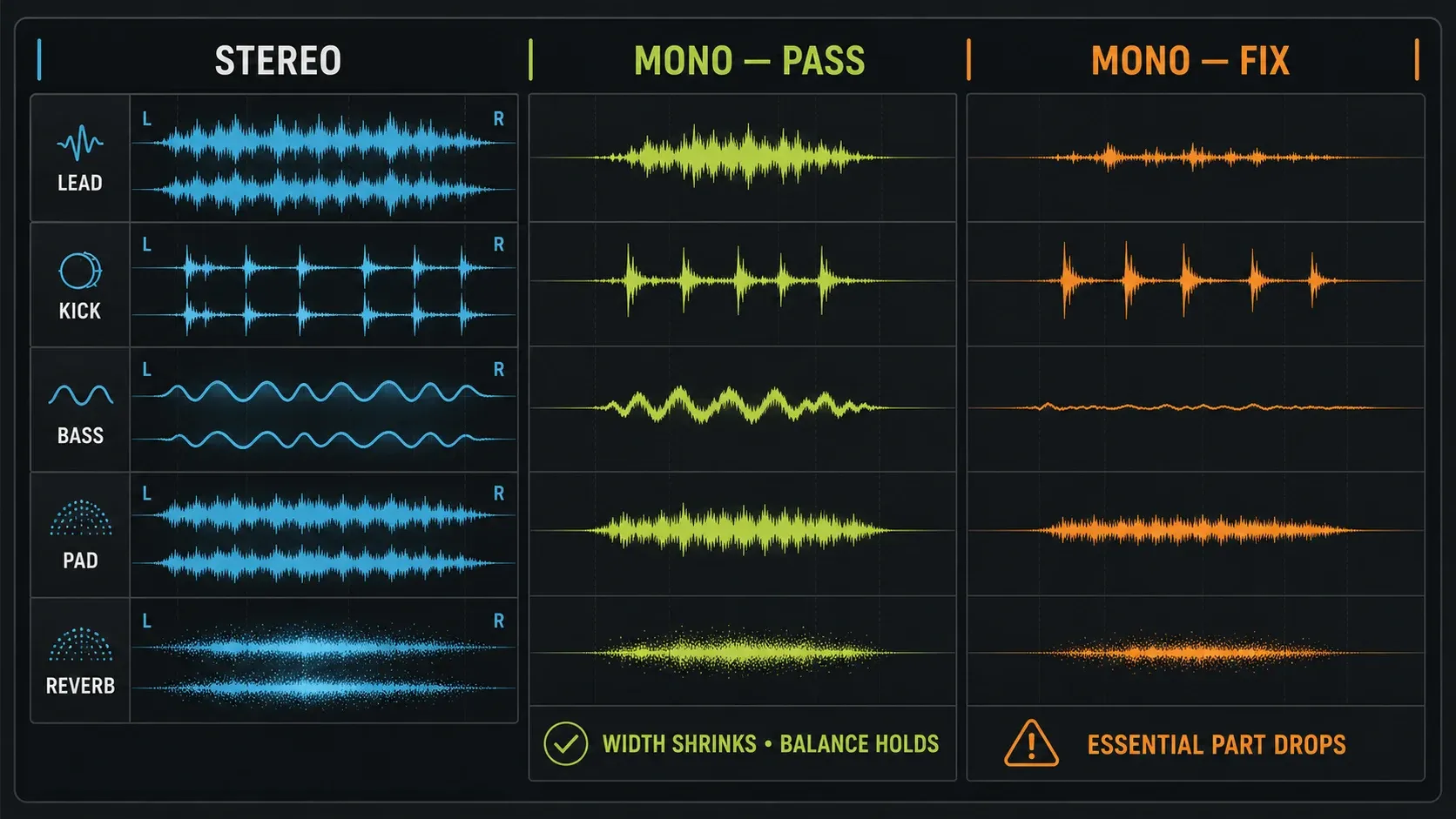
Why mono can sound quieter, hollow or almost silent
The Fruity Stereo Shaper manual defines the Mid signal as (L + R) / 2 and Side as (L − R) / 2. Mid is the combined left and right signal, not just instruments panned to the center. A hard-panned sound can still be present in that sum.
If the same waveform reaches both channels at equal level but with opposite polarity, the sum can cancel completely. A delayed copy is different: the relationship changes with frequency, so some frequencies reinforce and others cancel. That produces the hollow, comb-filtered tone explained in iZotope’s guide to comb filtering.
Level loss alone does not prove either fault. Summing changes the balance between shared and different channel content, and removing panning separation can expose masking. Check the source and its processing before compensating with more Master gain.
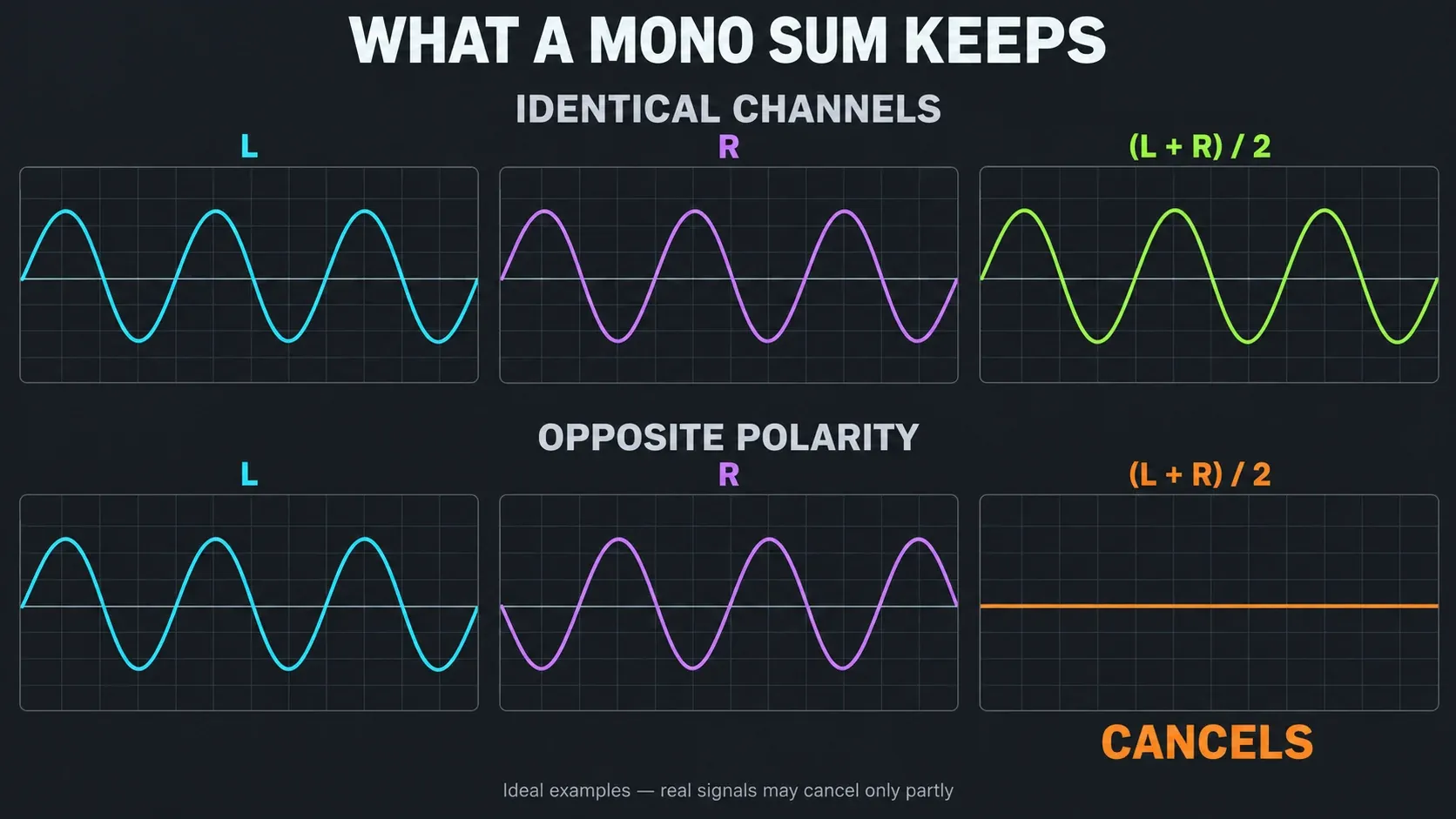
Find the responsible track, return or layer
Start with the full mix folded to mono. Mute one broad group at a time, then restore it: drums, bass, music, vocals, effects. If a problem changes when a group is removed, investigate that group and its interaction with what remains. A missing lead cannot be diagnosed by simply muting the lead itself; solo it to hear whether its own tone survives.
On the suspect path, compare stereo and mono with effects bypassed one at a time. The documented effect-slot order runs from 1 through 10. Work back from the last processor without deleting or reordering the chain. If bypassing a widener restores the sound, compare its input and output and check the wet amount, delay and level.
A helpful bypass is a clue, not proof. It may also alter loudness, compression or a parallel interaction. Restore the processor and repeat at comparable listening levels. Keep send paths and sidechain triggers intact unless one is the variable you are testing.
For layers, listen to A, then B, then A+B. If each sounds solid alone but the pair turns thin, investigate their timing and polarity relationship. Check several notes or hits: a shift that helps one transient can hurt the next or change the groove.
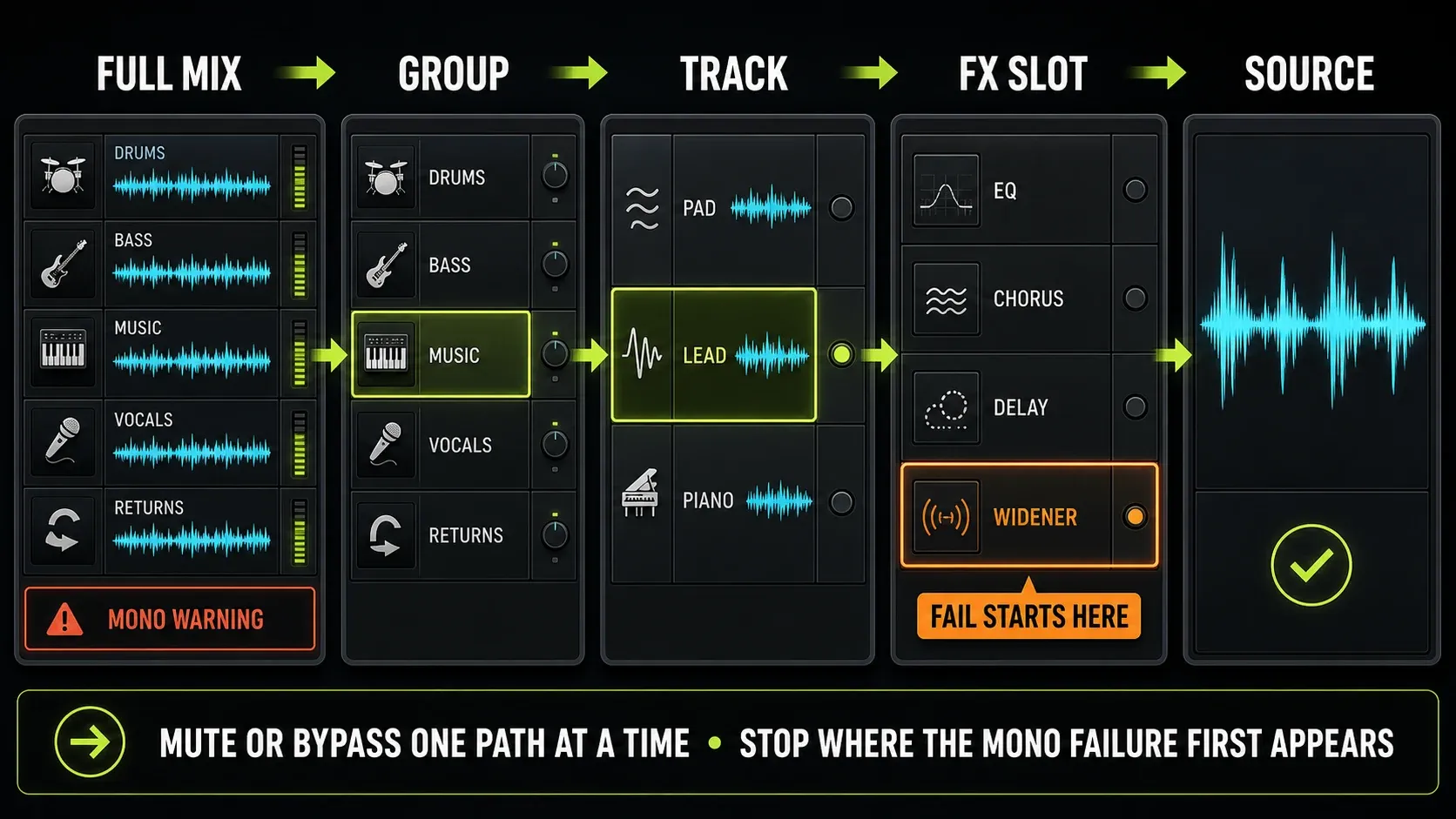
Read Wave Candy at the right point in the chain
Load Wave Candy in an available effect slot on the track you want to inspect and select Vectorscope. According to the Wave Candy manual, centered mono draws a vertical line, a single left or right channel draws a diagonal line, and stereo produces a broader figure. A horizontal line indicates left/right opposition; complicated music is less easy to interpret than a simple signal.
A Wave Candy instance in a Master effect slot measures before the Master Stereo separation control. The effect stack precedes the built-in track properties. It can still show a stereo figure while you hear the Master folded to mono. That is not proof that the mono control failed. Use the scope there to inspect the stereo signal feeding the fold, and listen to the fold itself for translation.
The Current (C) track is another documented location for Wave Candy: it receives the selected Mixer track’s output. Its target changes when you select another track. Do not add corrective processing there casually—effects and EQ on Current can affect whichever track you select.
A broad display is not a failed mix. If you use a separate correlation meter, a negative reading is a reason to listen more closely, not a prediction that the entire song will vanish. The scope cannot tell you whether a quieter backing part still fulfils its musical role.
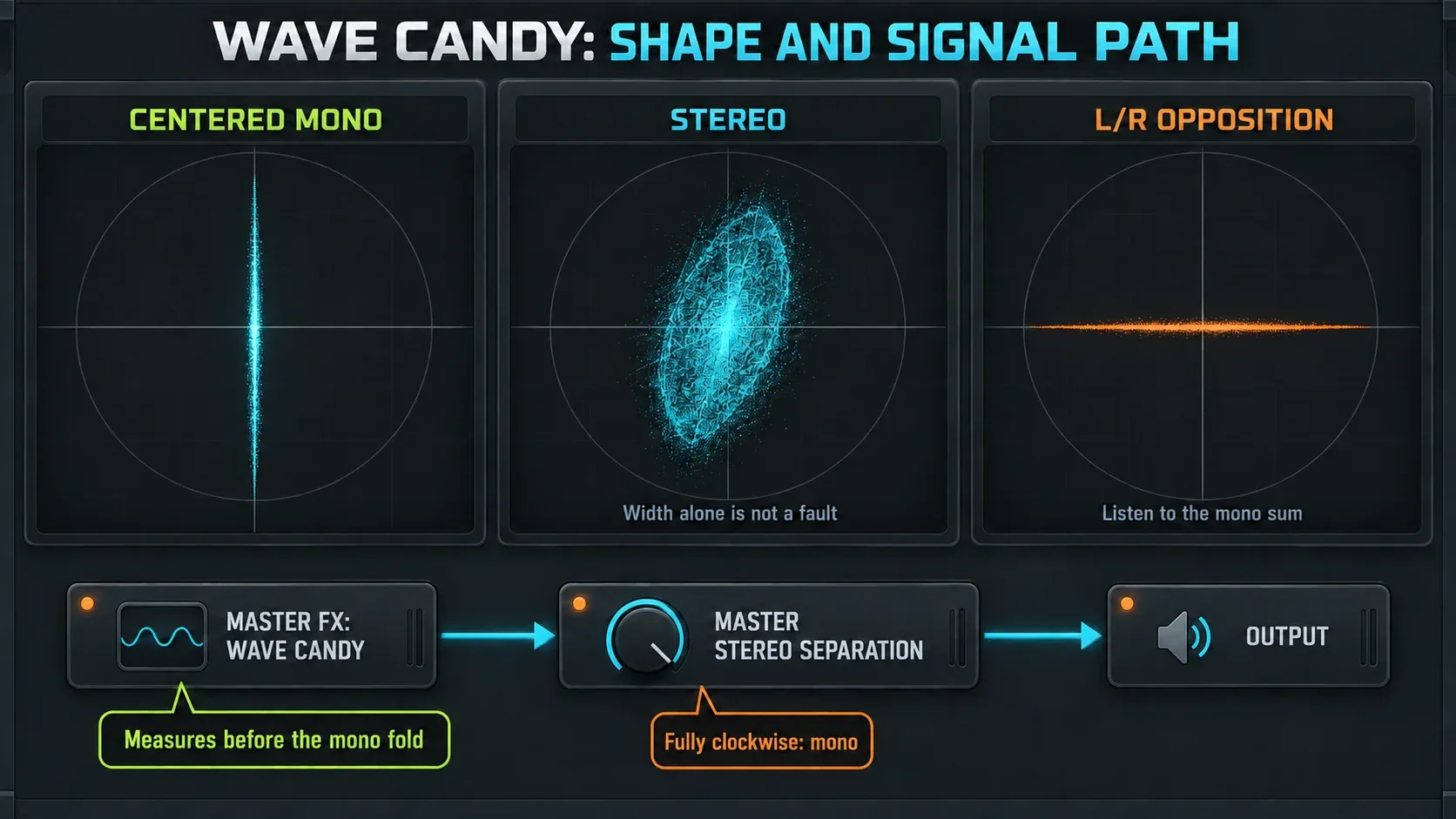
Make the smallest repair that actually helps
Haas delays, chorus and widening
Try reducing the delayed or wet layer, adjusting the inter-channel delay, or retaining more dry signal. Audition each choice in mono and stereo. Shorter is not automatically better: delay changes move the cancellation pattern. Narrowing cannot recreate detail already cancelled in a printed mono file; work from the stereo source or earlier project when available.
Spreader’s documentation describes its Spread process as mono-compatible but warns that its separate Separation control can break compatibility. Low Bypass excludes low frequencies from the spread effect; its Mono option additionally folds that bypassed range to mono. These are different decisions, not a guarantee that any preset fixes a damaged source.
Polarity and timing are different repairs
The Mixer’s Invert phase control flips a track’s waveform polarity. Try it when correlated tracks, such as two microphones on one source, cancel against each other. Keep the change only if the combined passage improves. It does not time-align a recording or remove an arbitrary frequency-dependent phase shift.
If the cancellation is between the left and right channels inside one stereo file, flipping both together will not fix their opposition. In the ideal case, L = x and R = −x still sum to zero after both signs flip. Inspect the channels separately. Stereo Shaper offers Invert Left and Invert Right presets for a confirmed single-channel polarity error; do not apply them blindly to the whole mix. Image-Line also warns that inverting one channel can itself create cancellation.
One-sided recordings and effect returns
A mono microphone recorded through only one side of a stereo input is not the same as phase cancellation. Select the appropriate mono input in the Mixer’s input list for the next take; Image-Line’s audio-recording instructions explain how that puts the active input into both Mixer channels. For an existing file, preserve the original before selecting its useful channel.
For reverb and delay, compare dry, return and both together. A smaller tail in mono can be acceptable; a lead that relies on the sides to remain audible needs rebalancing. The separate dry-and-wet send workflow makes this easier. Keep intentional ducking intact using the sidechain setup while you test the return.
| What you hear | First comparison | Possible next move |
|---|---|---|
| Wide synth nearly vanishes | Dry versus widened signal | Reduce the responsible wet layer or revise its delay |
| Bass loses weight | Each layer, then the pair | Test timing or polarity; keep changes that help the whole phrase |
| Vocal drops behind the mix | Lead alone, then doubles and returns | Rebalance backing layers or competing instruments |
| Stacked snare turns hollow | Each sample, then both | Adjust the relationship or choose a different layer |
| Whole mix changes sharply in level | Master stereo processing on and off | Identify gain versus cancellation before changing width |
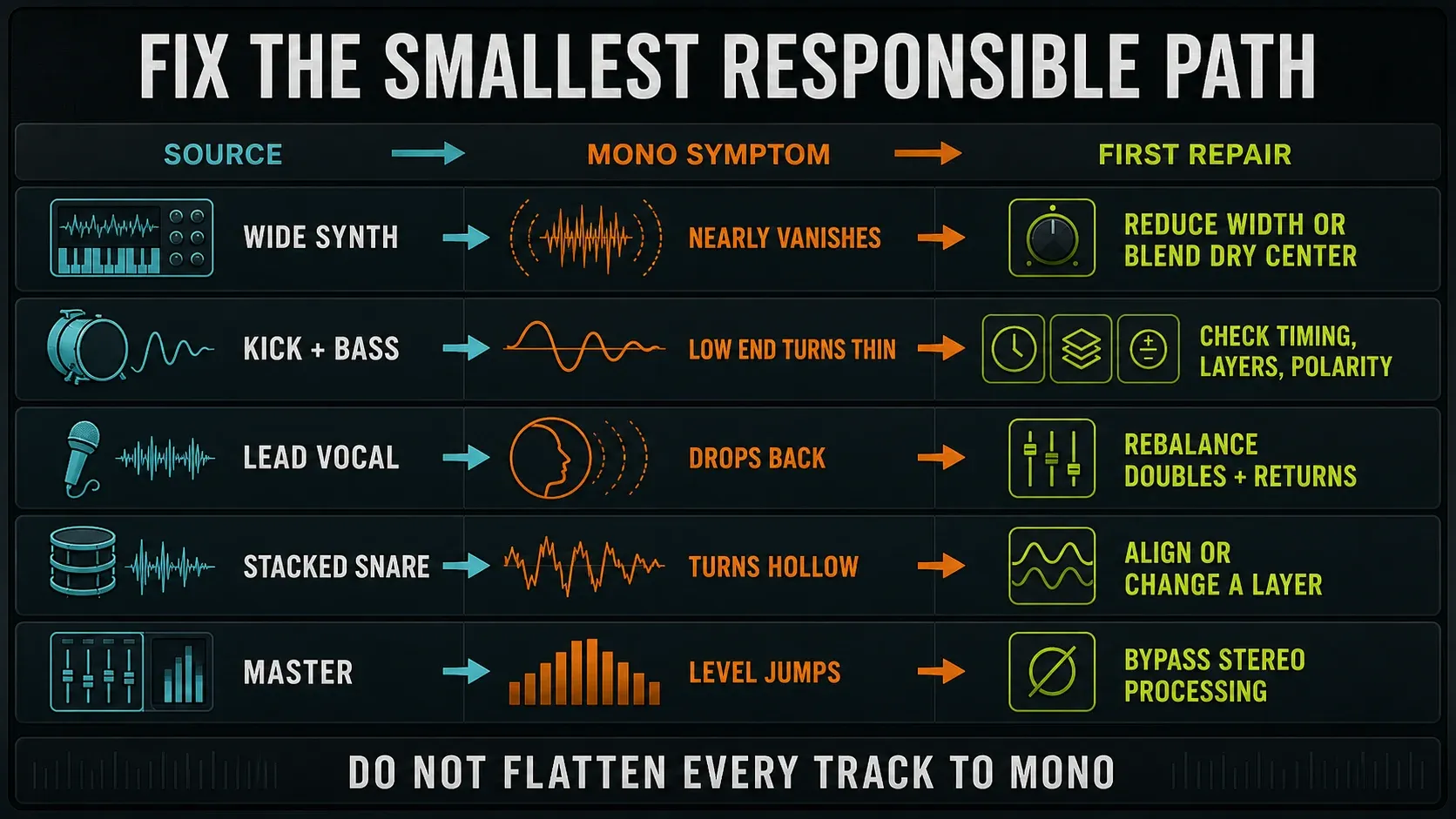
If the low end is the problem, continue with mixing the 808 against the kick. For a lead that needs a stronger center, use the vocal-mixing workflow. There is no compulsory frequency below which every bass must be mono: protect the useful low-end weight and judge any stereo layer in context.
Level-match, restore the project and check the export
Compare the same passage at similar perceived loudness so a louder repair does not win by default. Make listening compensation downstream of the processing you are judging; raising a plugin’s input can change its behaviour. First note the unadjusted level change, then compare the tone and balance. The gain-staging guide covers those input-versus-output decisions.
Restore the saved Master Stereo separation setting and all temporary mute or bypass states before the stereo render. The export manual says ordinary audio exports render the Master. Leaving its mono fold active affects that mixdown. Choosing a stereo file does not restore width already removed in the signal path. Split Mixer track exports are a different path; do not assume the Master check processes each separate stem.
For a deliberate mono file, Mono (merged) sums the channels; Mono (left only) and Mono (right only) select one channel instead. Those are not interchangeable compatibility tests. Replay a short export outside the project, then check its stereo and mono playback without applying the Master chain twice.
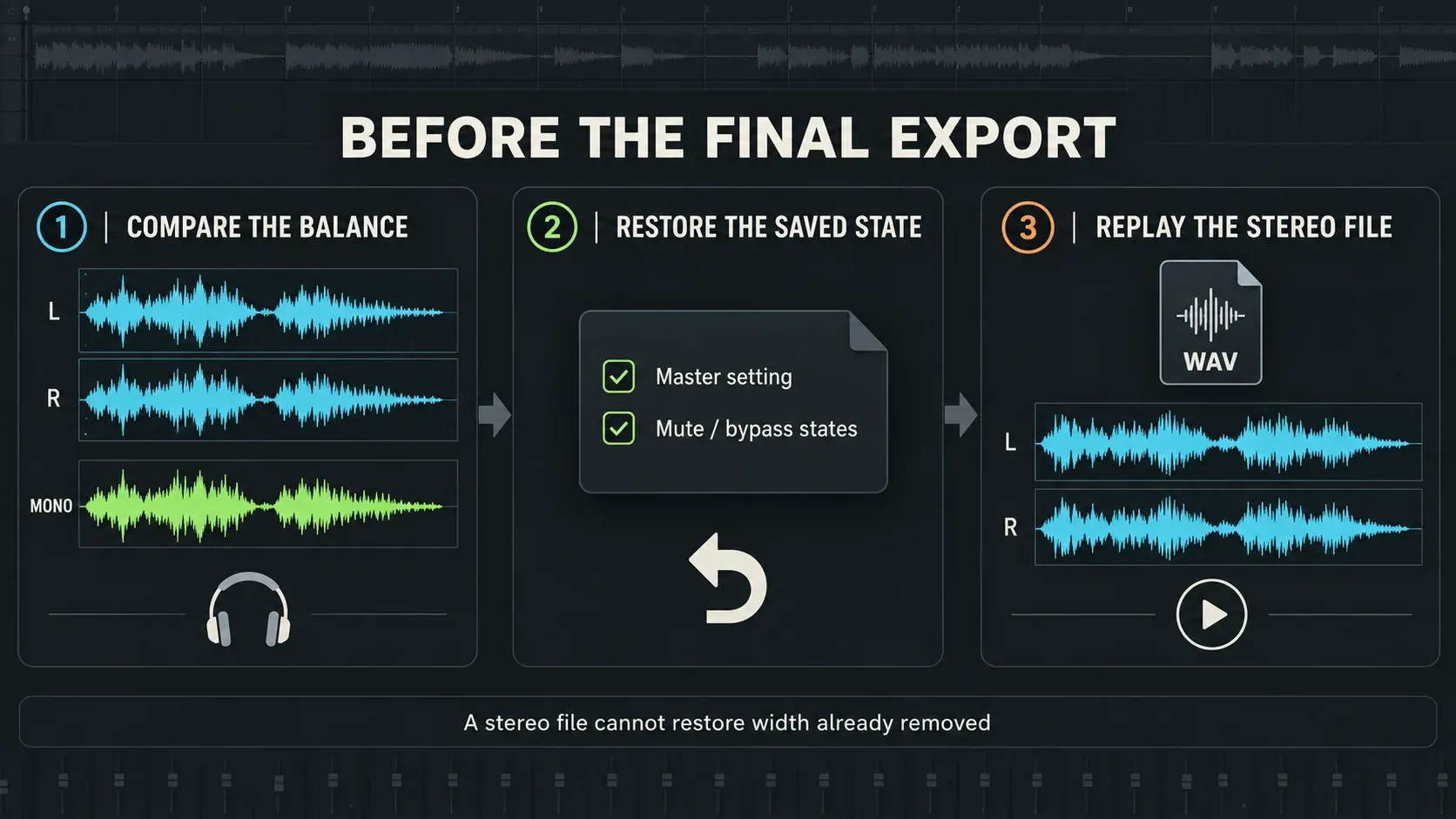
Finish the delivery choices with the mastering workflow and export settings guide. If the sound is distorted in both stereo and mono, investigate clipping and earlier overload rather than assuming a phase problem. The Mixing hub connects the wider workflow; the Troubleshooting hub helps with faults that remain outside this check.
FL Studio mono compatibility FAQ
How do I check mono compatibility in FL Studio?
Note the Master Stereo separation setting, loop a busy passage and turn the control fully clockwise. Listen for missing parts, hollow tone or damaging balance changes. Restore the saved setting, isolate the suspect path and compare again after each repair.
Which direction turns the Master to mono?
Fully clockwise. Center leaves stereo separation unchanged; counter-clockwise enhances existing stereo differences. Restore your original setting after testing, not automatically center if you started elsewhere.
Why is my mix quieter in mono?
Summing changes the balance between shared and different left/right content, and timing or polarity differences may cancel. Reduced panning separation can also expose masking. A level drop alone does not prove a phase fault; isolate the sound and its processing.
Why does a synth disappear in mono?
Its stereo signal may rely heavily on opposing left/right content. Compare the dry sound with wideners, chorus and delays bypassed one at a time. Adjust the responsible process and compare levels before deciding what to keep.
Why does Wave Candy still look stereo after I turn the Master to mono?
A Wave Candy instance in a Master effect slot measures before the Master Stereo separation control. It can show stereo while the later control folds what you hear to mono. Check the measurement point before treating the display as a fault.
Does a wide Vectorscope display mean the mix fails?
No. Stereo normally produces a broader figure. A horizontal tendency warrants a mono listen, but the display alone does not tell you whether the important musical parts survive or whether the balance needs changing.
Should the bass always be mono?
There is no universal rule for the whole bass sound or a compulsory crossover frequency. Check whether the useful low-end weight survives the fold. Keep stereo layers that work, and change only the layer or processing that causes a problem.
Can Invert phase fix cancellation?
It can help a confirmed polarity conflict between correlated tracks. It does not fix every timing or phase problem. Flipping both channels of one stereo file together will not repair opposition between its left and right channels.
Do I need to mix the entire song in mono?
No. Periodic mono checks can expose balance and cancellation problems, but a stereo release also needs stereo decisions. Work in whichever view helps the decision, then check both before keeping the change.
Will leaving the Master in mono change my export?
It affects an ordinary mixdown rendered through the Master. Restore the saved Stereo separation setting before your stereo export; a two-channel file cannot recover width already removed. Separate Mixer-track exports do not all pass through the Master.