FL Studio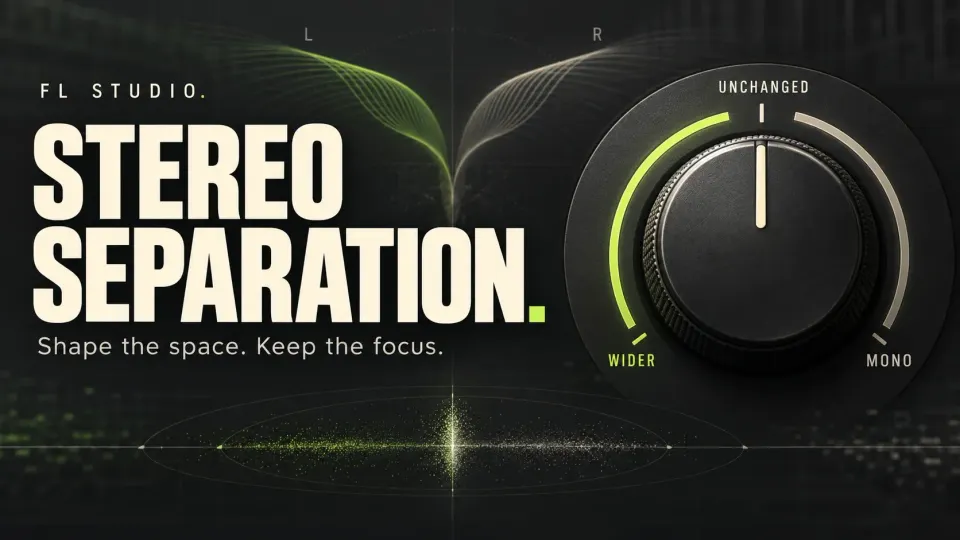
In FL Studio's Mixer, turn Stereo separation left to widen an existing stereo signal, or right to narrow it. Fully clockwise merges it to mono; the center position leaves this control inactive. If the left and right channels reaching the control are identical, there is no stereo difference for it to enhance.
That is the quick answer. The useful next question is whether the sound needs a different position, a different width, or new stereo information. A lead that feels small might need quieter surrounding pads, not another widener. Start with that musical decision before choosing a plugin.
Set stereo separation in eight steps
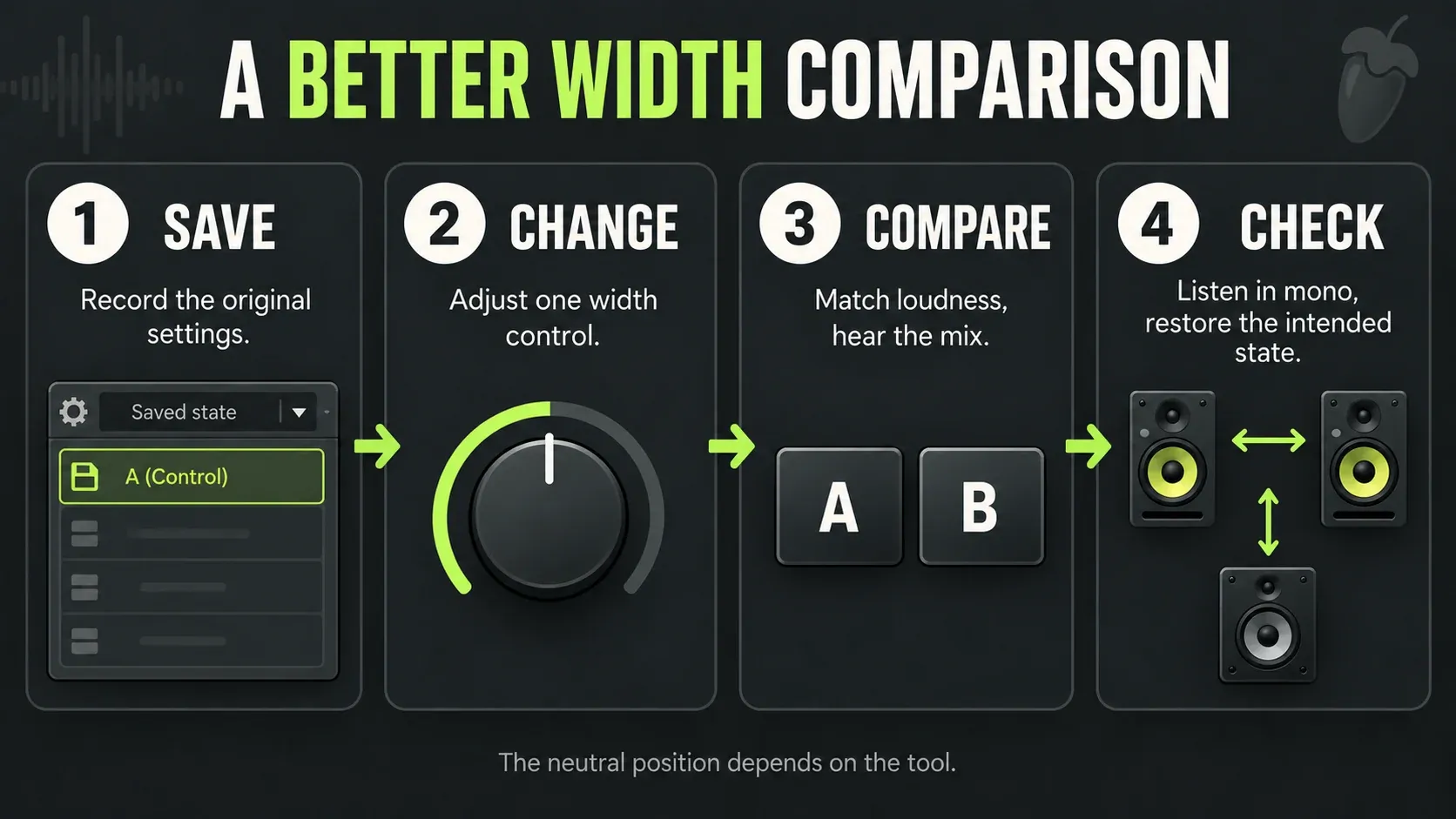
- Choose one sound and a repeatable passage. Loop a section where the part plays with the instruments around it. Decide what you want to hear differently: less spread, more space, or a clearer position.
- Save the original settings. Keep a project version and note the existing width and any automation. Mixer center is neutral for that control, but an existing mix may intentionally use another setting. Other plugins have their own defaults.
- Check the signal reaching the control. Listen to the source and its effects. A mono recording can become stereo through earlier processing; a two-channel file can still contain identical left and right audio.
- Choose the appropriate control. Use pan for position, Mixer Stereo separation for existing width, or a stereo-producing effect when you need new L/R differences. Change one control at a time.
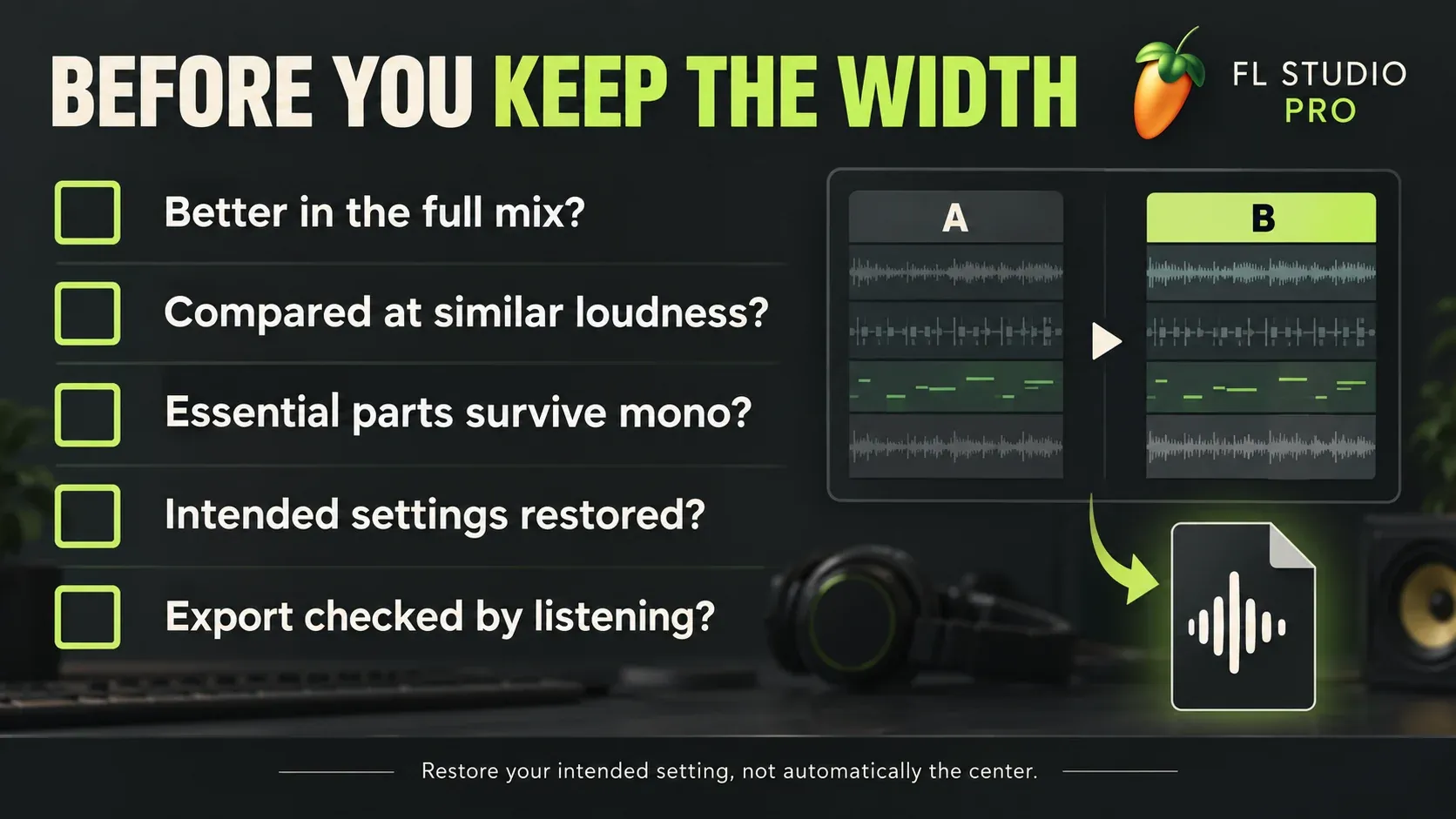
- Compare at similar perceived loudness. Compensate for a level change before choosing a winner. A louder result can seem more impressive even when the width itself is less useful.
- Judge the result in the full mix. Check the lead, low end and returns together. Keep the change only if it helps the part fit its surroundings; solo playback is useful for diagnosis, not the final decision.
- Check the mono fold-down. Note the Master's intended setting, then temporarily turn its Stereo separation fully clockwise. Listen for lost words, notes or body. This checks paths reaching the Master, not separate hardware-output paths that bypass it.
- Restore the intended state and verify the export. Return the temporary mono check to the setting you actually want, including any relevant automation. Render a comparison and listen to the file so a monitoring change does not become an accidental delivery choice.
What the Mixer knob changes—and what it cannot create
The Mixer manual's Stereo Separation section describes the directions explicitly. Left of center enhances existing stereo information. Right of center reduces it, reaching mono at the fully clockwise end. Do not confuse it with the pan knob. If the control is hidden, expand the Mixer and check its layout and additional track-property display options; the visible controls depend on those choices.
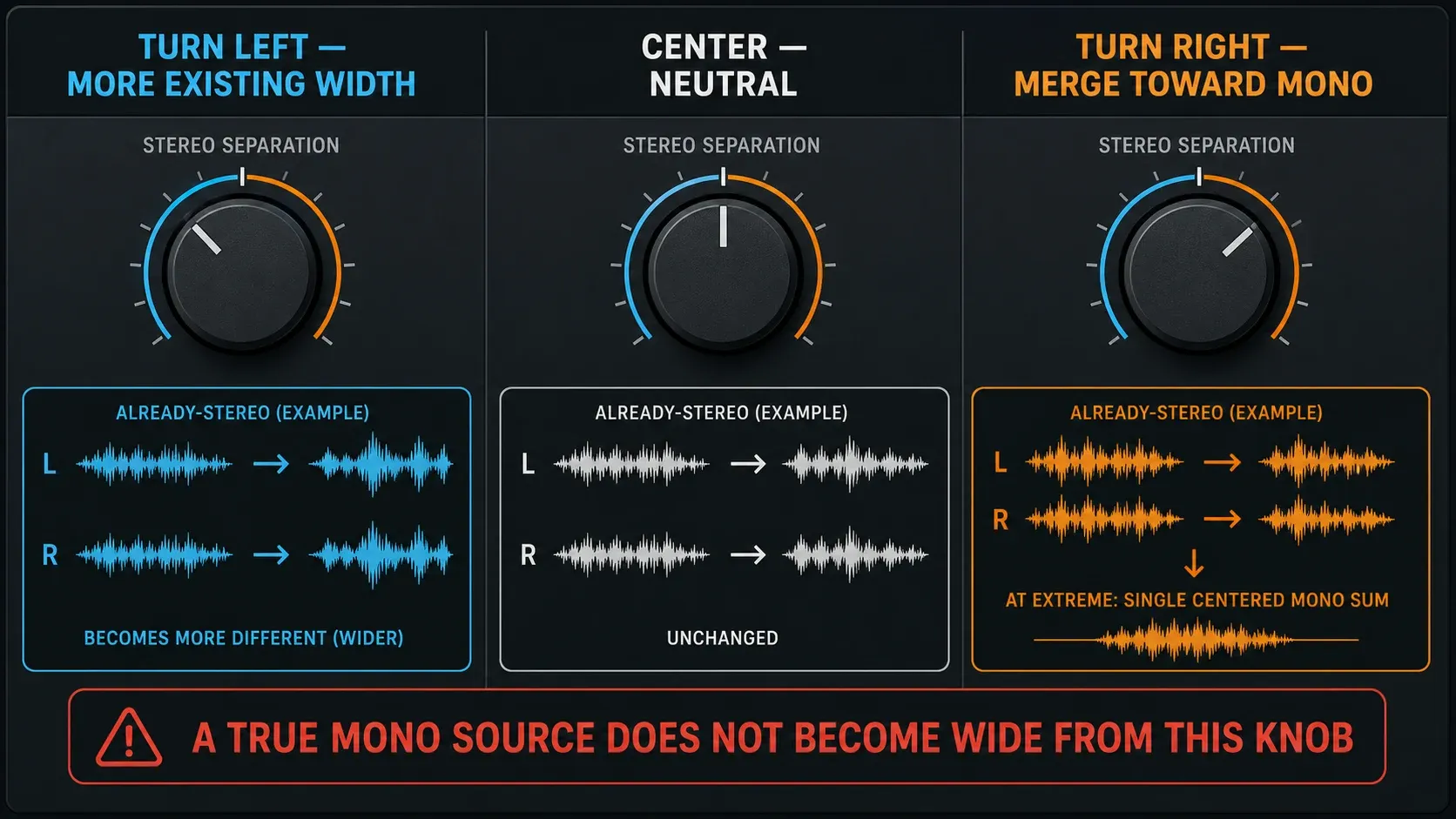
The word existing matters. This control works on the difference between left and right. A centered mono signal with identical channels has no width to turn up. Loading the same mono take twice and panning the copies apart does not create the performance differences of genuine double-tracking.
Check the current signal, not just the file label. FL Studio's effect-slot signal flow puts the FX stack before the built-in track properties. A stereo chorus or reverb before the knob can give a mono recording L/R differences. Conversely, earlier mono processing can remove differences from a stereo source. Our Mixer routing guide explains how to follow that path.
The short mid/side explanation
Using the convention in Image-Line's Stereo Shaper tutorial, Mid = (L + R) / 2 and Side = (L − R) / 2. Mid is the channel sum, not a separate collection containing only center-panned instruments. Side is their difference.
The Mixer's widening process uses phase-inverted cross-mixing to change that relationship. Shared center content can become less dominant relative to the stereo content. That is why a wider pad may also feel less solid, and why level compensation belongs in the comparison. You can change width without moving the pan knob, but that does not guarantee an unchanged perceived balance.
Pan, width or new stereo: choose the job first
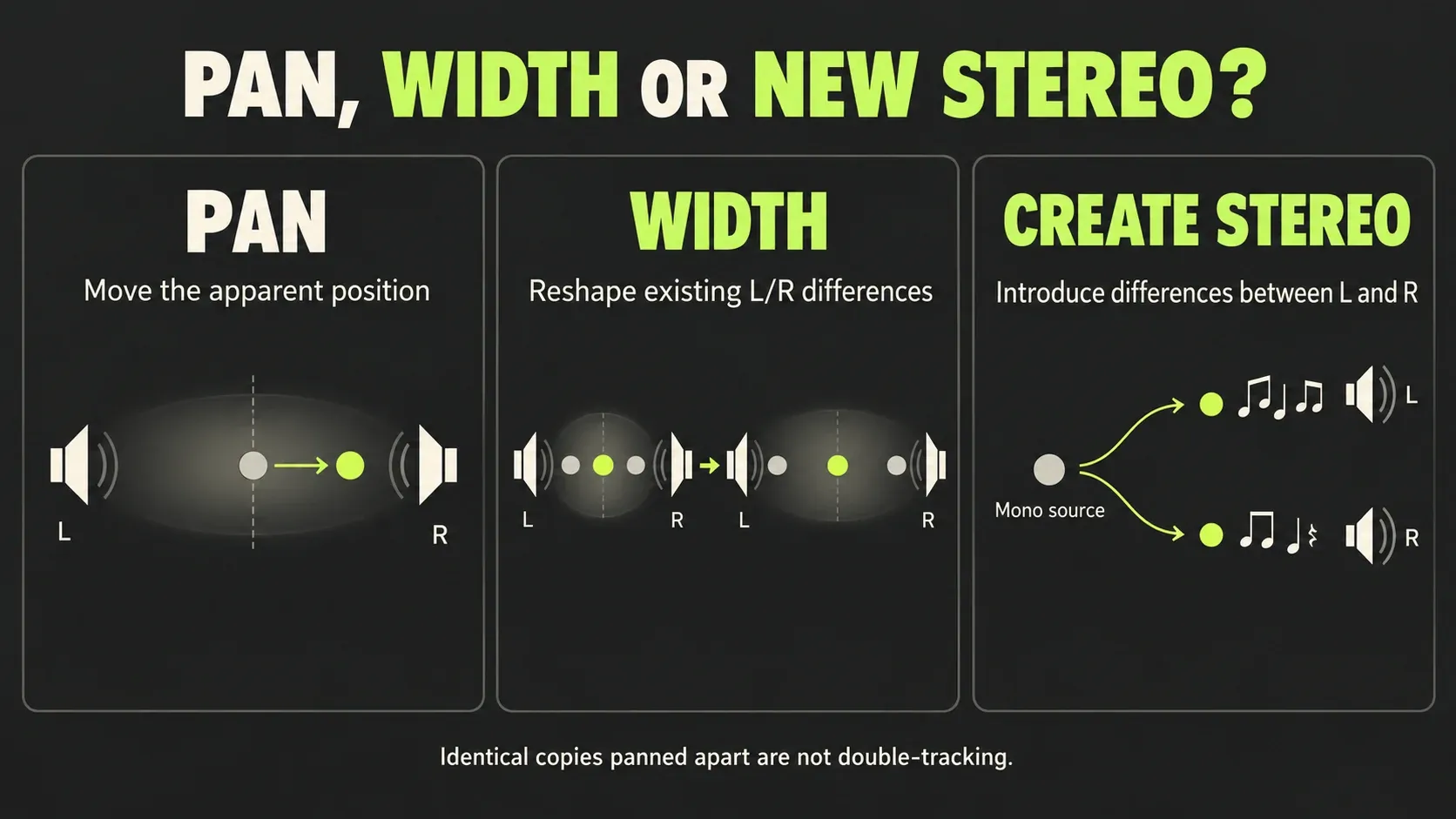
Pan changes position. Try it when two parts compete for the same apparent place. The FL Studio Mixer pan control cross-mixes the channels; it is not simply a balance control that turns down one side while leaving the other independent. Do not use it as a shortcut for extracting only the original left or right channel.
Width reshapes an existing stereo relationship. Try the Mixer control when a stereo pad is crowding the sides or a stereo recording needs a modestly broader presentation. Listen to what happens to its center as well as its edges.
Stereo creation introduces L/R differences. Stereo chorus, different performances panned apart, stereo reverb, or a suitable stereoizing processor can give a mono source a spread it did not have. Synth unison helps only when its settings produce actual differences between the channels; simply adding identical voices is not a stereo-width method.
For example, keep a lead vocal focused and try width on genuine doubles or its wet return. If the real problem is intelligibility, use the vocal mixing workflow first. Width cannot substitute for a sensible vocal level or an arrangement that leaves room for the words.
Choose the right stock width tool
| Your aim | Start with | Watch for |
|---|---|---|
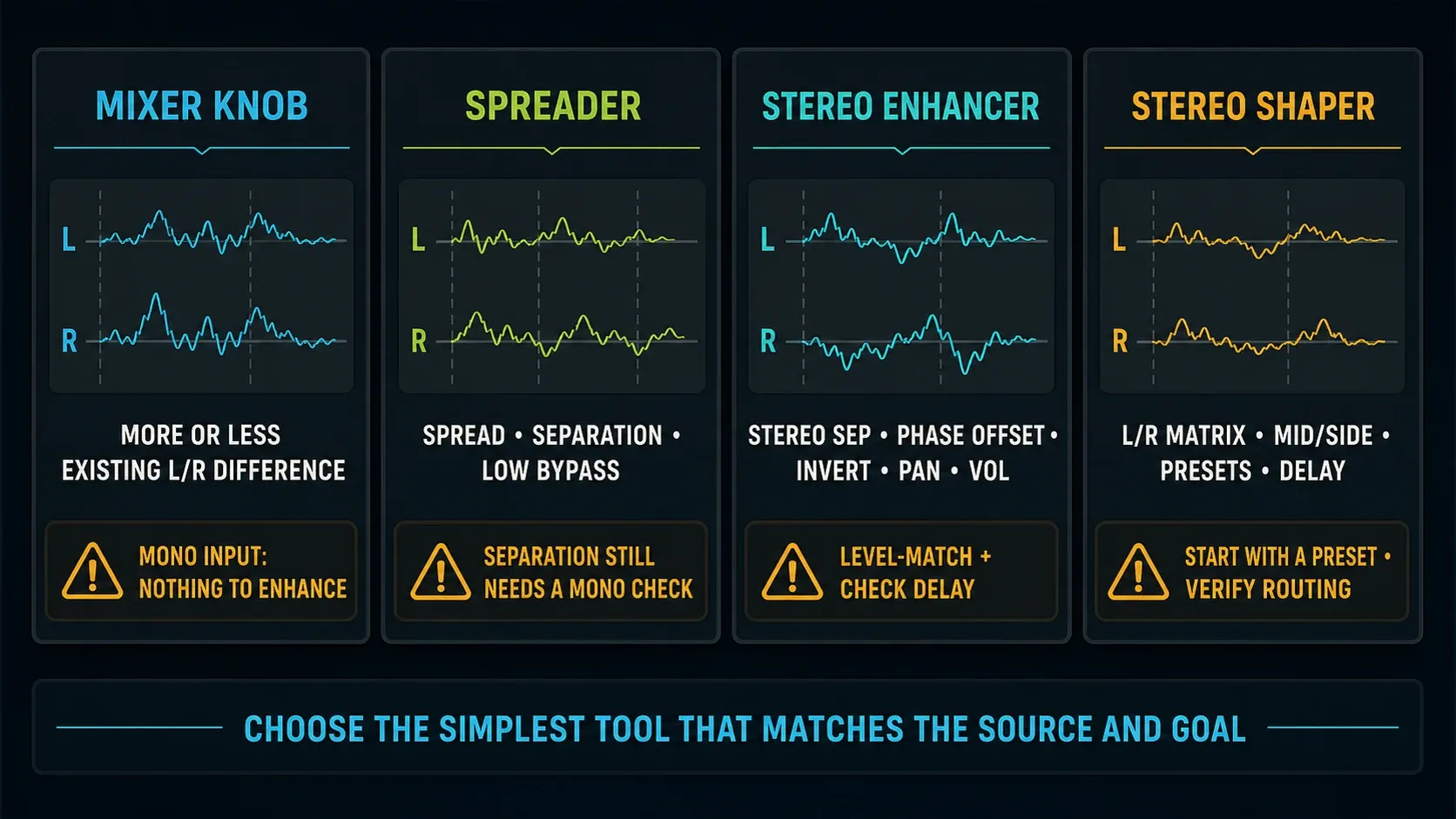
| Narrow or enhance an existing stereo track | Mixer Stereo separation | No new spread from identical L/R; changed level and center dominance |
| Add stereo spread with a dedicated processor | Spreader's Spread control | The separate Separation control has different behavior and directions |
| Adjust width plus a channel delay | Fruity Stereo Enhancer | Phase Offset can change balance and mono tone; merging is not complete |
| Choose, swap or cross-mix L/R; work with M/S | Fruity Stereo Shaper | A preset can change routing or polarity, not just width |
| Keep the dry part focused while adding space | A stereo reverb or delay return | Excess wet level, a wandering image or mono cancellation |
Spreader: two controls with different jobs
Start by separating Spread from Separation. Image-Line describes Spreader's Spread processing as mono-compatible. The same manual warns that increasing its separate Separation control can break mono compatibility. A plugin name is not a guarantee for every combination of its settings.
Spreader's Separation runs left toward merged mono and right toward separated. That is the opposite direction labeling from the Mixer's knob. Read the control you are actually adjusting instead of transferring a left/right habit between plugins.
Low Bypass excludes low frequencies from the spreading effect. Its separate Mono switch also collapses that bypassed low-frequency signal to mono. Choose the boundary by listening to the bass and the rest of the arrangement; there is no single cutoff that belongs on every song.
Stereo Enhancer: not an exact mono switch
Fruity Stereo Enhancer combines separation, Phase Offset, channel inversion, pan and output volume. Its separation knob follows the Mixer direction, but Image-Line specifies maximum separation and merging of around 98%. Use the Mixer's fully clockwise control when the check requires a complete mono fold, rather than treating Enhancer's end stop as identical.
Phase Offset delays one channel. It can produce a wider impression, but can also shift the apparent position or make the summed result hollow. The iZotope explanation of Haas-delay comb filtering is useful here: a delayed copy can cancel different frequency regions when combined with the original. A shorter delay is not automatically a safer one. Change the delay, wet contribution or technique according to the sound you hear.
Stereo Shaper: use a known preset
Stereo Shaper is useful when you need explicit channel selection, polarity inversion or M/S routing. Begin with the preset that matches the task and read what it outputs. Its Mid preset combines L and R; LR to LL keeps the original left channel in both outputs. Those are different operations, even though each can leave you hearing a mono signal.
Do not experiment with a subtractive matrix on the Master and assume every fader is a width control. If you already have the individual tracks, a focused source or return change is usually easier to judge than rebuilding the whole mix with an M/S matrix.
Give width a musical role
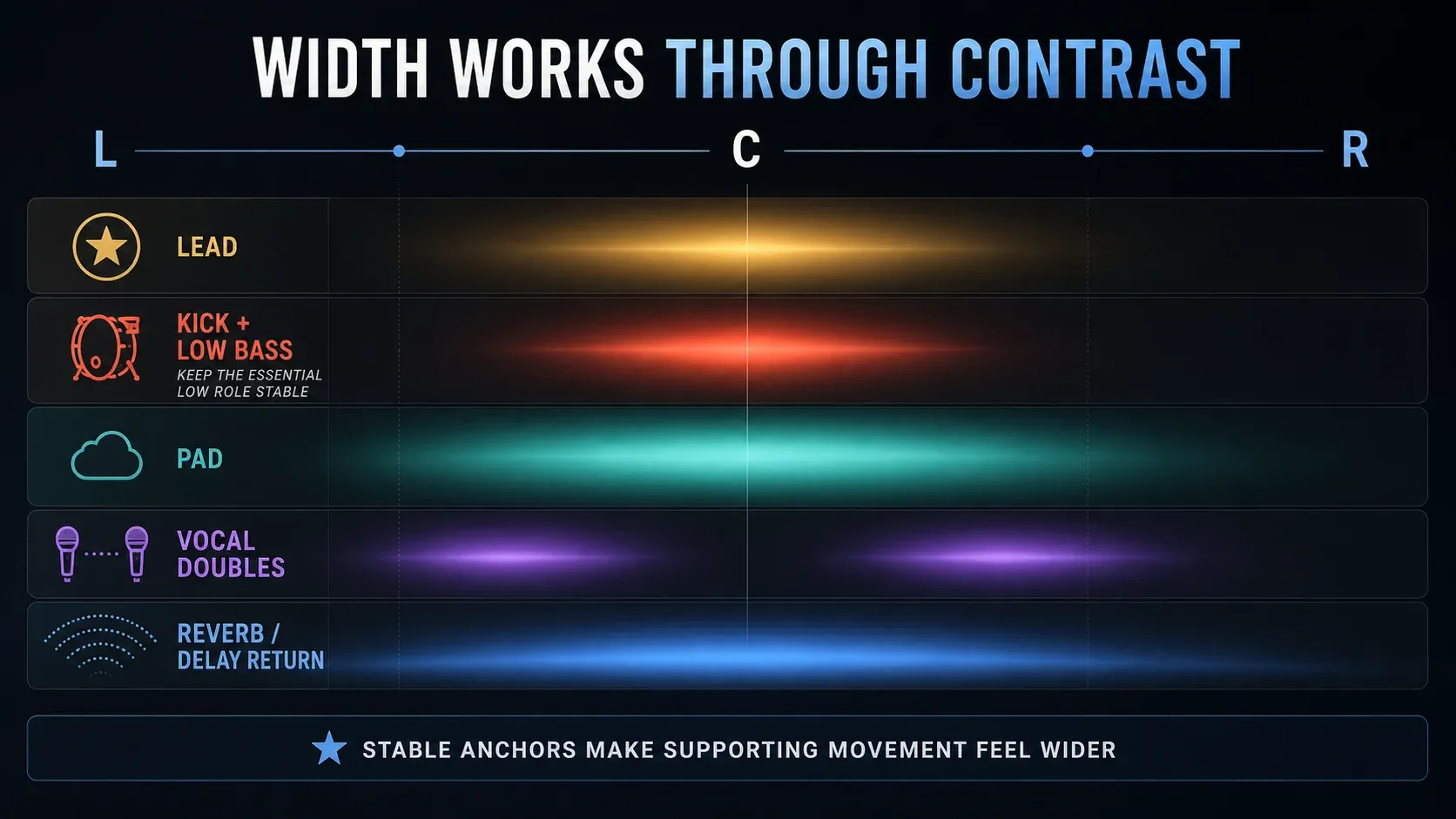
Pads and supporting synths: try narrowing one competing layer before widening another. A contrast between focused and broad sounds often makes the arrangement easier to read. For a moving bass texture, the Sytrus Reese bass tutorial deals with the patch itself; come back here to judge its stereo footprint in the song.
Lead vocals and doubles: keep the words easy to follow, then decide whether the doubles or ambience should carry the spread. These are starting choices, not rules that every lead must sit dead center.
Reverb and delay: changing a wet return's width lets you shape its space without applying that same width control directly to the dry source. Follow the reverb and delay send setup if the dry/wet routing is not clear yet.
Kick and bass: listen for a stable foundation in stereo and mono. Do not remove useful upper-frequency character just because a preset is called bass. The 808 mixing guide covers note length, kick overlap and audibility; a width adjustment will not repair every low-end problem.
Put the meter after the change
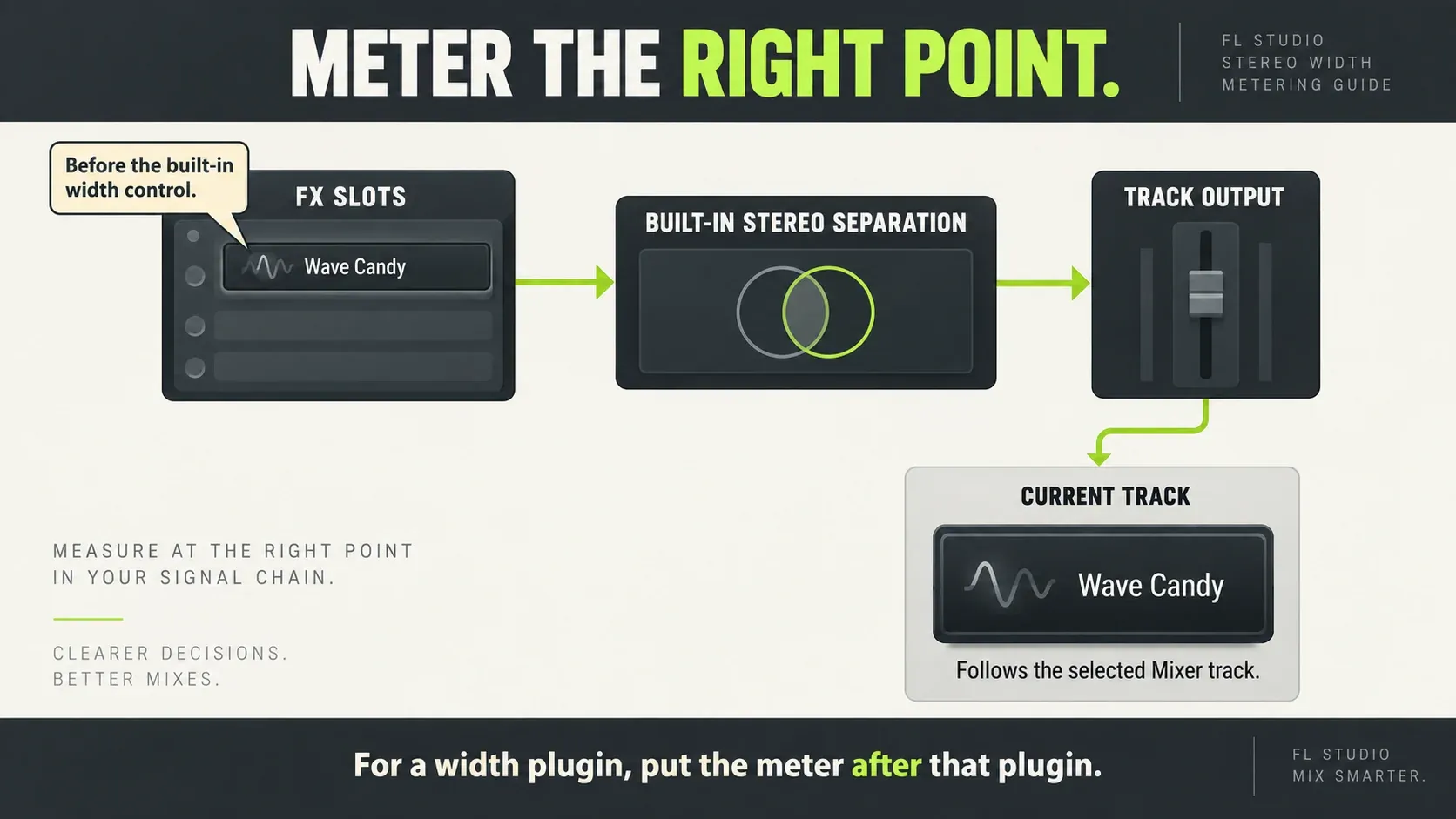
A vectorscope is only useful if you know which signal it receives. Wave Candy in an FX slot sees the audio at that slot, before the same track's built-in Stereo separation control. Moving the knob afterward can change what you hear without changing that scope. The same warning applies on the Master.
For a width plugin, put Wave Candy after that plugin to inspect its result at that point. For a built-in Mixer-width adjustment, the documented Current-track monitoring method is useful: load Wave Candy on Current (C), then select the Mixer track whose output you want to inspect. Current follows the selection, so reselect the Master when checking the mix. Keep unwanted processing off Current; its effects and EQ can affect the selected track.
With centered mono, Wave Candy's vectorscope produces a vertical line. Stereo differences make a wider or more complex figure. A strongly horizontal orientation is a reason to investigate phase relationships, not an automatic judgment that the entire mix fails. A broad picture also does not prove that the vocal survives a fold-down. Listen.
Spreader's pre/post display compares the input and output of Spreader itself. It cannot certify changes made later in the chain. If notes or words disappear when summed, use the mono compatibility troubleshooting guide to isolate the responsible layer instead of widening the remaining sound to compensate.
Be careful with Master-wide changes
A Master adjustment changes every part that reaches it together. If only a pad is too wide, changing that pad is more selective. Reserve a whole-mix decision for a whole-mix need, and compare against the saved baseline. The mastering guide puts that decision alongside the rest of the final chain.
Watch output level after widening. Use gain staging to keep the comparison fair and the clipping checks if distortion appears. For a longer loudness comparison, the LUFS measurement guide explains the meter readout; do not turn a loudness number into a target width setting.
For normal mix delivery, restore the intended Master state and choose the intended channel format before rendering. Image-Line's export documentation says ordinary mix export renders the Master path; Split mixer tracks uses different paths and bypasses the Master for individual stems. A Master-only width choice therefore is not a promise that every stem carries that processing.
Also distinguish Stereo from Mono (merged), Mono (left only) and Mono (right only). Saving two channels does not recreate stereo differences already removed upstream. Use the export settings guide for delivery options, then listen to the actual file. Audition it through a clean playback path: sending the rendered mix through the same widening chain again would apply that processing a second time.
The next useful move might be balance, EQ or a quieter return, not more width. The Mixing library gives you those routes. If the behavior still does not match the control you changed, use the FL Studio troubleshooting library to follow the symptom.
FL Studio stereo separation FAQ
Which direction makes the Mixer mono?
Turn the Mixer's Stereo separation fully clockwise. Center leaves that control inactive; turning left enhances existing stereo differences. This is not the direction convention of every width plugin.
Why does Stereo separation do nothing?
If identical left and right signals reach the Mixer control, there is no stereo difference to enhance. Check earlier effects, the actual routed track and any automation. A mono source with stereo effects may behave differently from its unprocessed file.
Is panning the same as stereo separation?
No. Panning changes apparent position; separation changes the relationship between the channels. FL Studio's Mixer pan also cross-mixes L and R, so it is not an independent channel-selection tool.
How can I make a mono sound wider?
Introduce useful L/R differences with stereo processing or different performances panned apart. Stereo chorus, reverb or a suitable stereoizing effect are options. Identical copies panned apart are not genuine double-tracking; compare the result in mono before keeping it.
Why does Spreader's Separation work the other way?
Its documented range runs from merged mono on the left to separated on the right, opposite to the Mixer knob. Spreader's Spread is a separate control; the manual warns that Separation can break mono compatibility.
Can Stereo Enhancer replace a complete mono check?
Not exactly. Image-Line specifies around 98% maximum merging for Stereo Enhancer. Use the Mixer's fully clockwise Stereo separation for a complete fold-down, and restore the intended setting afterward.
Why does Wave Candy stay unchanged when I turn the knob?
Wave Candy in the same track's FX stack is before its built-in Stereo separation. Use Current to monitor the selected track's output, or place the meter after a width plugin when checking that plugin. Confirm which track is selected.
Should every bass sound be mono?
No universal rule fits every bass patch. Check whether the low foundation stays useful in mono and whether the wider upper content helps the arrangement. Spreader's Low Bypass and separate Mono switch offer different ways to manage the low region.
Should I widen the Master?
Only if the whole mix benefits. A source or return adjustment is more selective when one part is the problem. Compare at similar loudness, check mono and remember that paths bypassing the Master do not receive its width adjustment.
Why is the exported stereo file narrow or mono?
Check the saved width settings, automation and export channel format. A Stereo file can still contain identical channels if the signal was merged before rendering. Ordinary Master export and Split mixer tracks also use different paths. Audition the delivered file through a clean playback path, without applying the widening chain a second time.