FL Studio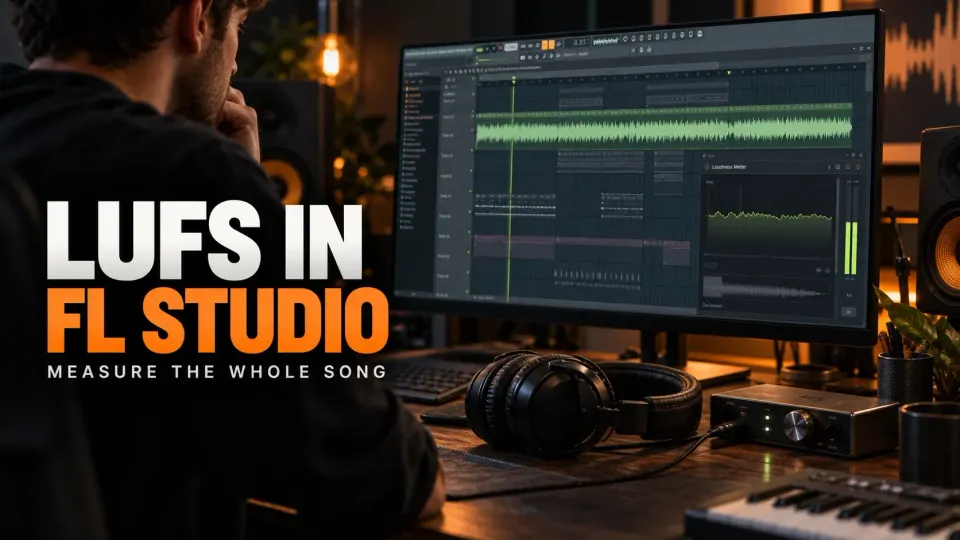
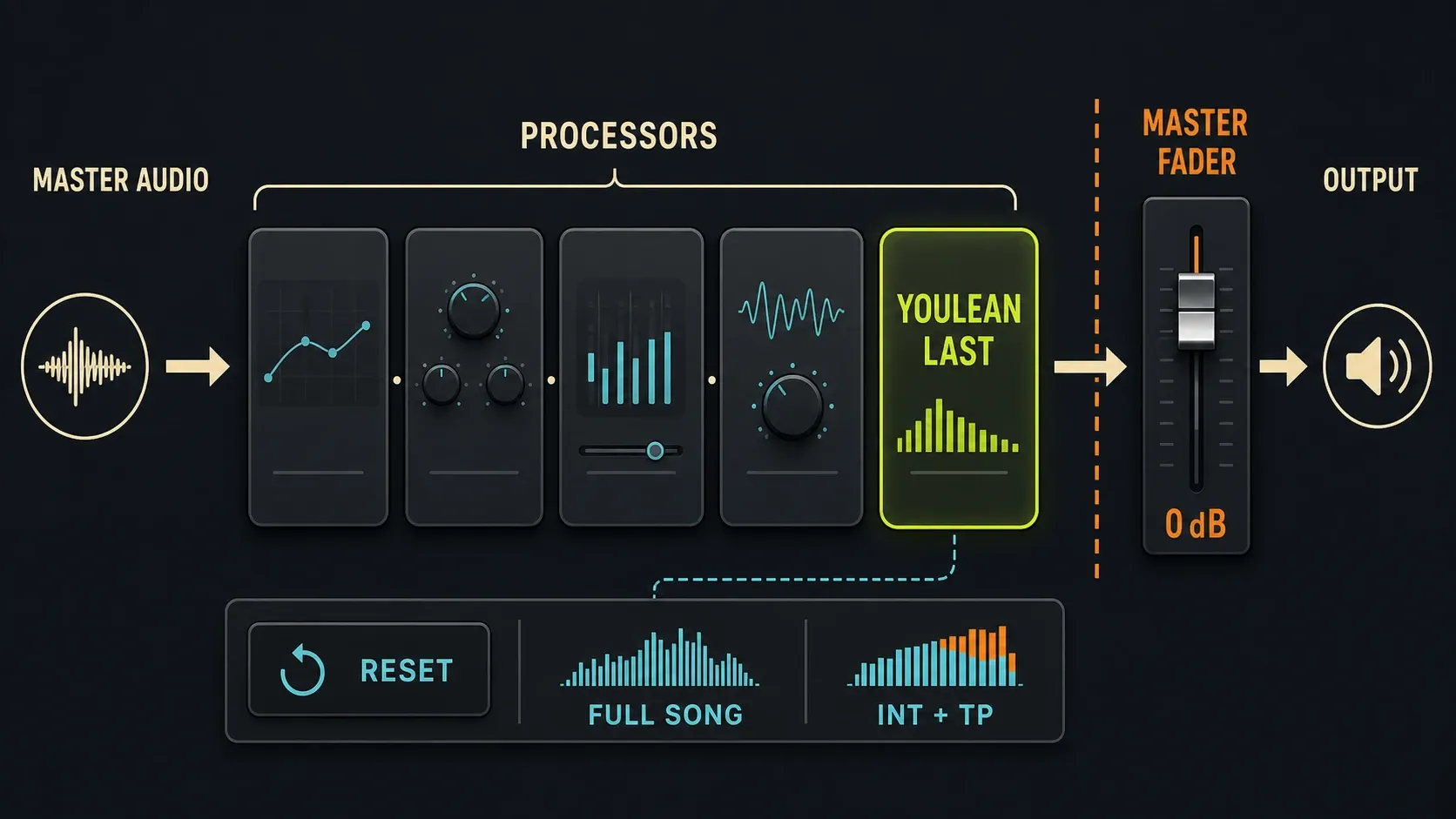
To measure LUFS in FL Studio without changing your master, put Youlean Loudness Meter Free last in the Master effect slots, clear its measurements and play the whole song once. Read Integrated LUFS and maximum true peak together. First check what happens after that slot: the Master fader and built-in Mixer controls can still change the signal you export.
Want a built-in option? Emphasizer measures Integrated LUFS in every current FL Studio edition; Emphasis adds Short-term and Momentary readings. Both are audio processors, so preserve the sound you intend to keep when using their meters. Below, choose a measurement route and check it against the finished file.
Using FL Studio Trial? Finish the renders you need before saving or leaving the current session. Image-Line's Trial limitations allow saving, but reopening those projects requires purchasing FL Studio. Do not leave needed work just to open an empty analysis project.
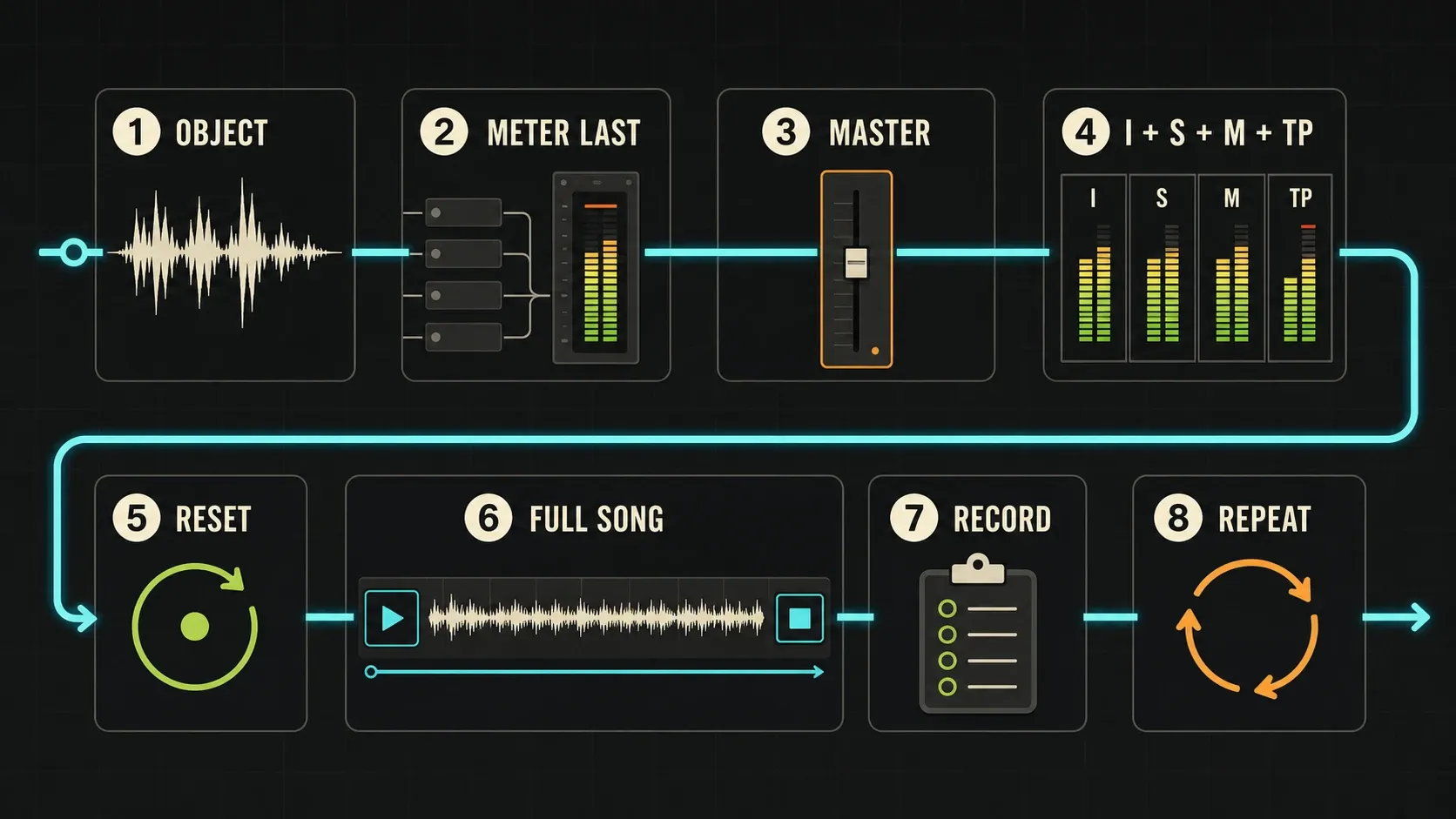
Measure LUFS in FL Studio in eight steps
- Label and protect the version. Decide whether you are measuring a premaster, finished master or exported file. In Trial, finish needed renders before saving or leaving the session; otherwise save a copy before changing the signal path.
- Put Youlean last. Load it after the limiter and other Master-slot processors, so it measures their combined output without adding mastering processing.
- Check the downstream controls. The documented last-slot setup uses a 0 dB Master fader. Built-in Master EQ, pan and stereo separation must also be neutral for a straightforward slot-to-output comparison. If those settings are intentional, preserve them and verify the rendered file separately.
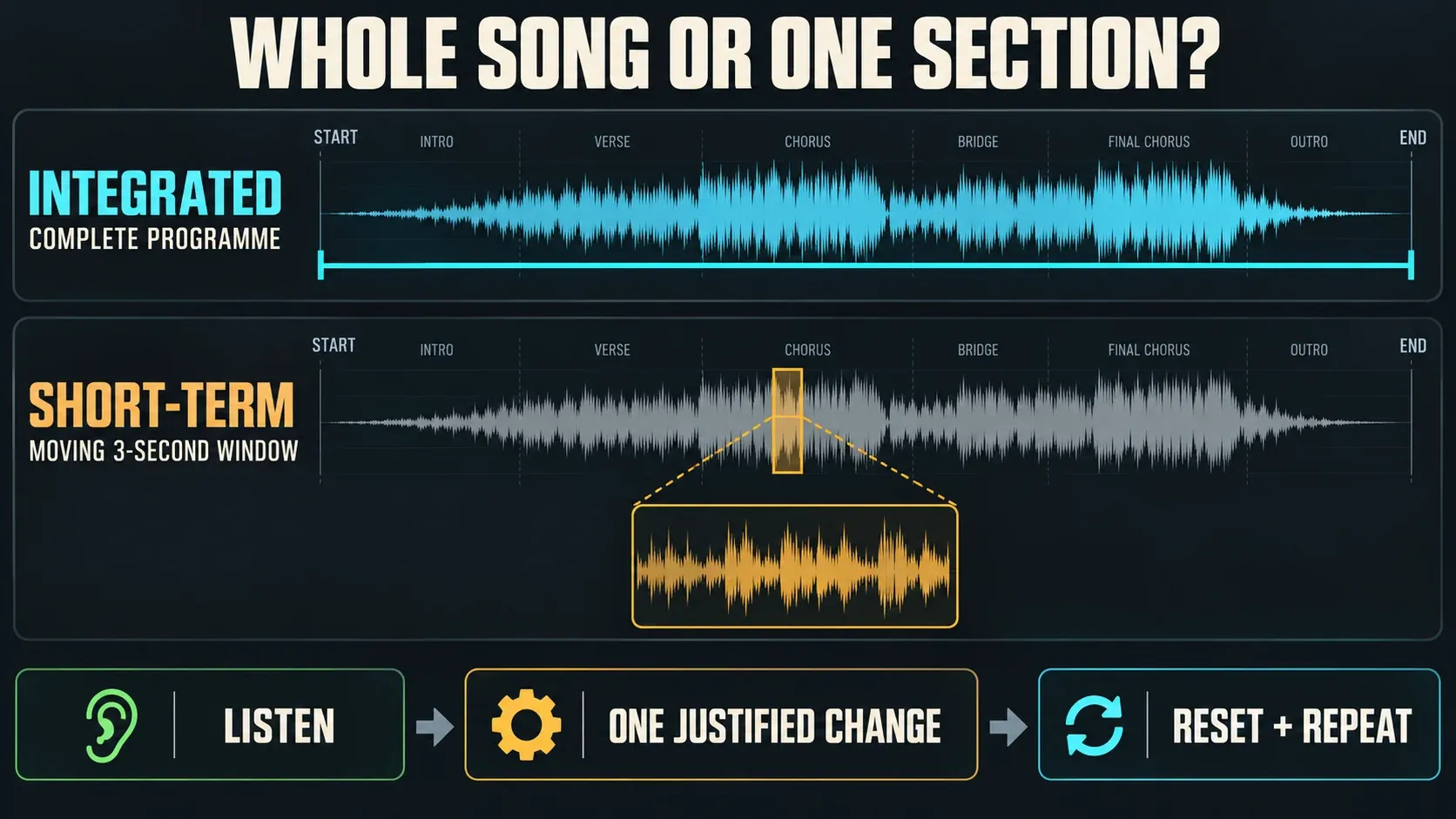
- Choose the readings. Use Integrated (INT) for the complete song, Short-term and Momentary for movement, and maximum true peak (TP) for peak headroom. Match the meter's channel configuration to the signal.
- Clear the previous pass. Reset all measurements, make sure measurement is not paused and put the playhead before the first sound.
- Play the complete arrangement. Use Song playback, include the intended ending and effects tail, and avoid looping, seeking or stopping during the pass.
- Write down the result. Record the version, measured range, Integrated LUFS and maximum dBTP. Note any verse or chorus whose Short-term reading needs a closer listen.
- Check the delivery. After any justified correction, reset and repeat. Analyze the exported file on a clean playback path, without processing the already-mastered audio again.
What LUFS measures—and what it cannot tell you
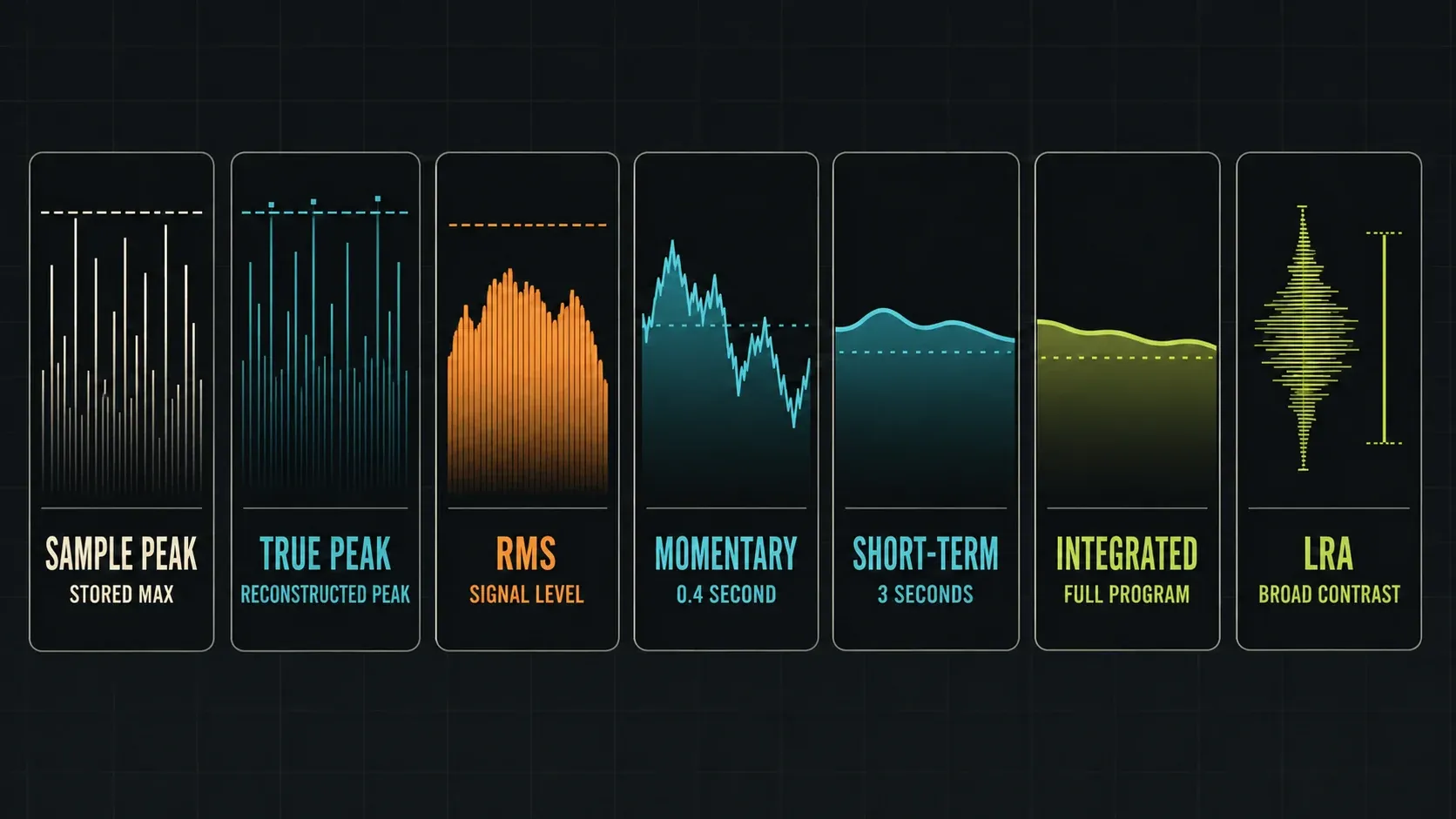
LUFS is a frequency-weighted measure of loudness over time, not the highest peak in a waveform. Integrated measurement uses gating to keep sufficiently quiet material from dominating the result. Momentary and Short-term use shorter moving windows; do not assume every readout applies the same gating. The EBU metering overview distinguishes the whole-programme reading from the 400-millisecond and three-second windows.
A sample-peak meter reads digital sample amplitudes. True peak estimates the reconstructed maximum, which can fall between those samples. RMS means root mean square: it measures signal amplitude statistically, without being interchangeable with the standardized loudness measurement. Youlean's measurement definitions also confirm that LUFS and LKFS are equivalent units.
None of these numbers tells you whether the vocal is buried or the snare hurts. Two songs with similar Integrated LUFS can still feel different because their spectrum, transients and arrangement differ. If the audio is already distorted, start with finding the clipping stage; lowering a loudness number cannot undo damage already recorded into a file.
Read Integrated, Short-term, Momentary and LRA correctly
| Reading | Time or scope | Useful question |
|---|---|---|
| Integrated / INT / LUFS-I | The programme measured since reset, with gating | How loud is this complete version? |
| Short-term / S | Moving three-second window | Does this chorus jump out from the verse? |
| Momentary / M | Moving 0.4-second window | Where are the fast loudness changes? |
| LRA, in LU | Statistical spread of gated Short-term loudness | How broad is the programme's loudness variation? |
| Maximum true peak, in dBTP | Highest reconstructed peak estimated during the pass | Does the file meet its peak-headroom requirement? |
A chorus-only Integrated result is valid for that chorus, not for the whole track. Label it accordingly. LRA is not a quality score or simply the loudest reading minus the quietest: EBU's Loudness Range specification uses a gated statistical distribution. Do not automatically equate a plugin's generic “Range” field with EBU LRA.
Choose the right FL Studio loudness meter
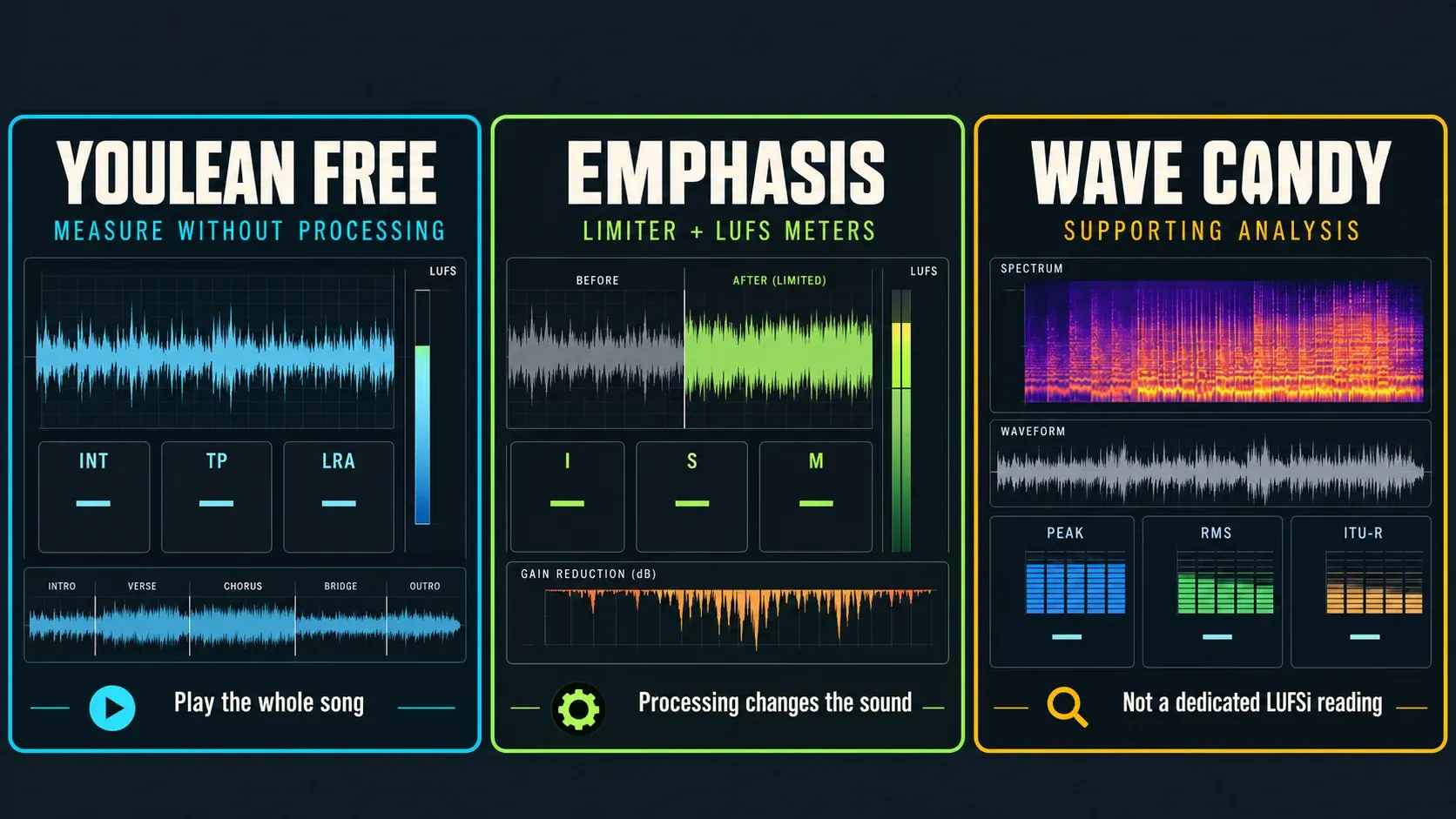
Youlean Free: the direct measurement route
The current Youlean Free feature list includes Integrated, TP and LRA readouts and says the free edition does not expire. You do not need the paid edition to measure a song during playback. Drag-and-drop file analysis, however, is listed under Pro; a free real-time workflow is not the same as instant offline analysis.
If the plugin is missing from FL Studio, follow the plugin installation and scan steps. For other useful tools alongside it, see the free-plugin starter selection. Youlean measures the signal; inserting it does not automatically normalize your song.
Emphasizer: Integrated LUFS in every edition
The current edition comparison includes Emphasizer in every edition, including Fruity. Its Integrated LUFS meter measures the full length analyzed since reset. Double-click that meter to clear it before a fresh playthrough; the cogwheel menu lets you disable metering, so check it is enabled. Note the finished result before clearing it for the next pass. Do not assume Emphasis's Stop-reset behavior applies to Emphasizer.
Emphasizer is still a limiter and clipping processor. Keep its intended processing state unchanged while measuring; setting its Emphasis control to zero bypasses the clipping stage but leaves the limiter as a safety stage. For a separate measurement without adding that processing, use Youlean. Emphasizer's documented peak/RMS displays are not a substitute for a dedicated maximum-true-peak reading.
Emphasis: LUFS inside a mastering processor
The Emphasis manual documents I, S and M loudness readings, output peak/RMS meters and a true-peak limiting option. That limiting option is not evidence of a separate maximum-dBTP readout. Use a dedicated true-peak meter downstream when you need that delivery figure.
The current edition comparison includes Emphasis in All Plugins Edition, while the Image-Line shop also offers it individually. Check your actual licence; appearing in the plugin menu is not proof that it is unlocked. Our edition guide explains the broader differences. You do not need to upgrade just to measure LUFS with Youlean Free.
Wave Candy: useful supporting analysis
Wave Candy offers Peak, PPM, RMS, VU, Leq(A) and ITU-R BS.1770 meter modes. Its manual describes the ITU-R option as frequency-weighted averaging over a long window, not a dedicated full-song Integrated/Short-term/Momentary suite. Do not label that number “LUFSi” or invent a fixed conversion to Youlean.
Keep it for its other analysis jobs, covered in the stock-plugin guide. A built-in meter is useful only if it measures the thing you need.
Measure with Emphasis without accidentally remastering
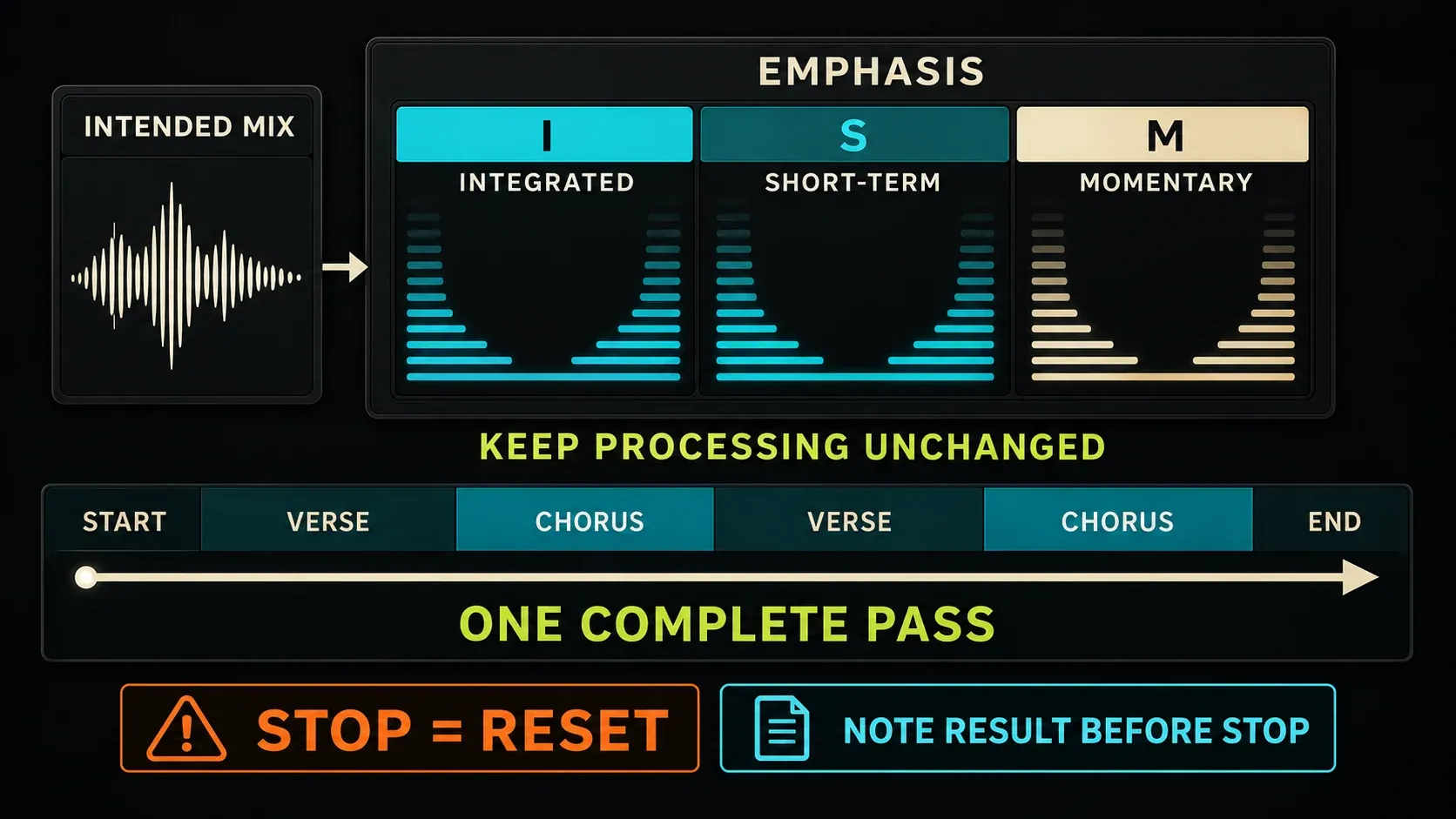
If Emphasis is already in your intended chain, save that processing state before measuring. Input, Hardness and the limiter settings can change the audio, so do not insert or adjust it merely to get a different number. Select I for the whole-song result, using S and M to investigate movement.
The manual says pressing Stop resets the LUFS measurements. Reset before starting, play the full song without interruption and note the result after the musical ending but before pressing Stop. If playback has already stopped and cleared it, run a fresh pass rather than guessing. Its Range field is described as the difference between highest and lowest LUFS; do not transcribe that as EBU LRA.
To check everything after Emphasis, including later processors, put Youlean after the final slot processor or measure the exported file. The mastering walkthrough covers the processing decisions; this pass is about measuring what you actually intend to deliver.
Place Youlean correctly and avoid stale measurements
Youlean's placement instructions specify the last Master slot and a 0 dB Master fader. Image-Line's Mixer signal flow explains why “last plugin” is not necessarily “last change”: built-in EQ, phase, stereo separation, volume and pan follow the slots. Also inspect Current (C), which follows the selected track; it is not a fixed Master measurement point.
Do not reset a carefully balanced Master fader to 0 dB and assume the mix is unchanged. Work in a saved copy, or leave the mix intact and measure its export. For a straightforward in-session comparison, use neutral downstream controls and keep intentional level changes before the meter.
The Youlean interface guide distinguishes clearing all measurements from pausing them. It also documents host-playback auto reset, which is unavailable in Continuous histogram mode. A manual clear before each full pass is easy to verify. Check that numbers are accumulating and that the channel configuration matches the file; a paused meter can look convincing while displaying yesterday's result.
Use the numbers to find a problem, then listen
If the full-song reading is unexpected, compare the same passage with a suitable reference at similar playback loudness. Is the difference a simple level offset, a heavy sub, a sparse arrangement or sustained limiting? Use gain staging to trace level changes and Fruity Limiter's compression controls when dynamics processing is actually the issue.
Make one change you can explain, then compare again at matched loudness. A higher number is not proof of a clearer mix. Record Integrated and maximum true peak for the entire pass; use Short-term to locate a section, not to replace the song result.
Spotify's -14 LUFS: recommendation, not a universal rule
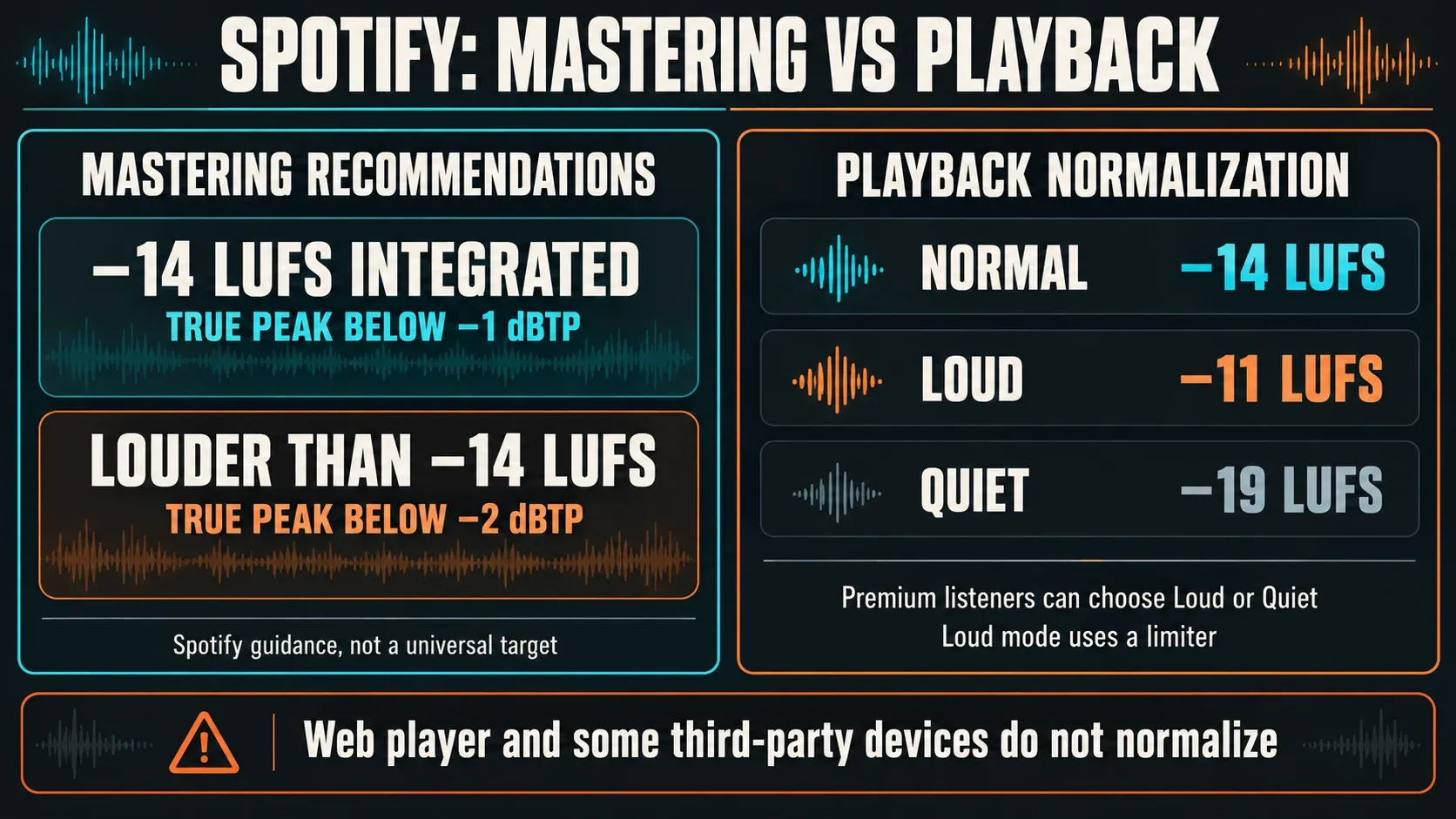
Spotify's current guidance recommends mastering at -14 LUFS Integrated, with true peak below -1 dBTP. If you master louder than -14 LUFS, it recommends keeping true peak below -2 dBTP. These are Spotify's recommendations, not one required artistic target for every song and destination.
With normalization enabled, Normal playback uses -14 LUFS. Premium listeners can also choose Loud (-11) or Quiet (-19); Loud uses a limiter. Quieter tracks may be raised only as far as available peak headroom allows. Album playback preserves relative track levels through album normalization, while shuffle and playlists can use individual-track adjustment.
Spotify also says its web player and some third-party devices do not normalize. Do not treat one playback comparison as a laboratory measurement of your master. Normalization cannot repair distortion already in the file, and the -14 figure is not a reason to flatten a song that needs musical contrast.
Measure the exported WAV without processing it twice
Render the exact intended range, including the desired tail, using the song-export steps. Confirm the intended Master processing is included. Image-Line's export manual distinguishes normal Master exports from split Mixer-track files, which bypass the Master. For format decisions, use the sample-rate, bit-depth and codec guide.
With Youlean Free, play the file in real time through a clean analysis path. A separate empty project is useful, but check the template: remove or bypass any default limiter, use unity playback gain, keep pitch and duration unchanged, neutralize built-in Mixer processing and leave only the meter in the analysis chain. Do not route the finished master through its original mastering chain again. Pro's drag-and-drop analysis is an alternative, not a required purchase.
If project and file readings disagree, compare the same channel configuration, range, reset state and processing path first. Then check export-specific plugin quality or oversampling settings. Extra silence does not necessarily lower Integrated LUFS because of gating; a missing musical section or tail is a different matter. Analyze a lossy deliverable too when that is what you will send, because encoding can change peaks.
Before you approve the measurement
- The version and full playback range are recorded.
- The meter is running, correctly configured and cleared of older passes.
- Any processing after its slot is accounted for.
- Integrated LUFS and maximum dBTP come from the same complete pass.
- Short-term and Momentary help diagnose sections; LRA is not a quality score.
- The actual delivery file has been checked on a clean path.
If the measurement is sound but the balance still needs work, continue through the mixing and mastering guides. If playback or export is behaving unexpectedly, use the troubleshooting routes to isolate that fault before changing the master.
FL Studio LUFS and loudness FAQ
Does FL Studio have a built-in LUFS meter?
Yes. Emphasizer has an Integrated LUFS meter and is included in every current edition, including Fruity. Emphasis adds Short-term and Momentary readings and is included in All Plugins Edition or sold separately. Both process audio; use Youlean Free for a dedicated measurement route without adding limiting or clipping.
Can Wave Candy measure Integrated LUFS?
Its manual documents an ITU-R BS.1770 weighted averaging mode, not a dedicated whole-song Integrated LUFS workflow. Do not substitute that number for a LUFSi delivery measurement.
Where should a LUFS meter go in FL Studio?
Put Youlean last in the Master effect slots. Its documented setup uses a 0 dB Master fader; built-in Master processing after the slots must also be accounted for. If those settings are intentional, measure the exported file on a clean path.
How long should I measure Integrated LUFS?
Measure the complete intended programme once, including its musical ending and tail. Reset first and avoid loops or seeking. A chorus-only pass describes the chorus, not the whole track.
What is the difference between LUFS and true peak?
LUFS describes loudness over time. True peak estimates the reconstructed maximum, potentially between digital samples. Read Integrated LUFS and maximum dBTP together because a suitable loudness result does not guarantee sufficient peak headroom.
Should every song be mastered to -14 LUFS?
No. Spotify recommends -14 LUFS Integrated and uses that level for Normal playback normalization, but it is not a universal artistic target. Follow the actual destination's guidance while preserving the balance and dynamics the music needs.
Why does Emphasis lose the LUFS result when I stop?
Its manual says Stop resets LUFS measurements. Note the complete-song result after the musical ending but before pressing Stop. If it has reset, measure again. Use a dedicated downstream meter for maximum true peak.
Can Youlean Free analyze an exported WAV?
Yes, by measuring it during real-time playback on a clean, unity-gain path. Do not apply the mastering chain a second time. The product's drag-and-drop file analysis is a Pro feature.
Why does Integrated LUFS change when I loop the chorus?
The result covers what the meter has accumulated since reset. Repeating one section changes its contribution, so that pass no longer represents one normal playthrough of the song.
Why is exported loudness different from the project reading?
Check the Master fader and built-in processing after the meter, export range, included Master effects, meter reset and channel configuration. Also check export-specific plugin settings and whether the rendered file was normalized, stretched or processed again during analysis.