FL Studio
To tune an 808 in FL Studio, identify the note in its steady bass body, assign that note to the Sampler root key, and check the result before writing the bass line. You can find the pitch with Tuner alone; Edison is another option if you want to inspect pitch regions. The part that trips people up is the starting point: hear the sample at its original pitch, not an arbitrary Piano Roll note that has already transposed it.
This guide is for a pitched 808 one-shot in desktop FL Studio. It separates three checks: the right note name, the intended octave, and any small sharp/flat offset. A sample that keeps sliding throughout its body may not have one reliable root.
Tune an 808 in eight steps
- Protect the original. Save a project copy and load the untouched one-shot into a separate test Sampler Channel.
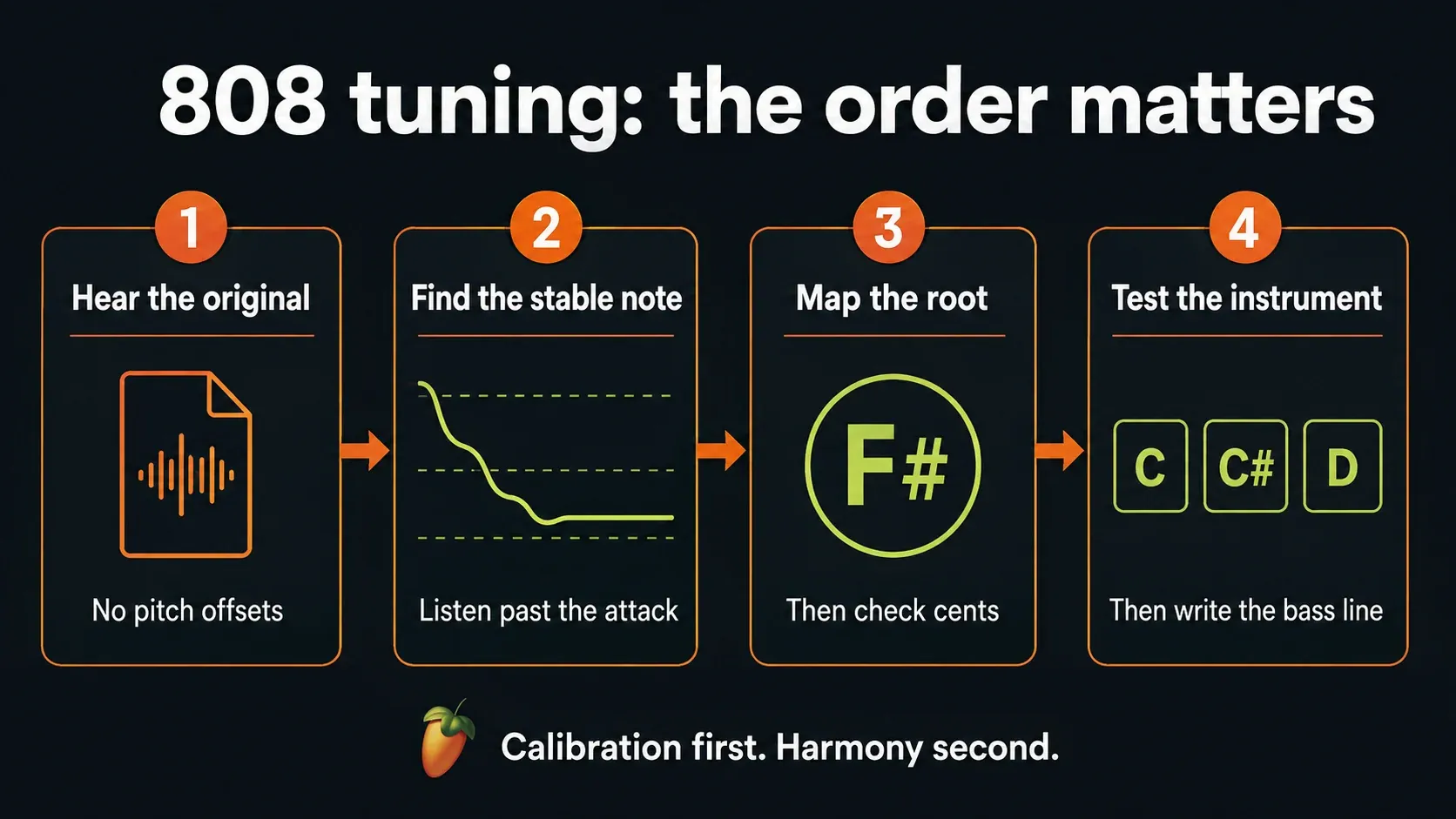
- Establish original-pitch playback. Remove pitch-changing offsets on the test Channel and play its currently assigned root key, not an arbitrary note.
- Find the steady body. Read the settled pitch with Tuner, or inspect the original file with Edison's Detect pitch regions command if available.
- Map the detected note. Right-click the matching note class on the Sampler preview keyboard, choosing its keyboard octave deliberately.
- Check the name and register. Play a known Piano Roll note and compare the sounding note and octave with a reference instrument.
- Correct a small offset. If the intended note is consistently sharp or flat, adjust Fine slightly and listen again.
- Test neighboring notes. Play C, C-sharp and D separately, then check an octave; confirm that the steady body follows the intended pitches.
- Write and check the bass line. Choose notes that support the chords, then reintroduce processing and listen in the song.
Do not move the root, Fine and bass notes simultaneously. You need to know which change solved the problem. In the Beatmaking & Drums library, this is the tuning step between choosing a usable sound and arranging its part.
Start with the original sample, not the finished bass bus
Keep the original audio file untouched. Use a separate test Channel so changing its tuning does not unexpectedly change an instrument already used elsewhere in the project. If you use the standard trial, remember its saved-project reopening restriction: saving a copy does not let you reopen it before purchase and the appropriate plugin licensing.
Drag the one-shot into the Channel Rack. The Sampler documentation distinguishes this single-sample instrument from dropping audio onto the Playlist as an Audio Clip. If you are still finding your way around instrument Channels, use the Channel Rack walkthrough.
For the test, use neutral pitch controls, no pitch envelope or modulation, and no pitch-changing Mixer effects. Check that time stretching has not already changed the sound; a plain one-shot baseline uses Time set to (none) and Resample mode. Keep the monitoring level comfortable. Do not reset the whole song to establish this baseline.
Now locate the Channel's current root key and play that key. With other pitch offsets neutral, this is how you hear the file's original pitch. Playing C5 only does that when C5 is the current root. Embedded sample information or previous edits may have changed the assignment. For a controlled test you can explicitly assign C5 first, then play C5; that is a temporary reference position, not a finding that the sample was recorded in C.
Find the 808 note with Tuner, without Edison
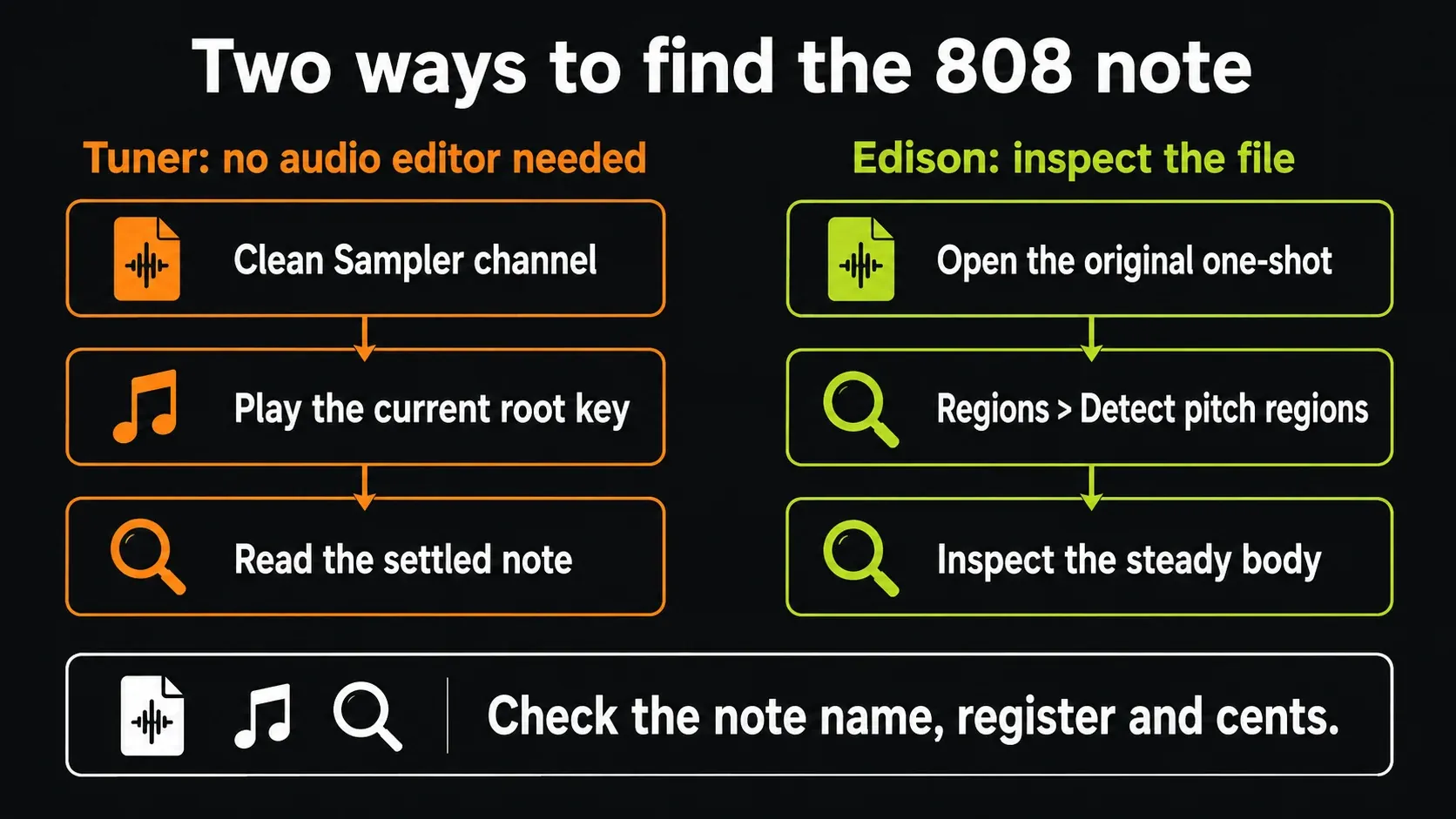
Route the test Channel to its own Mixer Track and insert Tuner there. Let only this 808 reach the detector. Image-Line lists Tuner in every FL Studio edition, so you do not need a separate audio editor for this route.
In Tuner's controls, use a 440 Hz reference unless the music intentionally uses another tuning reference. Start with faster Reactivity for a short sample and adjust if the display chases the attack. Bass extends detection below 40 Hz, but needs roughly 100 ms at minimum. Very short low-pitched sounds may end before a useful reading forms. Tuner reports pitch; it does not retune the audio.
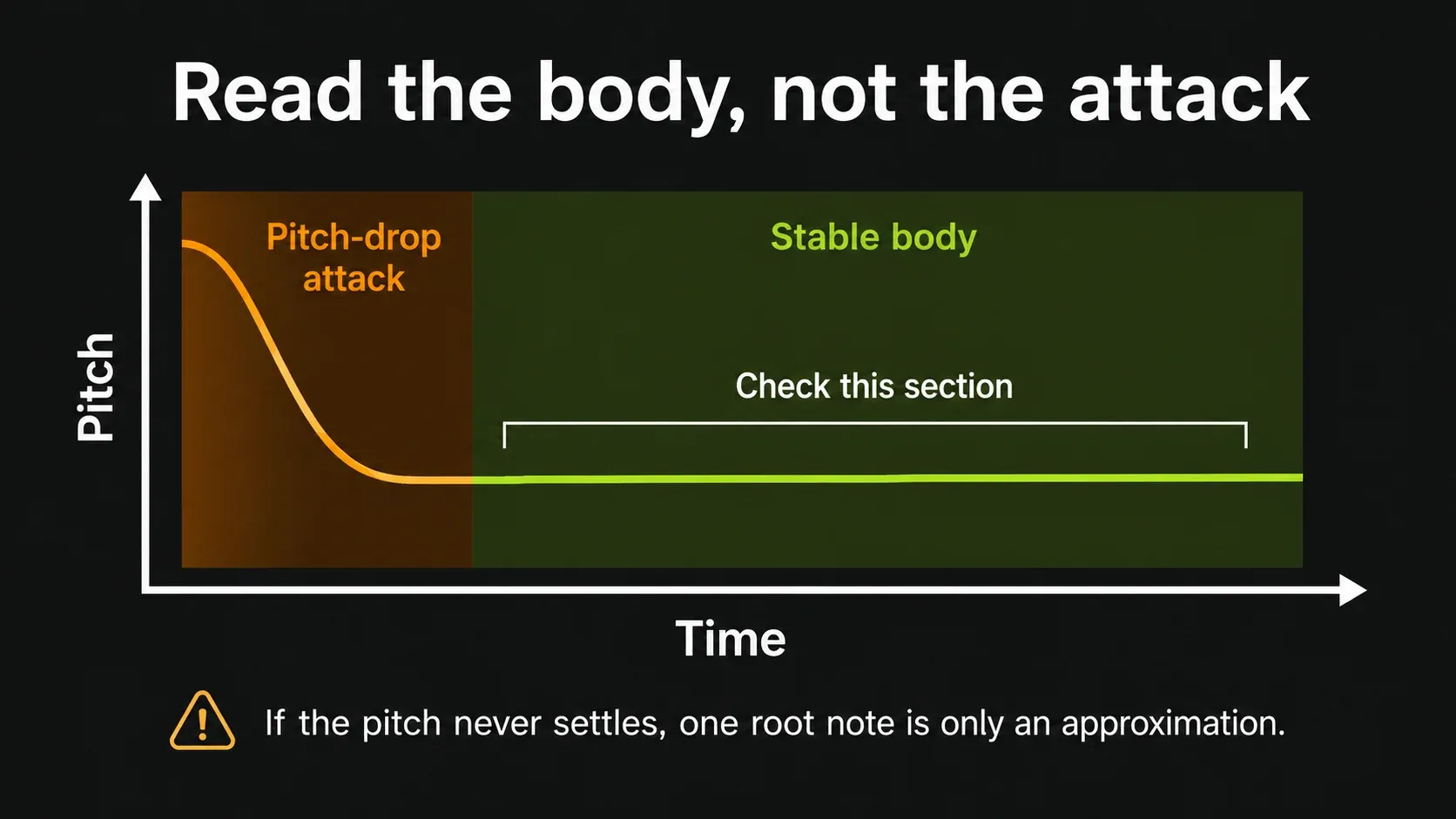
Play the established original-pitch trigger and watch the body after the initial drop. Note the settled name and register, not just whether the indicator is centered. A longer MIDI note cannot invent sustain that is missing from a short audio file. If the reading never becomes credible, use the checks below rather than accepting the first flashing letter.
Use Edison to inspect the original file
If Edison is available under your license, open the untouched one-shot in it and choose Regions → Detect pitch regions. The Edison menu reference describes detection of constant-pitch regions. Those markers help locate a useful section; running the command is not automatic pitch correction.
Look for a substantial steady section after the attack. Several tiny regions at the beginning may describe a deliberate pitch drop rather than several competing answers for the whole sound. Listen to the section you choose. The longest region is a useful starting point, not a guarantee that a detector has identified the fundamental correctly.
The Edison editing guide covers the wider editor workflow. For this job, you can stop at inspection: there is no need to overwrite the source file or export a newly “tuned” WAV just to set up Sampler.
Set the root note and choose its keyboard octave
Open the Sampler Channel's miscellaneous settings and right-click a key on the preview keyboard to assign the root. Image-Line's root-key explanation is about mapping: the assigned key plays the sample at its original pitch. The default is C5, and raising the root makes a fixed played key sound lower.
If some keys go silent after you touch that keyboard, check the playable key range. Left-clicking and dragging can define a restricted range; it is not the gesture for setting the root. Restore the range you need and confirm the root again before retuning the sound.
Here is a concrete example. Suppose the clean sample's steady body is F-sharp, with no remaining cents error. Assign F#5 as the root. Playing F#5 now gives the original bass pitch; playing C5 gives a C six semitones below it. The “5” chooses where that original sound sits on the keyboard. It does not turn a low bass sample into the concert pitch normally associated with F#5.
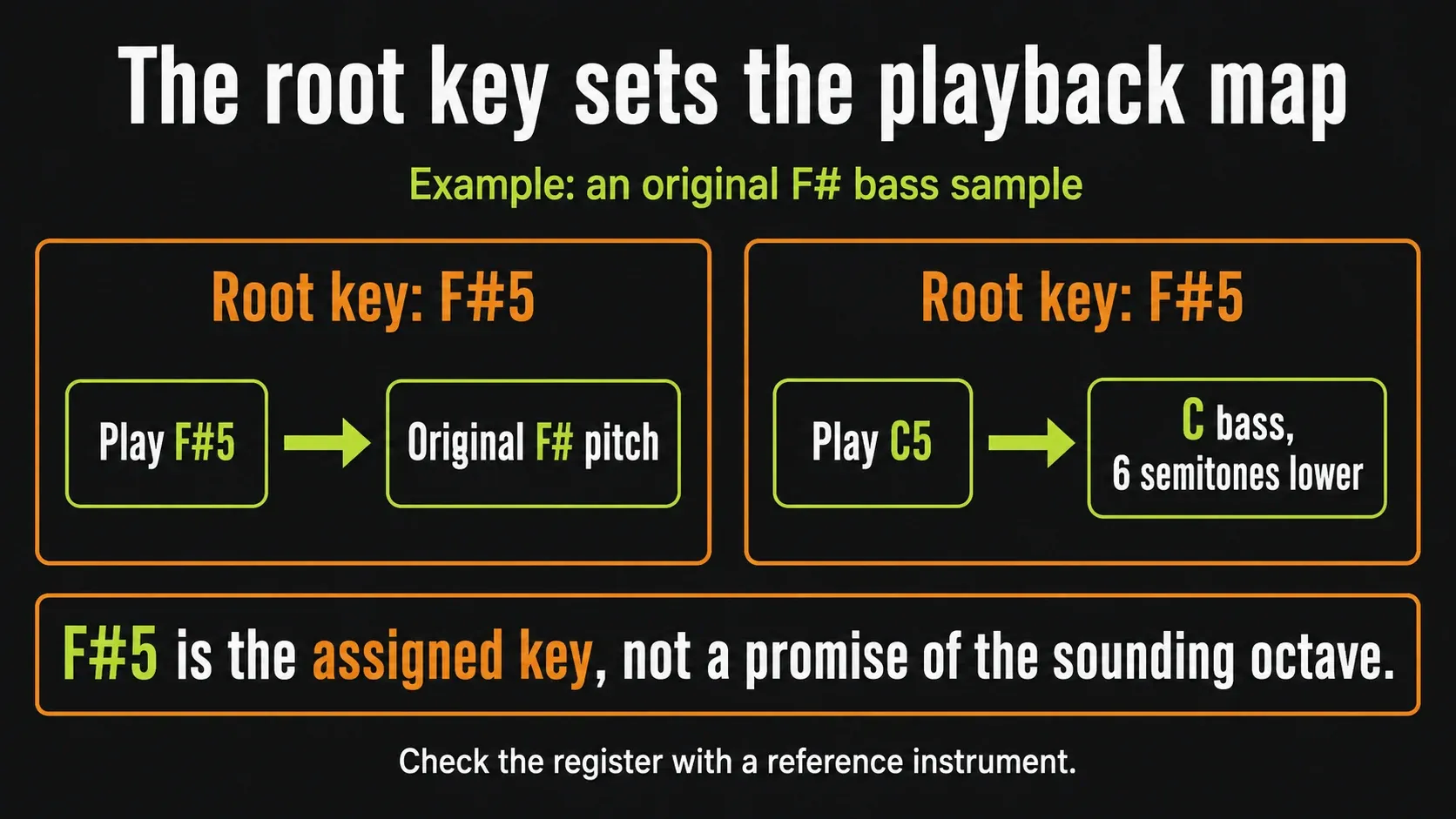
This is why copying the low octave reported by a detector into the root field can shift your usual pattern unexpectedly. Decide what you want: convenient bass playback around your existing notes, or an absolute pitch-to-key mapping that matches another instrument's register. For the latter, compare the actual sounding octave or frequency with a trusted reference as well as the letter name. Move by whole octaves if needed, then recheck the notes. Do not assume that a C5 label in two different instruments proves they produce the same frequency.
Check the note name before correcting cents
A chromatic tuner can sit at zero while reporting D when you intended C. That is not a slightly sharp C. Revisit the mapping and any pitch offsets first. Only after the correct note is sounding should you use Fine for a small, consistent detuning error.
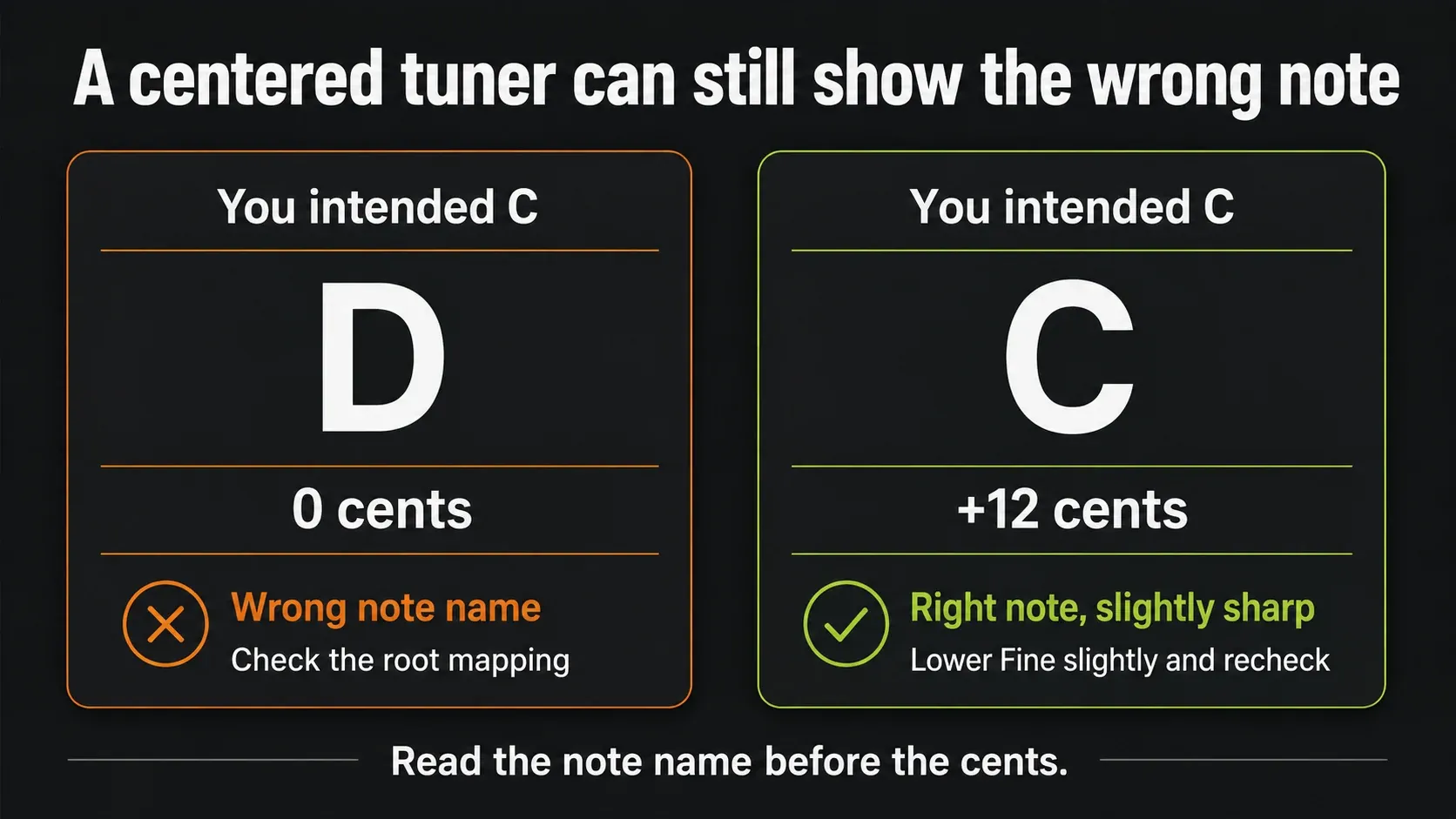
For example, an intended C reading as C +12 cents is slightly sharp: lower the fine adjustment a little and recheck the settled body. An intended C reading as D at zero cents needs a different diagnosis. These are illustrative readings, not measurements from a tested sample.
A cent is one hundredth of a semitone. Avoid chasing every movement in the attack with a new adjustment. If the body wanders above and below the target, one fixed correction cannot flatten that movement.
Test a short note run before copying the bass line
In Piano Roll, enter C, C-sharp and D one after another in a usable register. Leave enough space to hear each sample separately, then compare an octave. Check against a simple reference instrument with neutral tuning. If only the lowest note is hard to judge, temporarily move the test up an octave; return to the intended register afterward.
Listen for three things: does each note have the right name, is it in the octave you intended, and does its body hold close enough to the target for this part? Do not require the short attack to remain perfectly flat. That movement may be exactly why you chose the sample.
Now choose notes that work with the song
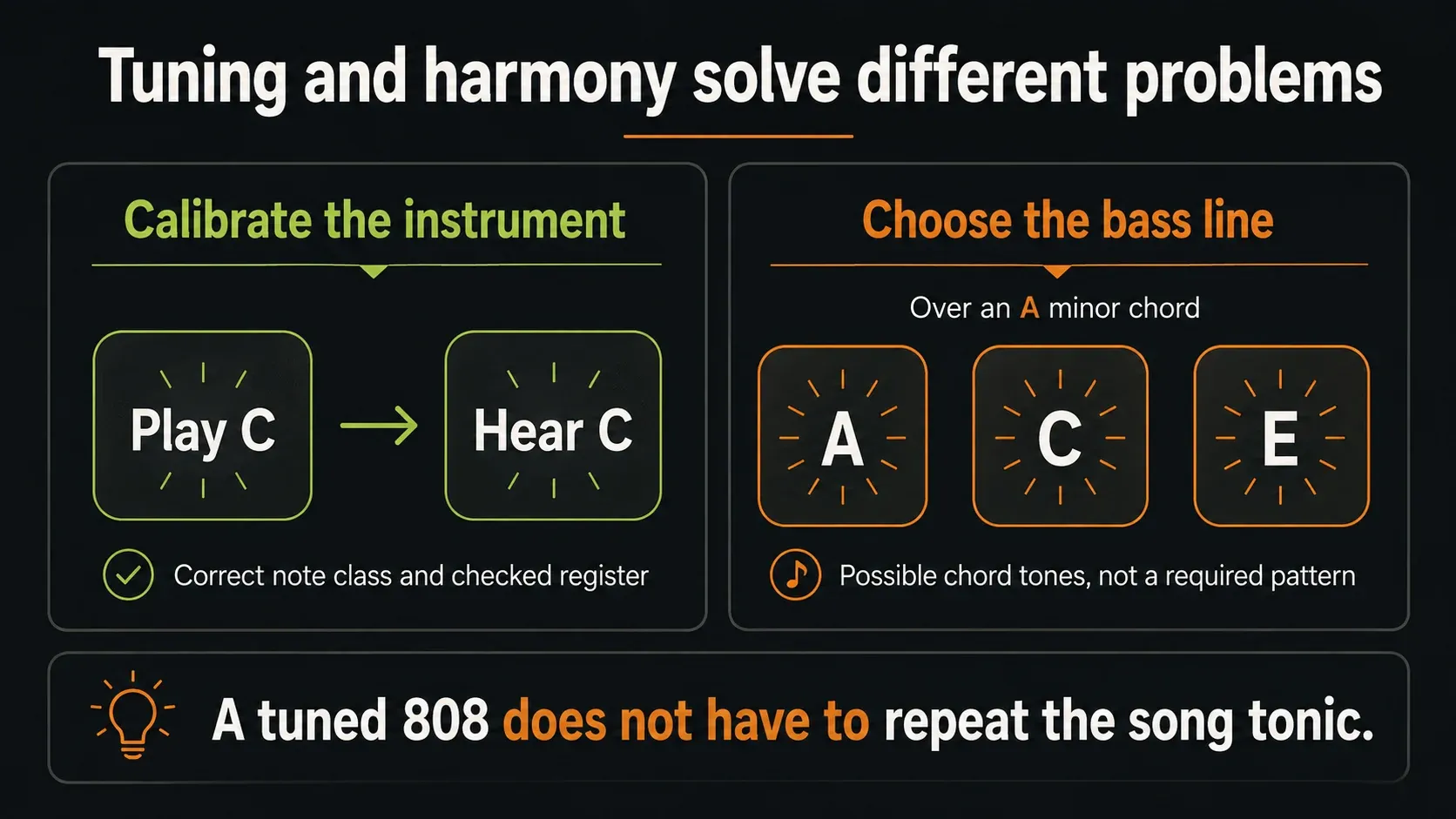
Calibration answers “Does this key produce the intended note?” Harmony answers “Do I want that note under this chord?” They are different decisions.
Over an A minor chord, A, C and E are chord tones you can try, not a required three-note pattern. A line may follow chord roots, linger on one note or use a passing tone. Listen to where it lands and what the melody is doing. When an accurately tuned note clashes, try another bass note before undoing the calibration.
Scale highlighting can make your chosen note set easier to navigate; it does not analyze or tune the sample. Use the drum-pattern guide to work on the rhythm, and the complete beatmaking workflow to place this bass part in an arrangement.
What to check when the 808 is still out of tune
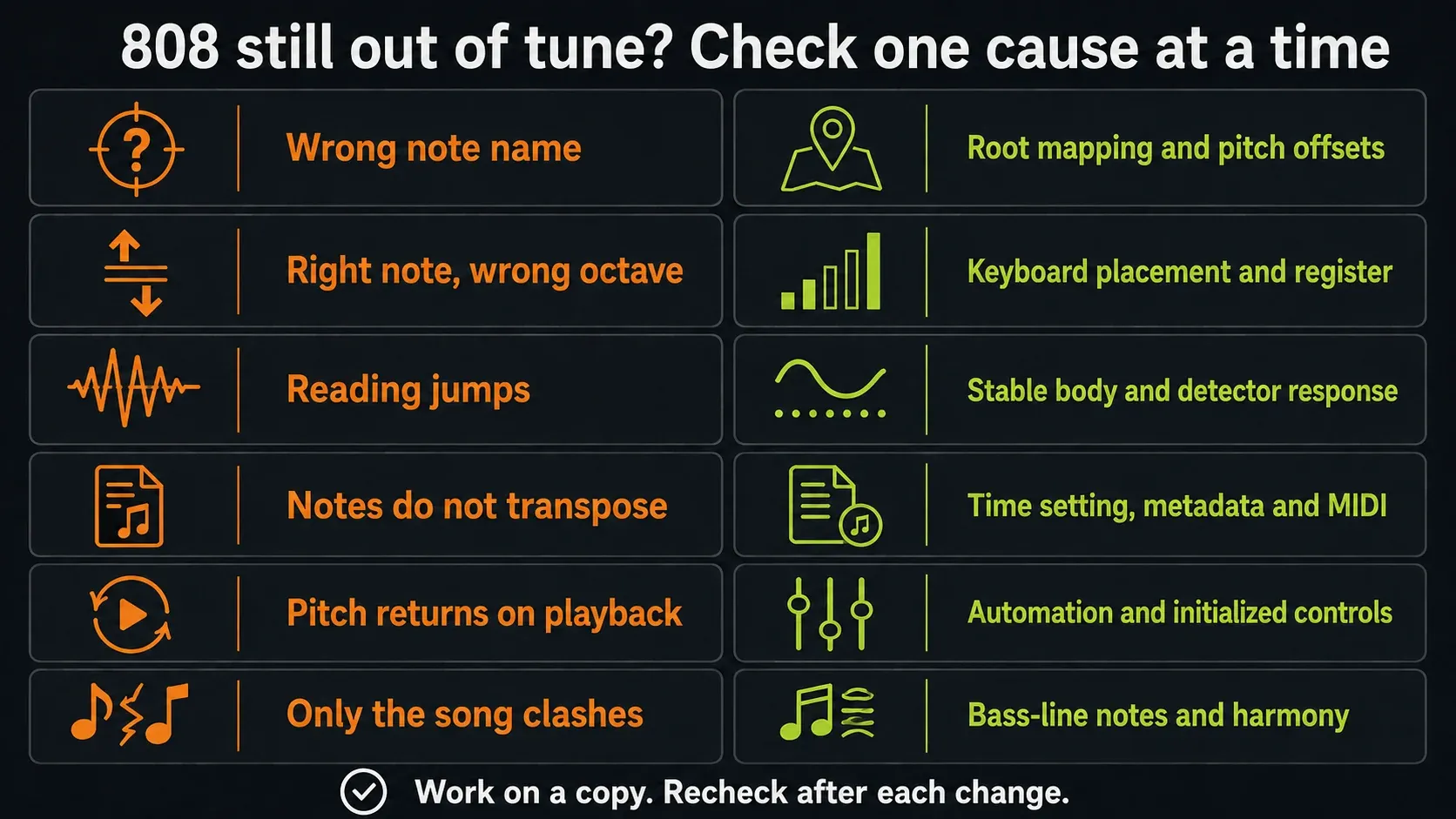
Make each check on your test copy, then replay the same notes. Image-Line's pitch-problem checklist identifies several places where pitch can change besides the root:
- Wrong name or octave throughout: check the root assignment and existing pitch offsets. Do not judge by a sample filename alone.
- The sample ignores different notes: check Time settings and whether MIDI is triggering the intended Channel. Compare direct Piano Roll playback with your controller before changing unrelated controls.
- Pitch changes when playback starts: inspect Channel pitch, per-note fine pitch, automation and initialized values. A manual adjustment can be replaced by recorded control data.
- The clean file and loaded Channel disagree: inspect embedded root/fine information and any stretching or sample processing. Edison's Sample Properties explains that metadata; changing a filename does not reliably change it.
If time stretching is the cause, follow the time-stretching guide instead of repeatedly moving the root. If only the effected signal sounds wrong, reintroduce your processing one stage at a time. Tuning and the kick-and-808 mix need separate decisions; the Mixing library covers balance and processing after the pitches make sense.
When the sample never settles on one note
Some 808s are built around a long glide, vibrato or a noisy, distorted tail. Two detectors can disagree, or agree on an upper harmonic. Treat their readings as evidence to check by ear, not a verdict. An octave-up listening check can help, but does not repair the original sound.
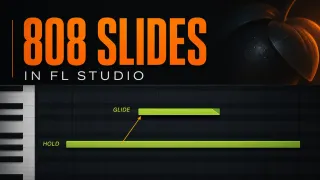
If no usable body holds its pitch, you have a musical choice: accept the movement and place it carefully, edit the sound deliberately, or choose a steadier sample. Simply resampling the same drifting performance preserves the drift. For a controllable synthesized source, try the 3xOSC 808 workflow. For intentional movement between already-calibrated notes, use 808 slides and glides.
Keep the setup without overwriting the source
Save the project with the working Channel and keep the original sample available. Root-key mapping is a playback setup; it does not rewrite the source audio into C. If you later export a repitched one-shot for reuse, give it a distinct name and verify the exported file independently. Do not apply the old correction again just because it worked on the original.
FL Studio 808 tuning FAQ
Can I tune an 808 without Edison?
Yes. Use a clean Sampler Channel and Tuner, establish original-pitch playback, and inspect the steady body. Edison is an optional second route for examining pitch regions.
Should I set every 808 root note to C5?
No. C5 can be a temporary original-pitch reference when you explicitly assign it, but it does not prove the sample is in C. Map the detected note class and check the register.
Should the root octave match the octave shown by Tuner?
Not automatically. The root selects the key that plays the original file. Choose the keyboard placement deliberately and compare the actual sounding register with a reference instrument.
Why is the tuner centered but my bass still sounds wrong?
Check the reported note name, the octave and the harmony. Zero cents for D is still the wrong result if you intended C.
Which part of an 808 should I use to detect its pitch?
Start with a substantial steady body after the attack, then listen to confirm it. If the whole sample keeps moving in pitch, a single root is only an approximation.
Can pitching an 808 up help with tuning?
An octave-up test can make its note easier to hear. Treat it as a cross-check, restore the intended register and verify the original setup again.
Does every bass note have to be the song tonic?
No. Choose notes that support the chords and phrase. Correct sample tuning does not decide the bass line for you.
Does changing the root save a permanently tuned WAV?
No. It changes playback mapping in the Channel, not the original audio file. A separately exported, repitched sample needs its own pitch check.