FL Studio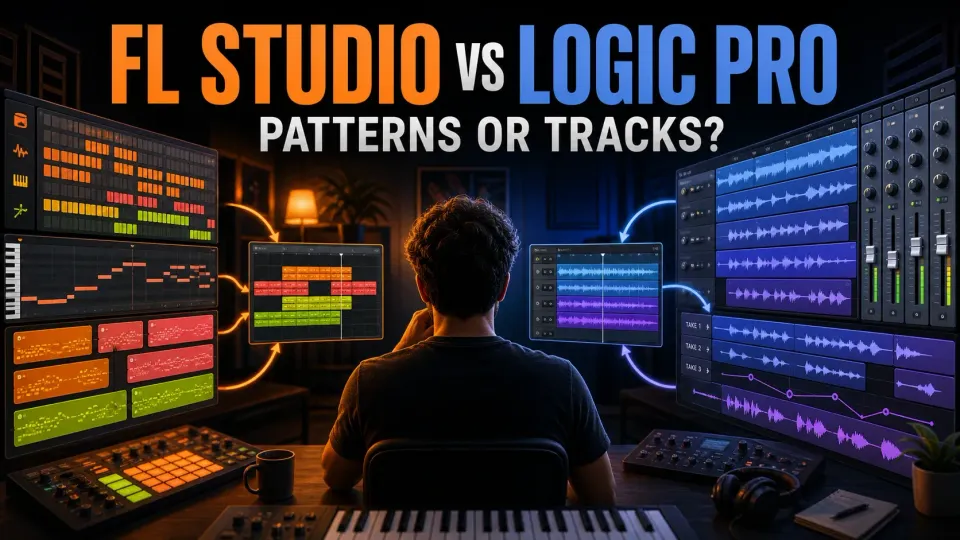
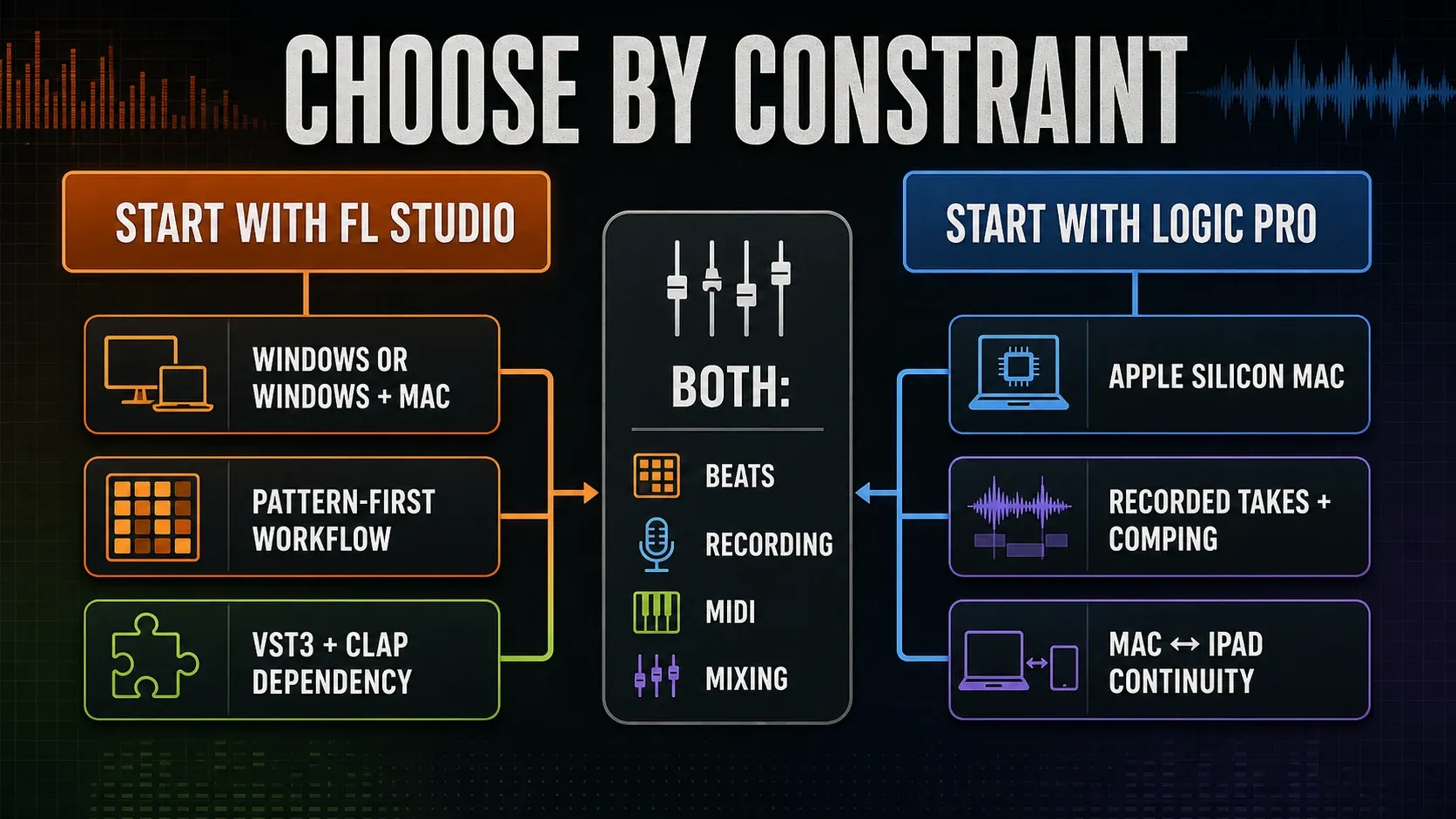
Choose FL Studio if your normal session starts with drum patterns, short musical ideas and mouse-led Piano Roll work—or if Windows must remain an option. Choose Logic Pro if you already have a compatible Mac and your sessions revolve around recorded takes, track-based arranging, comping and a consistent channel-strip workflow. Both can make beats, record audio, edit MIDI, mix and master. Neither has an inherent sound-quality advantage. The useful question is which one asks you to reorganize your thinking less often.
Documentation and US prices checked September 12, 2026. The FL Studio download page lists 26.1.6; Apple’s standalone Logic Pro listing lists 12.3.1. This is a documentation-led workflow comparison, not a timed benchmark or a claim that we recorded identical sessions in both apps. The examples below are tasks you can try on your own setup.
FL Studio vs Logic Pro: the quick verdict
| Your real constraint | Better first trial | Reason |
|---|---|---|
| You produce on Windows, or move between Windows and Mac | FL Studio | FL Studio supports both desktop platforms; Logic Pro does not run on Windows. |
| You build drums and melodies as reusable patterns | FL Studio | The Channel Rack, Step Sequencer, Piano Roll and Playlist form one pattern-first loop. |
| You record vocals, guitars or several takes on a Mac | Logic Pro | Tracks, take folders, Quick Swipe Comping, Flex tools and channel strips stay connected. |
| You sketch on iPad and finish on Mac | Logic Pro | Apple documents project round-tripping between Logic Pro for iPad and Mac. |
| You depend on VST3 or CLAP plug-ins | FL Studio | FL Studio hosts those formats; Logic Pro’s third-party plug-in path is Audio Units. |
| You want a complete standalone Mac package at one tier | Logic Pro | The standalone Mac app is sold as one product rather than four feature editions. |
| You want a low entry price and can choose features by edition | FL Studio | Fruity starts lower, but recording and some tools require Producer Edition or above. |
| You need Dolby Atmos delivery inside the DAW | Logic Pro | Logic includes an integrated spatial-audio workflow and ADM export. |
Treat the table as a starting point, not a scorecard. Windows rules Logic out; an existing compatible Mac leaves both choices open. If you make beats and record vocals in the same project, compare how each app handles the handoff from programming to recording. Neither genre labels nor a feature count settles that question.
The central difference is pattern-first versus track-first
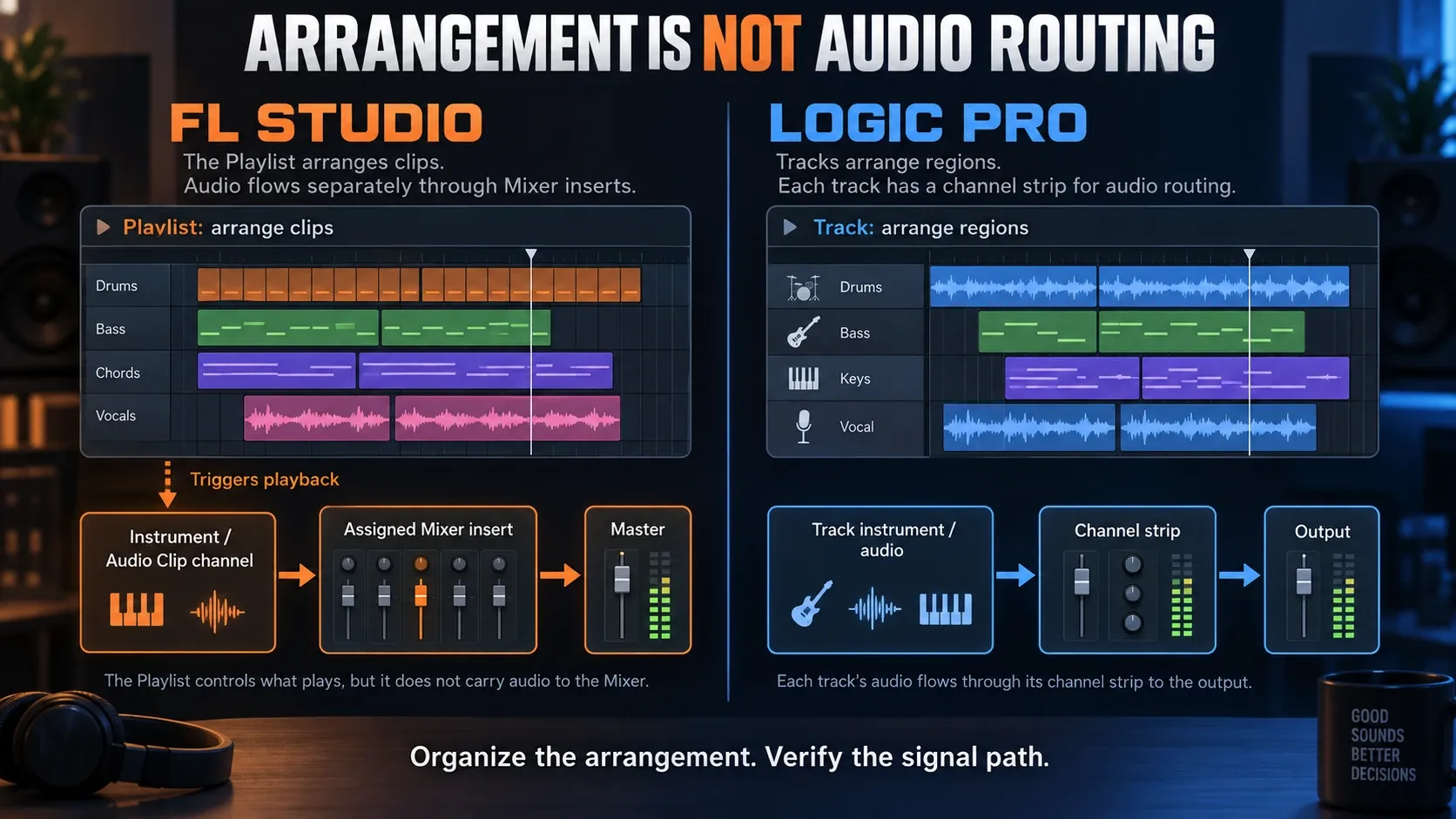
FL Studio begins naturally with a Channel Rack pattern. You program steps or notes, create variations, then place Pattern Clips beside Audio Clips and Automation Clips in the Playlist. Playlist lanes are flexible: a lane can hold different clip types unless you deliberately use Track modes. That freedom is excellent when a song grows from interchangeable eight-bar ideas. It also means the producer must impose naming, mixer assignment and arrangement discipline.
Image-Line’s Playlist documentation explains the separation: clips trigger playback, while the source channels determine Mixer routing. Instrument and Audio Track modes can link the Channel Rack, Playlist and Mixer for a more conventional layout. Our Playlist guide explains that setup; flexibility does not mean you must organize every project manually.
Logic Pro begins with a track connected to a channel strip. MIDI or audio regions live on that track, track alternatives and takes stay associated with it, and mixer organization follows the arrangement more directly. Logic also has Live Loops, pattern regions and a Step Sequencer, so “linear” does not mean rigid. Its default structure simply keeps the song’s identity attached to tracks longer.
Beat making and MIDI: FL is faster only when its model fits you
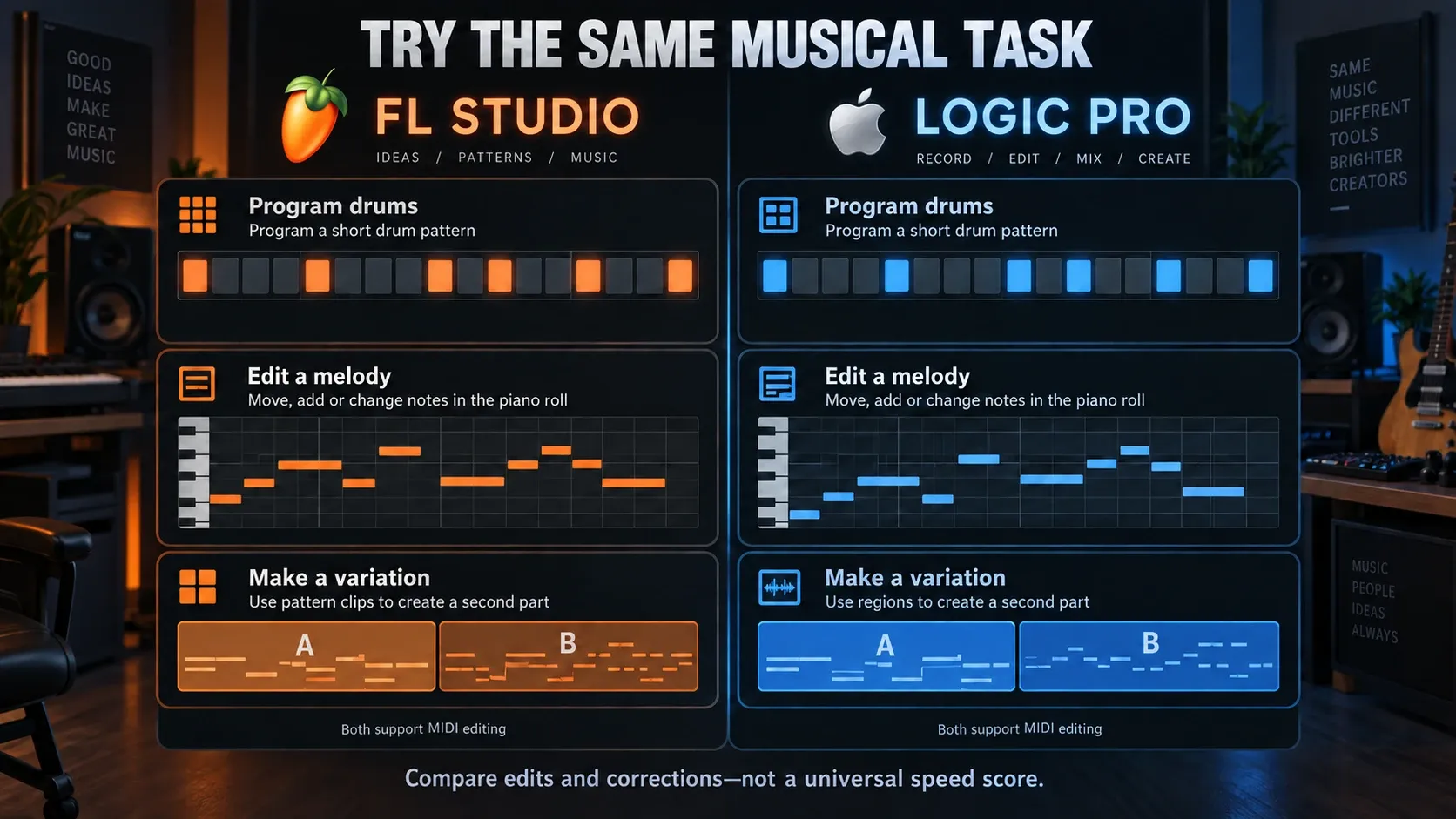
FL Studio’s strongest case is the short path from sample to pattern. Load a kick, snare and hats, click steps, open the Piano Roll for the bass or chords, duplicate the pattern and change the variation. Per-note properties, ghost notes, scale context, strum and arpeggiation tools make mouse-led composition unusually direct. The detailed techniques belong in the Step Sequencer guide and Piano Roll guide, not in a comparison table.
Logic is not missing a beat workflow. Apple’s current Logic Pro product page and App Store description list Step Sequencer, Drum Machine Designer, Quick Sampler, Sample Alchemy, Live Loops and Session Players. A producer can build drums, resample audio and develop patterns without leaving Logic. The difference appears after the first loop: Logic tends to pull the idea into tracks and regions, while FL keeps pattern variations as independent building blocks.
Do not accept “best Piano Roll” as proof without a task. Draw a chord, shorten every second note, edit velocity, create a strum, copy only the rhythm to another sound and turn the result into a B section. The winner is whichever editor completes that sequence with fewer corrections for your hands—not whichever one has the loudest reputation.
Recording vocals and instruments: edition and comping change the answer
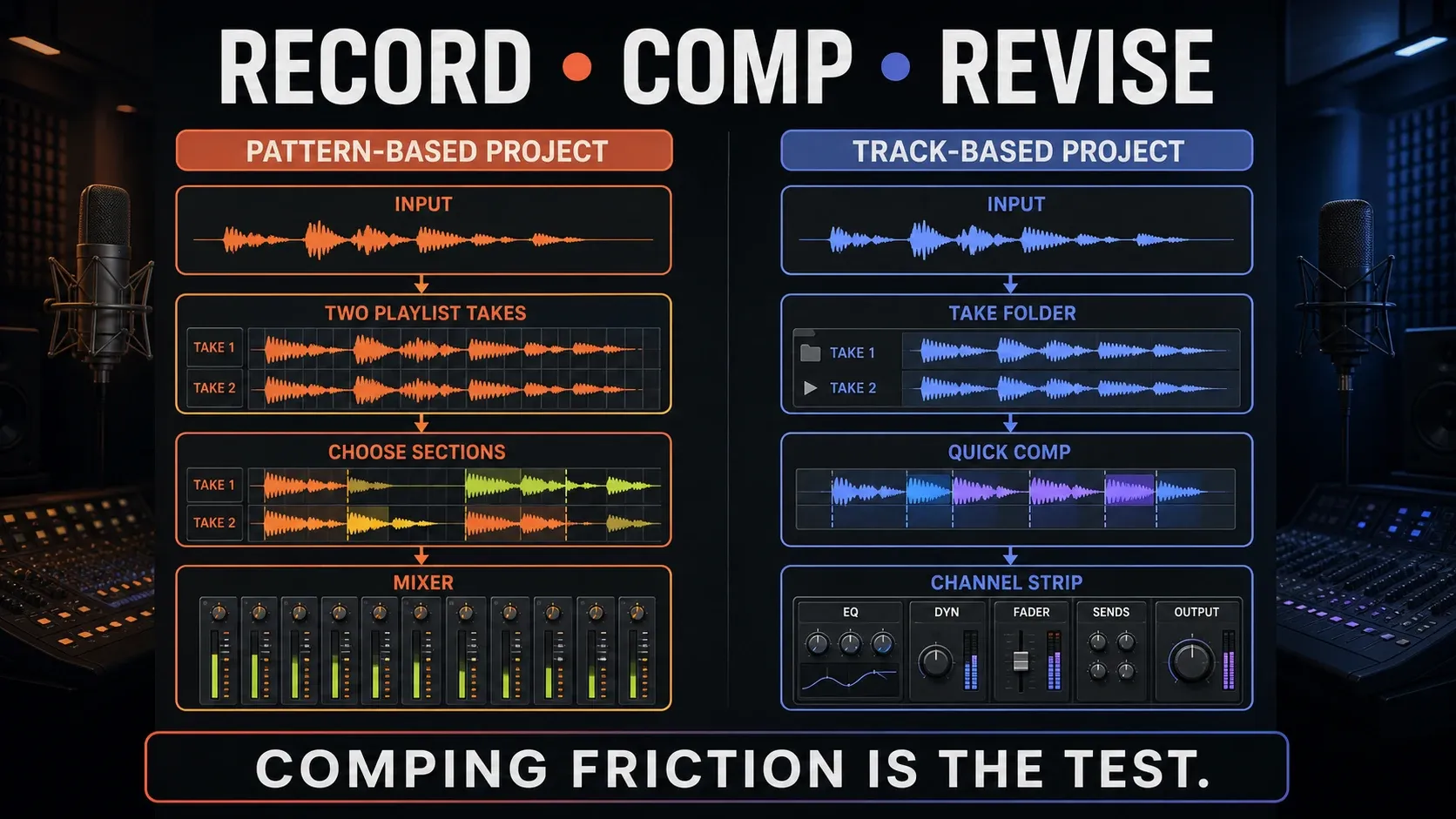
FL Studio records vocals and instruments, but the edition matters. The official audio-recording guide requires Producer Edition or higher. Fruity is not the like-for-like purchase for a singer, guitarist or band comparing FL with Logic. Check the actual tools you need, including any pitch-editing plugin, rather than assuming audio recording unlocks every optional editor.
In FL, external audio enters through a Mixer input and can be captured into the Playlist or Edison. You can record several inputs and loop takes; a template with named tracks and deliberate routing makes repeated sessions easier. After choosing the performance, the vocal-mixing guide covers processing. Recording the take and mixing it are separate jobs.
Logic’s advantage is not that FL “cannot record.” It is that take folders, Quick Swipe Comping, track alternatives, Flex Time and Flex Pitch sit inside the same track-first model. For a session built around repeated performances, that reduces translation between recording, choosing takes and editing. Apple lists those tools in the standalone app’s current feature description.
Arrangement and audio editing favor different kinds of revision
FL makes pattern-level revision cheap. Change one source pattern and every linked instance can reflect it; make a unique copy when the chorus needs a variation. Audio Clips and Automation Clips can move independently, which is powerful for electronic arrangements but can become visually untidy when naming and grouping are postponed.
Logic makes track-level revision legible. Regions, track alternatives, markers, arrangement sections and automation remain close to the instrument or recording they belong to. Smart Tempo can conform imported or recorded material, and Flex tools handle timing or pitch changes. That structure is helpful when the project is a song with many recorded passes, tempo decisions and handoffs.
Neither approach wins every revision. FL often feels lighter when a chorus is assembled from pattern variants; Logic often feels calmer when a singer asks for “the second line from take four, but with the timing from take two.” Put your most common revision into the trial test.
Mixing, automation and mastering do not create a sound-quality winner
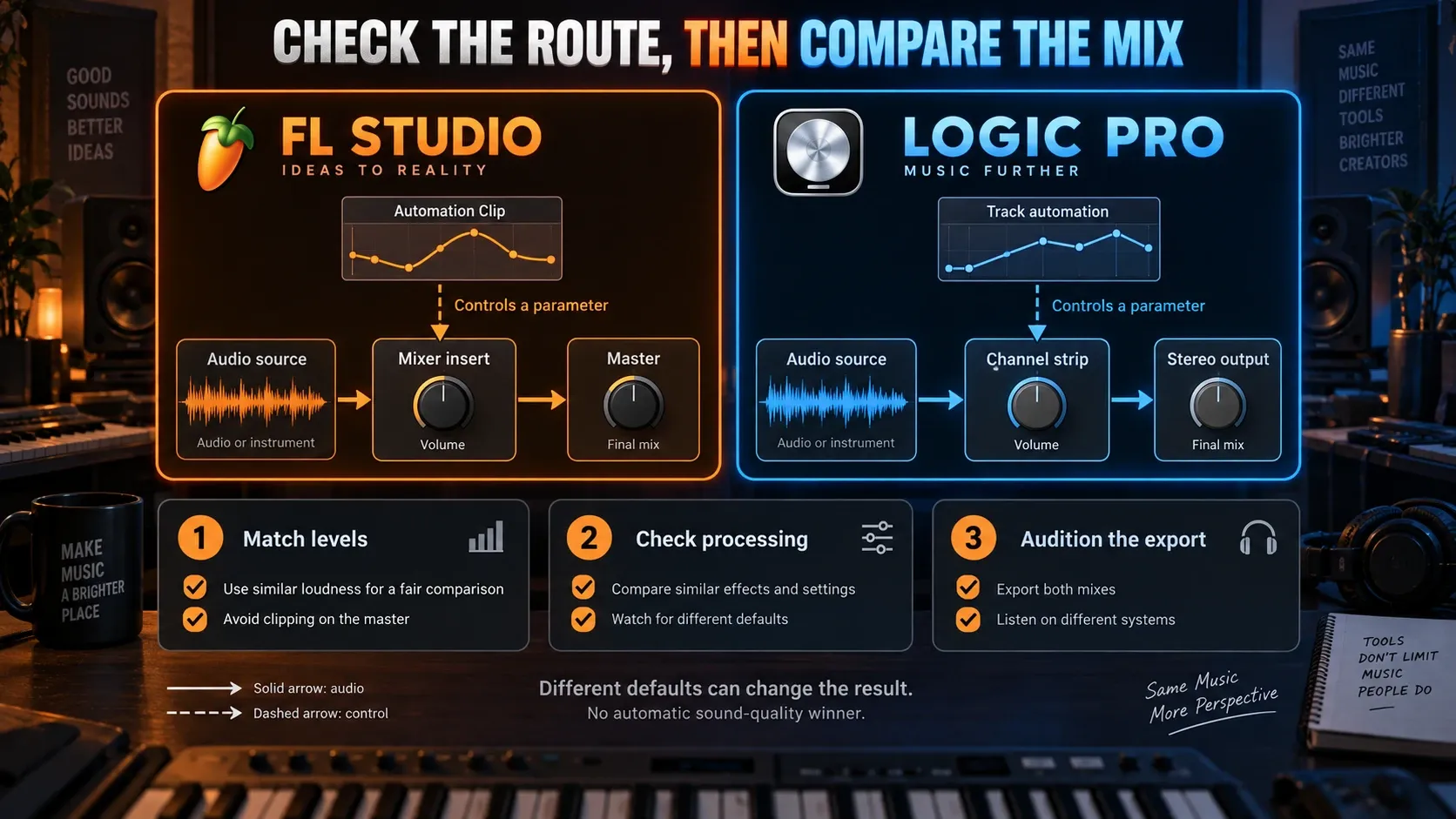
FL Studio’s Mixer supports insert routing, sends, sidechains, buses and complex chains. Automation Clips are visible, movable objects in the Playlist, which makes reusable modulation easy to see. The trade-off is that Channel Rack, Playlist and Mixer relationships can remain independent until you connect and name them. A disciplined template matters more than a screenshot of a large routing graph; the FL Studio Mixer guide explains that setup.
Logic’s channel strips follow tracks more conventionally, with inserts, sends, buses, groups and track or region automation. Apple’s current Logic Pro page also highlights Mastering Assistant and integrated spatial-audio tools. FL can master stereo releases through its own tools and plugins; Logic has the clearer built-in path when Dolby Atmos and ADM delivery are actual requirements.
Do not buy a DAW for an assumed professional tone. Both provide the tools for a finished stereo mix, but different pan laws, processing, resampling and export settings can produce different results. Image-Line documents why playback and rendered audio may differ. Compare level-matched exports and check settings before blaming the audio engine; this is not a promise that two separately built mixes will null. Our mastering guide handles the release workflow.
Stock instruments, sounds and plug-in formats
Logic Pro is sold as one complete standalone Mac app, and Apple describes a large collection of instruments, effects, loops and samples. Current tools include Alchemy, Quick Sampler, Sampler, Drum Machine Designer, Sample Alchemy, Session Players, Stem Splitter and Mastering Assistant. The exact content and hardware-dependent features can change, so a current App Store check is stronger than an old plugin-count graphic.
FL Studio’s included tools depend on the edition. FLEX, FPC, the native generators and effects available in one edition are not identical to the next tier, while optional Image-Line plugins and FL Cloud remain separate decisions. Use the stock-plugin guide, free-plugin guide and edition comparison to build the smallest usable bundle.
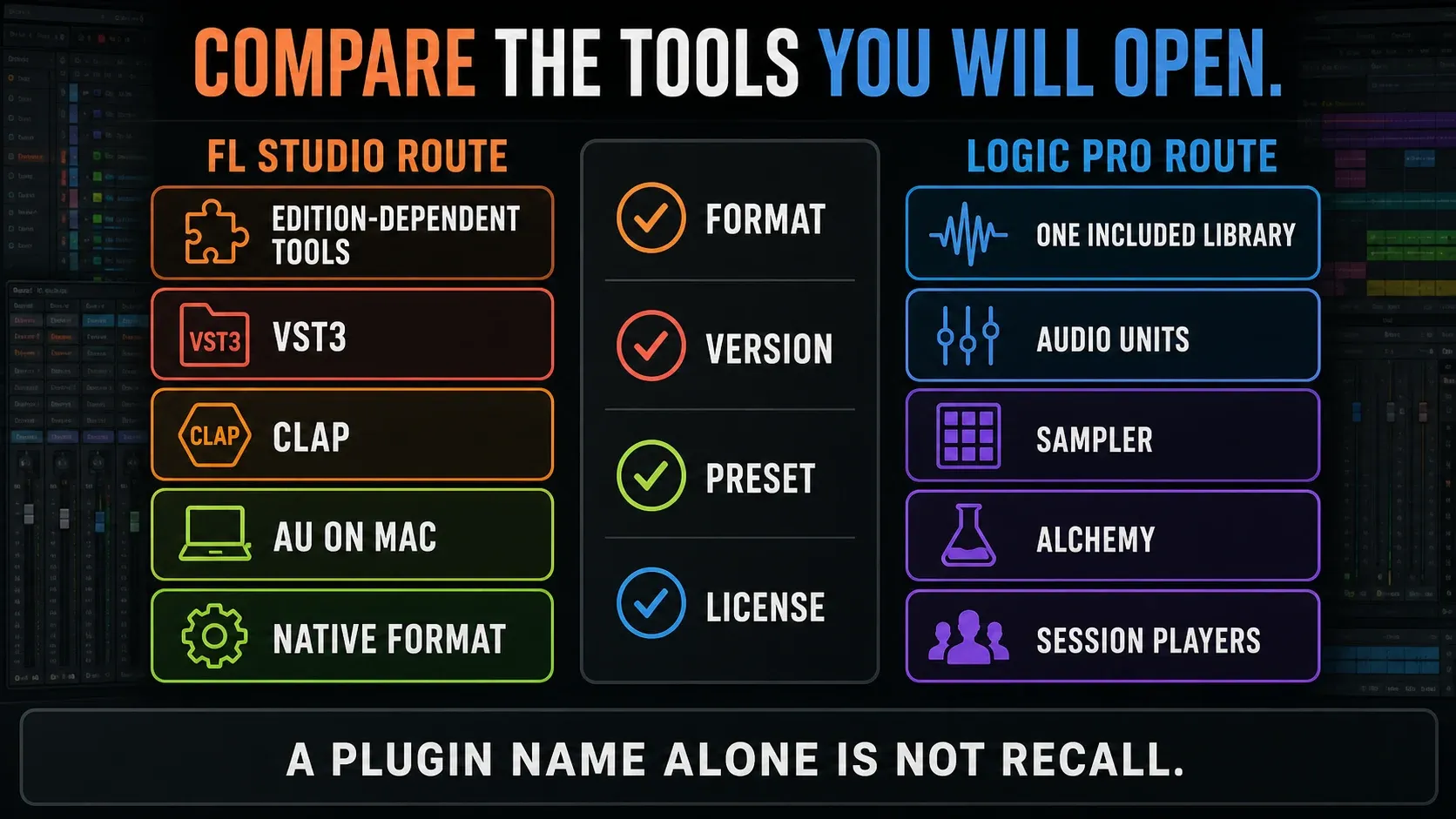
Format compatibility may decide more than the stock library. Image-Line’s supported plugin formats include VST2, VST3, CLAP and native plugins on Windows and macOS, plus Audio Units on Mac. Apple documents Audio Units and Audio Unit Extensions in Logic. A VST-only plugin does not load there directly. Even when an AU edition exists, check the license, preset transfer and version; a matching product name does not transfer a whole chain.
Platforms and continuity: Windows–Mac versus Mac–iPad
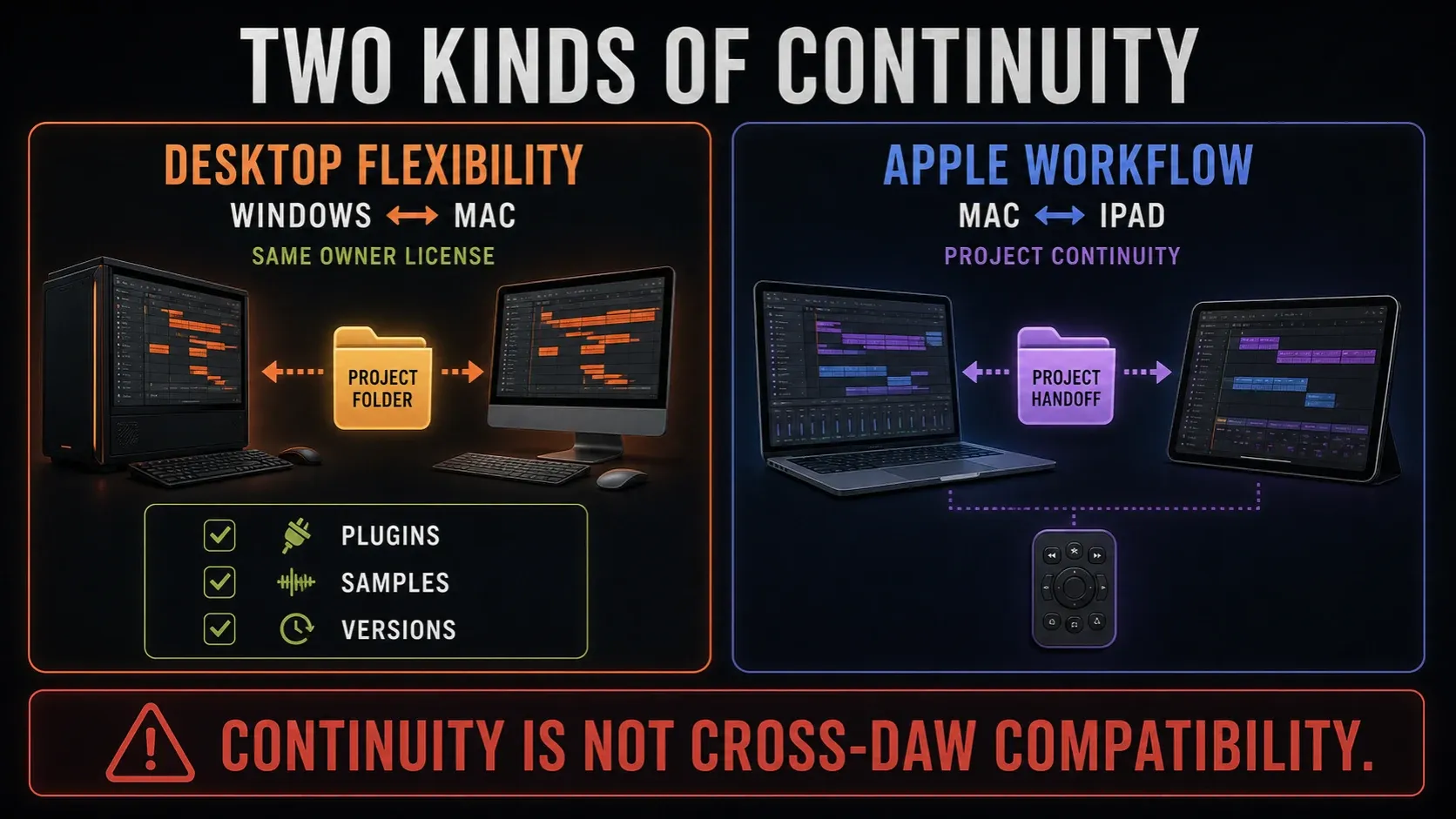
FL Studio supports Windows 10/11 or newer on Intel/AMD processors and macOS 10.15.7 or newer on Intel or Apple silicon, according to the current installer page. Windows ARM is not officially supported. One owner’s license covers both supported desktop platforms. Use the system-requirements guide to separate minimum compatibility from a computer suited to your sessions.
For the current Logic release, Apple specifies a Mac with Apple silicon and macOS 15.6 or later. Logic for iPad requires iPadOS 26 and A12 Bionic or later; individual features may need newer hardware. Follow Apple’s current compatibility requirements, not an old Logic X tutorial or an App Store field that omits the processor. An Intel Mac that runs an older Logic installation is not evidence that a new current-version purchase is supported.
Logic offers Mac–iPad project round-tripping, but not every Mac project or plugin transfers unchanged. Apple’s project-sharing instructions require a project package and explain when to bounce incompatible plugins to audio. Surround projects and several other configurations cannot open on iPad. Work on a copy before adapting a session. FL’s Windows–Mac sharing likewise needs the right samples, plugin formats and versions. Neither route makes an FLP open in Logic.
Price, updates and trials: compare usable routes
The US FL Studio pricing page advertises an entry price of $99, checked September 12, 2026. That entry tier is Fruity, not the recording-capable comparison for Logic. Price Producer or above if you need recording, then check the included plugins. Lifetime Free Updates cover your owned edition; higher editions, optional plugins and paid FL Cloud services remain separate. The discount guide explains purchase and upgrade offers.
Apple’s US Logic Pro purchase options list the standalone Mac app at $199.99 and Apple Creator Studio at $12.99 monthly or $129 annually, checked September 12, 2026. Apple says Logic’s features are the same through either route. Creator Studio also includes other apps and Logic on iPad; the standalone Mac purchase does not by itself buy the iPad subscription. Check local checkout and education eligibility. Do not treat Apple’s recent update history as an FL-style lifetime guarantee.
The FL trial has no time limit, can save and export, but cannot reopen saved projects until purchase and unlocking. Its edition and trial-plugin rules also matter after buying: unlock required trial plugins before reopening, and do not re-save a project with missing trial plugins or their settings may be lost. Keep the original backup and render important parts before closing. Apple advertises a 30-day Creator Studio trial; check renewal and cancellation terms before starting it.
With the Apple subscription route, cancellation does not delete your project files, but continued app use is a separate issue. Apple’s subscription guidance explains access through the billing period and returning through a new subscription or standalone purchase. Keep exports and backups you can use independently of a subscription.
Projects do not move between these DAWs as native sessions
Logic Pro does not natively open FLP projects, and FL Studio does not natively open Logic project packages. A dependable move uses consolidated audio stems from a shared start point, MIDI for parts that still need note editing, tempo and time-signature notes, dry and processed references, and a plugin/preset inventory. Automation, mixer routing, take folders, Playlist organization and native instruments will not translate as one editable session.
Before switching, render any instrument whose destination format is uncertain and keep the editable original. Export a full-song reference as well as separate files, then import them into the destination and listen through entrances, edits and effect tails. Do not treat a temporary freeze cache as a portable stem. Agree on start position, length, naming, sample rate and revision labels with collaborators; MIDI carries notes and performance data, not the sound of the original instrument.
Who should choose FL Studio?
- You need Windows now or may move between Windows and macOS.
- Your ideas start as drum, bass, chord and melody patterns.
- You do a large share of composition with the mouse in the Piano Roll.
- You value visible, reusable Automation Clips and free-form Playlist placement.
- You prefer Lifetime Free Updates for the edition you buy and are willing to choose that edition carefully.
If FL is the likely choice, verify the edition, run the official trial, then use the beginner project rather than judging the empty default screen. If live performance is central, compare FL Studio with Ableton Live before locking the decision.
Who should choose Logic Pro?
- You already own a compatible Apple-silicon Mac and expect to stay on Mac.
- Your sessions begin with microphones, instruments, takes or a linear song form.
- You want comping, Flex editing, channel strips and arrangement structure to remain closely connected.
- You want one deep included Mac package instead of comparing FL editions and optional plugins.
- You need Logic’s Mac–iPad continuity or integrated Dolby Atmos workflow.
Logic is not automatically the “professional” choice, and FL is not automatically the “beat-only” choice. These profiles describe defaults, not limits. A skilled producer can finish the same release in either; the deciding cost is repeated friction.
Test a small project before buying or switching
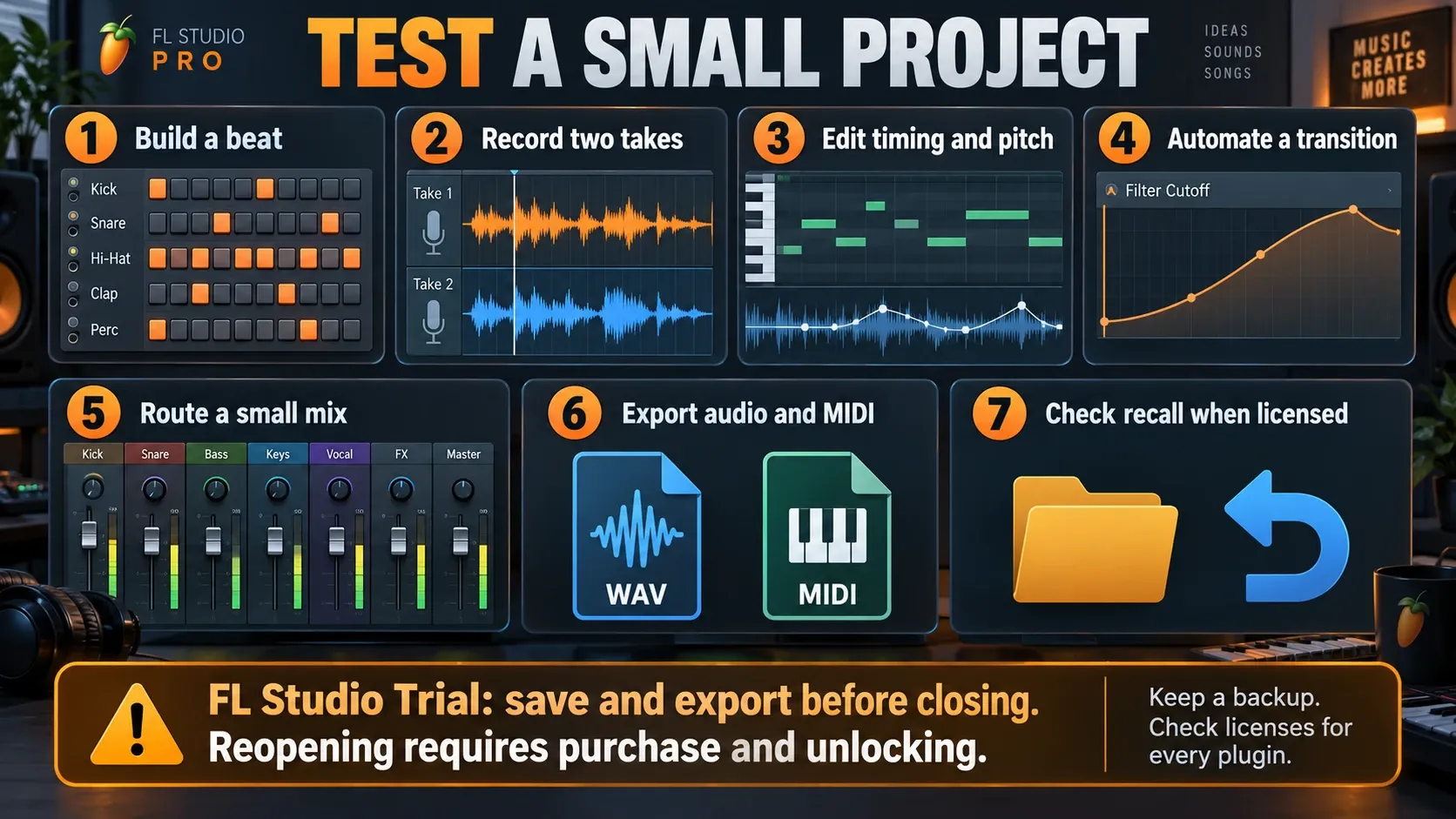
- Build the same eight-bar beat. Use the same samples and create one drum, bass and chord variation.
- Record two short takes. Capture a vocal, guitar or other real input and make one usable comp.
- Edit timing and pitch. Correct one obvious timing problem and, where appropriate, one pitch problem without changing the musical idea.
- Automate a transition. Create a filter, level or effect move, then revise its timing once.
- Route a small mix. Build one send, one group or bus, one sidechain and a clean master path.
- Export exchange files. Bounce a reference, consolidated stems and MIDI for one editable part.
- Check recall only where the license permits. In unlocked FL Studio with the required plugins, save a backup and verify reopening. In FL Trial, save and export before closing; mark reopening as unavailable until purchase, not as a failed test. In Logic, verify reopening while your trial or license is active.
Allow extra time for installation, downloads and unfamiliar controls. This is a short project exercise, not a promise that both apps can be learned in an hour. Count unclear routing, repeated cleanup, missing plugins and recall limitations. Use the computer and audio interface intended for your next project.
FL Studio vs Logic Pro FAQ
Is Logic Pro better than FL Studio?
No universal winner exists. Logic Pro is often the cleaner fit for compatible-Mac users recording and comping performances in a track-based project. FL Studio is often the cleaner fit for pattern-based producers, Piano Roll work and anyone who needs Windows support.
Is FL Studio or Logic Pro better for beginners?
FL Studio can get a mouse-led beat moving quickly; Logic can feel more familiar to a GarageBand user or a beginner recording vocals and instruments. The easier DAW is the one whose first complete project matches the beginner’s actual music.
Which is better for beat making?
FL Studio has the more central pattern, Step Sequencer and Piano Roll workflow. Logic remains capable through Step Sequencer, Drum Machine Designer, Quick Sampler and Live Loops, and may be more direct when the beat immediately becomes a recorded, track-based song.
Which is better for recording vocals?
Logic Pro has the stronger default comping workflow through tracks, take folders, Quick Swipe Comping and Flex tools. FL Studio records vocals in Producer Edition and above and can be efficient inside a beat-driven template; Fruity Edition is not the correct recording comparison.
Can Logic Pro run on Windows?
No. Apple’s current Logic Pro is for Mac and iPad. FL Studio supports Windows and macOS, so Windows use or a Windows–Mac desktop workflow points to FL Studio between these two choices.
Does Logic Pro support VST plugins?
Logic Pro’s third-party plug-in format is Audio Units, not VST. FL Studio supports VST3 and CLAP, Audio Units on macOS and its native format. Confirm the exact format, version and license for every essential plugin before switching.
Can Logic Pro open an FL Studio project?
Not as a native editable FLP. Move the production with consolidated stems, MIDI, tempo notes, references and a plugin inventory. Routing, automation, native instruments and DAW-specific editing structures must be rebuilt or rendered.
Which DAW is cheaper in 2026?
FL Studio has the lower US entry price, but Fruity Edition omits audio recording and higher editions include different tools. Logic Pro’s standalone Mac app is $199.99 in the US and is one complete tier. Compare the usable FL edition, hardware, plugins and future services—not the smallest sticker.
The useful verdict
Pick FL Studio if reusable patterns and Windows–Mac flexibility fit your work. Pick Logic Pro if recorded takes, track-based arranging and a compatible Apple setup fit better. When both sound right, try the same small project and compare the corrections you repeat. If Mac-only support rules Logic out but track-based recording still matters, continue with FL Studio vs REAPER.
The next step belongs in the Compare & Buy hub: verify the purchase route, then keep the first three projects deliberately small enough to learn the workflow rather than rebuild your entire studio on day one.