FL Studio
FL Studio 2026 adds new ways to find sounds, build chords and recover an unrecorded idea—but an update still needs to work with your existing songs. Checked September 12, 2026, the official installers are 26.1.6.5639 for Windows and 26.1.6.5406 for macOS. Start with the change you need, then test a duplicate project before moving a deadline session to the new build.
This is a documentation-led guide, not a benchmark or a claim that we tested your plugins. Lifetime Free Updates covers the edition you bought; a higher edition, optional plugins and paid FL Cloud services are separate purchases. The advice below explains what to try and what to preserve before updating.
What is the latest FL Studio 2026 version?
FL Studio 2026 is the release family launched on July 7. Version 26.1.6 is the current patch checked for this guide. Image-Line’s detailed changelog labels it September 2, while the new-features page labels the maintenance update September 7. Those dates differ; the installer build is the useful check before downloading.
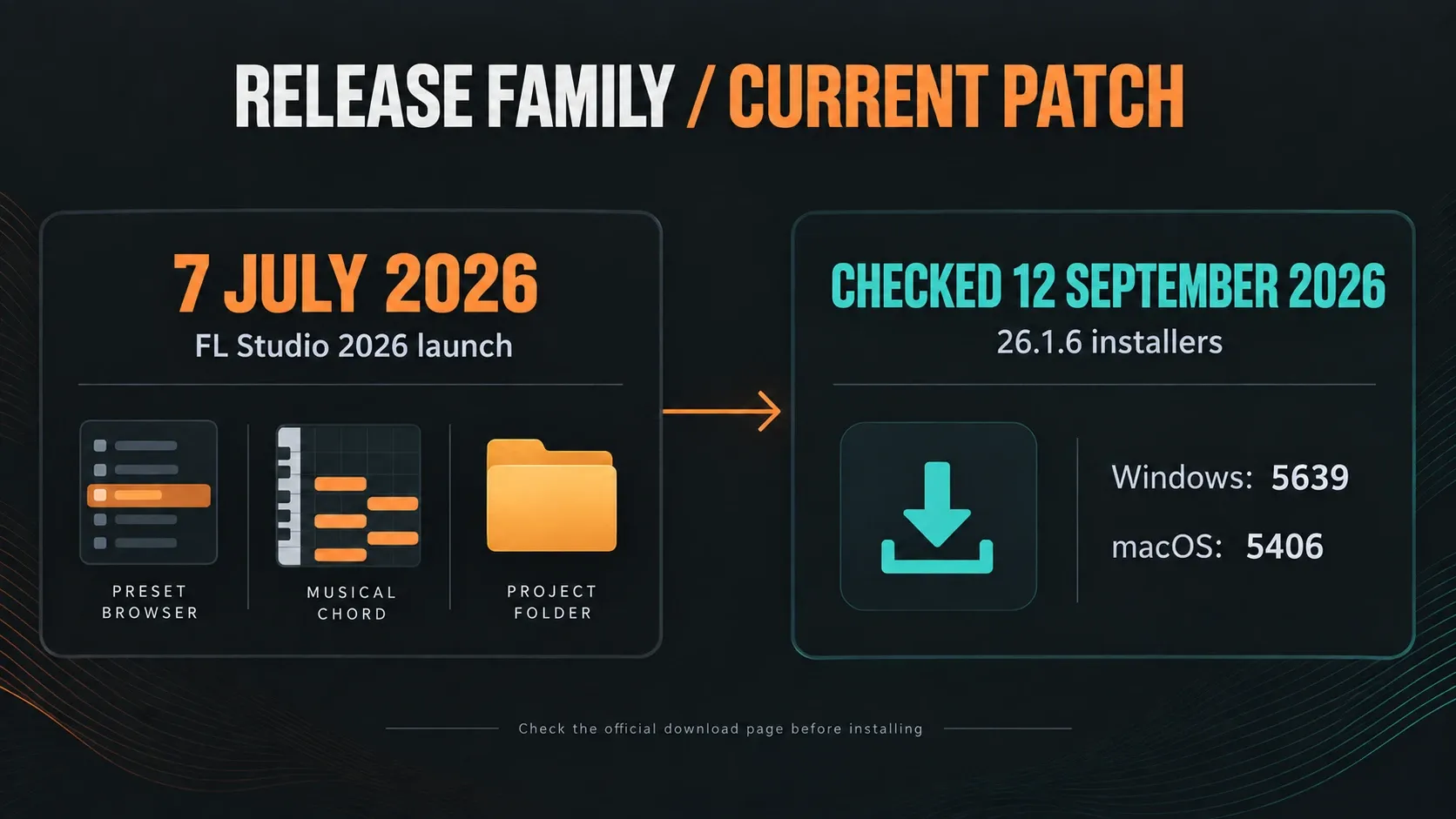
The 26.1.6 patch adds Master and Current checkboxes when splitting Mixer tracks, fractional values in the Plugin Performance Monitor and a notification for a newly connected MIDI controller. Its fixes include specific project-loading and consolidated-sample deletion problems. Read the notes for your build rather than assuming every problem is fixed. The Mixer’s 24-bit disk-recording option arrived in the earlier 26.1.5 patch, not with every July launch feature.
What changed in FL Studio 2026: the useful map
| Change | Who benefits | Boundary to remember |
|---|---|---|
| Rebuilt FLEX | Producers who browse and recall many presets | CPU claims depend on the generation of the pack in use. |
| FL Cloud Project Backup | Anyone who wants another recovery copy | Storage varies by Cloud tier; keep local and external copies. |
| Gopher controls | Users testing bounded organization and routing tasks | The manual calls it experimental and says it controls some features. |
| Chord and MIDI tools | Writers exploring harmony or labeled key maps | Detection and stamps assist decisions; they do not finish the arrangement. |
| Remix a Song | Producers starting from permitted source audio | Stem separation does not grant copyright permission. |
| Audio Logger | Anyone who just missed capturing a good output moment | Temporary audio through the Master; not saved project state. |
| Transmitter | Sound designers splitting transient and sustain paths | Included in All Plugins Edition; check your licence. |
| Plugin Manager and macOS work | Large plugin libraries and Apple Silicon systems | No update can guarantee every third-party plugin or driver. |
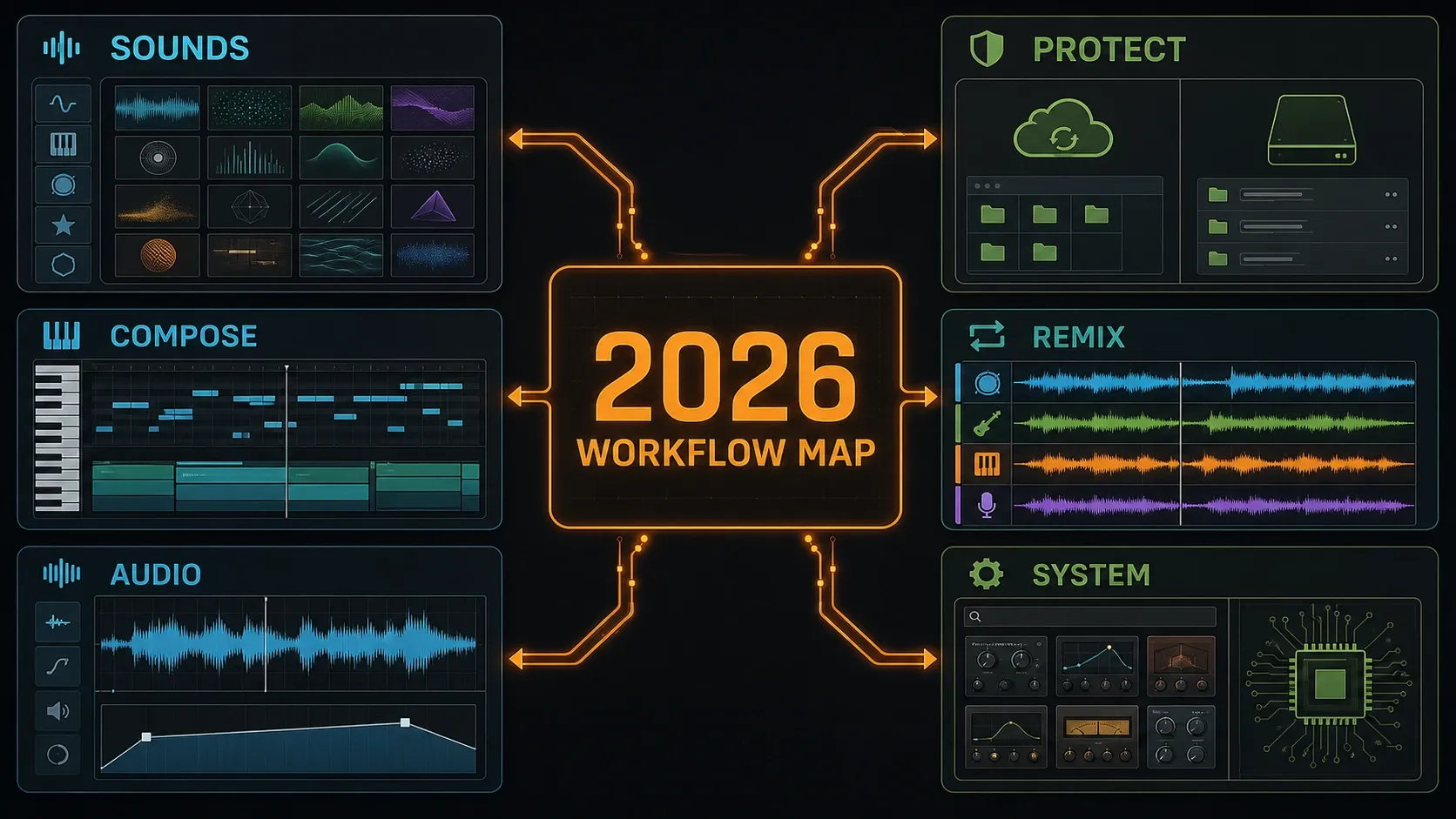
Pick a repeated job: finding a usable preset, saving a separate project copy, identifying a chord or capturing something you just heard. The 2026 release overview explains the headline additions. You do not need to change an entire working setup to try one of them.
FLEX is rebuilt around browsing, packs and recall
FLEX has a rebuilt engine and interface, with revised pack and preset browsing. Image-Line’s release announcement lists more than 200 presets across eight new Core Series packs for all users. Start with a sound you already use: find its pack, audition a replacement and compare it at a similar level before changing the arrangement.
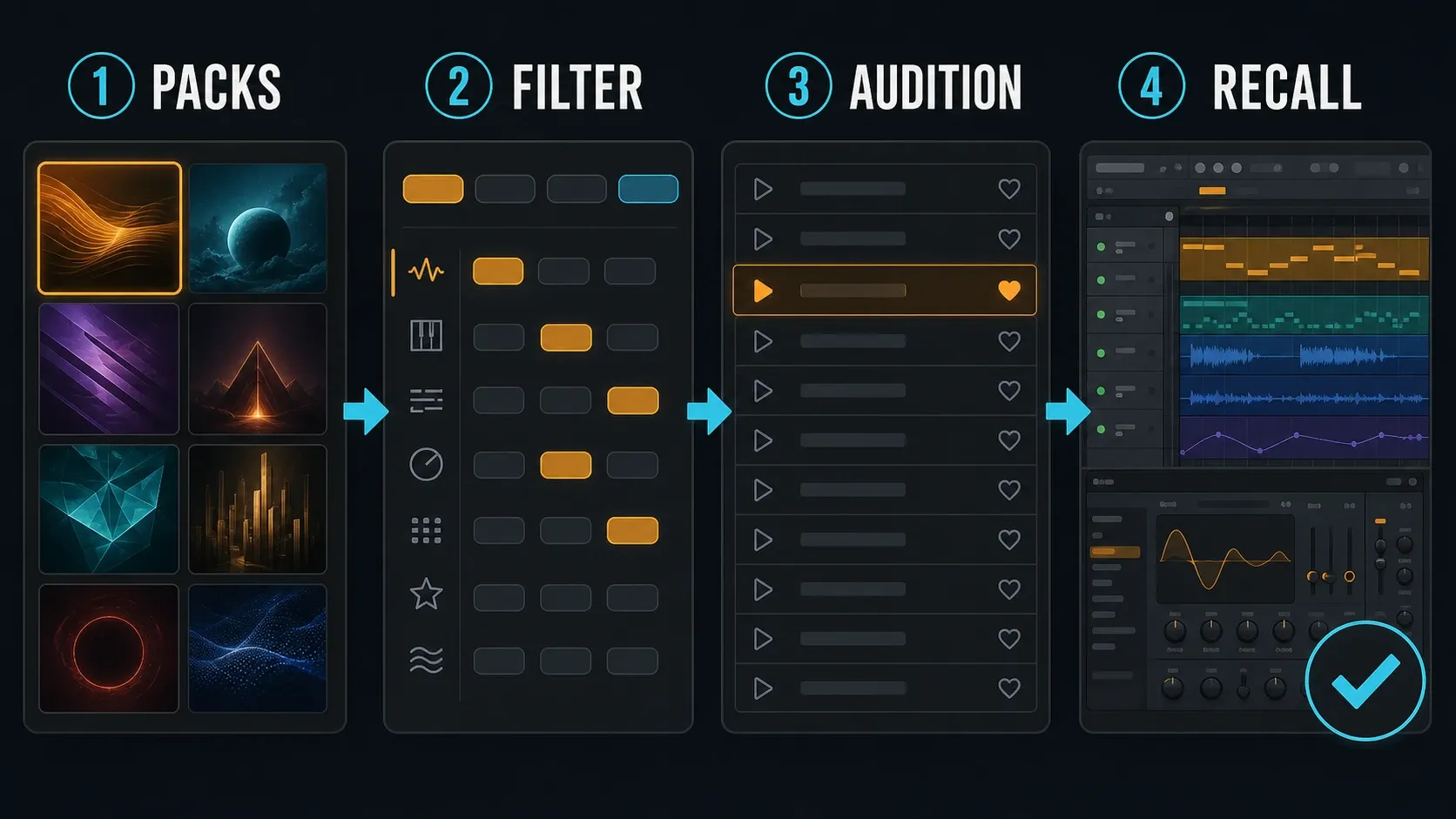
Image-Line qualifies its claim of up to 50% lower FLEX CPU use: it applies to second-generation packs. It is not a promise that every old project or computer will halve its load. On a duplicate project, keep the audio settings and played passage consistent, note the pack and preset, and check whether the change actually helps your session.
Use the FLEX workflow guide for browsing, pack management and missing sounds. In an unlocked installation, check that the chosen preset returns after saving and reopening the test copy. Finding a sound quickly is useful; keeping the song recallable matters more.
Project Backup adds a cloud layer, not a replacement for local copies
For FL Studio licence holders, project backup is available through File → Save and back up to FL Cloud. Enabling Settings → Project → Back up to FL Cloud Storage also uploads when you save. The Browser documentation makes two limits clear: this is not continuous background synchronization, and saving the same project name overwrites its existing cloud copy. Use another name when you need another version.
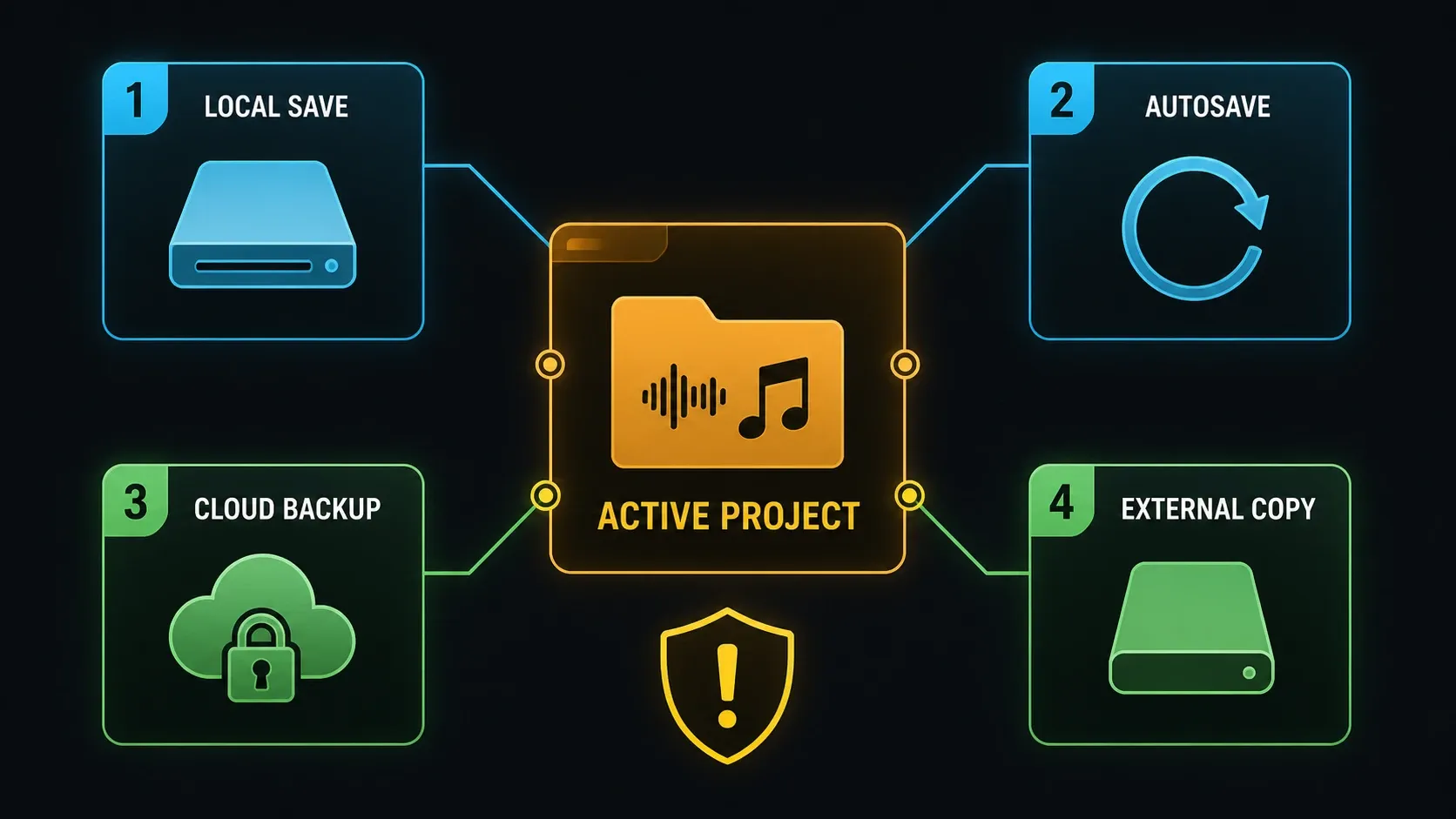
Image-Line’s storage FAQ lists 500 MB for Free, 5 GB for Plus and 1 TB for Pro, and says stored creative data is not used for AI training. These are the provider’s terms, not an independent security audit. Quotas and retention rules apply; keep an external or separately versioned backup rather than relying on indefinite cloud retention.
A cloud download is a ZIP project, not a complete replacement computer: separately installed plugins and their libraries still need attention. The FL Cloud Project Backup guide covers setup and restore checks. Use local autosave and backup for the separate job of recovering recent project revisions.
What does Audio Logger actually save?
The current Audio Logger documentation describes a rolling memory buffer with a maximum length of 1, 2, 5 or 10 minutes. It captures audio passing through the Master. Choose either before the Master effects or after those effects but before the Master fader. The launch page’s sixty-second summary is narrower than these current settings.
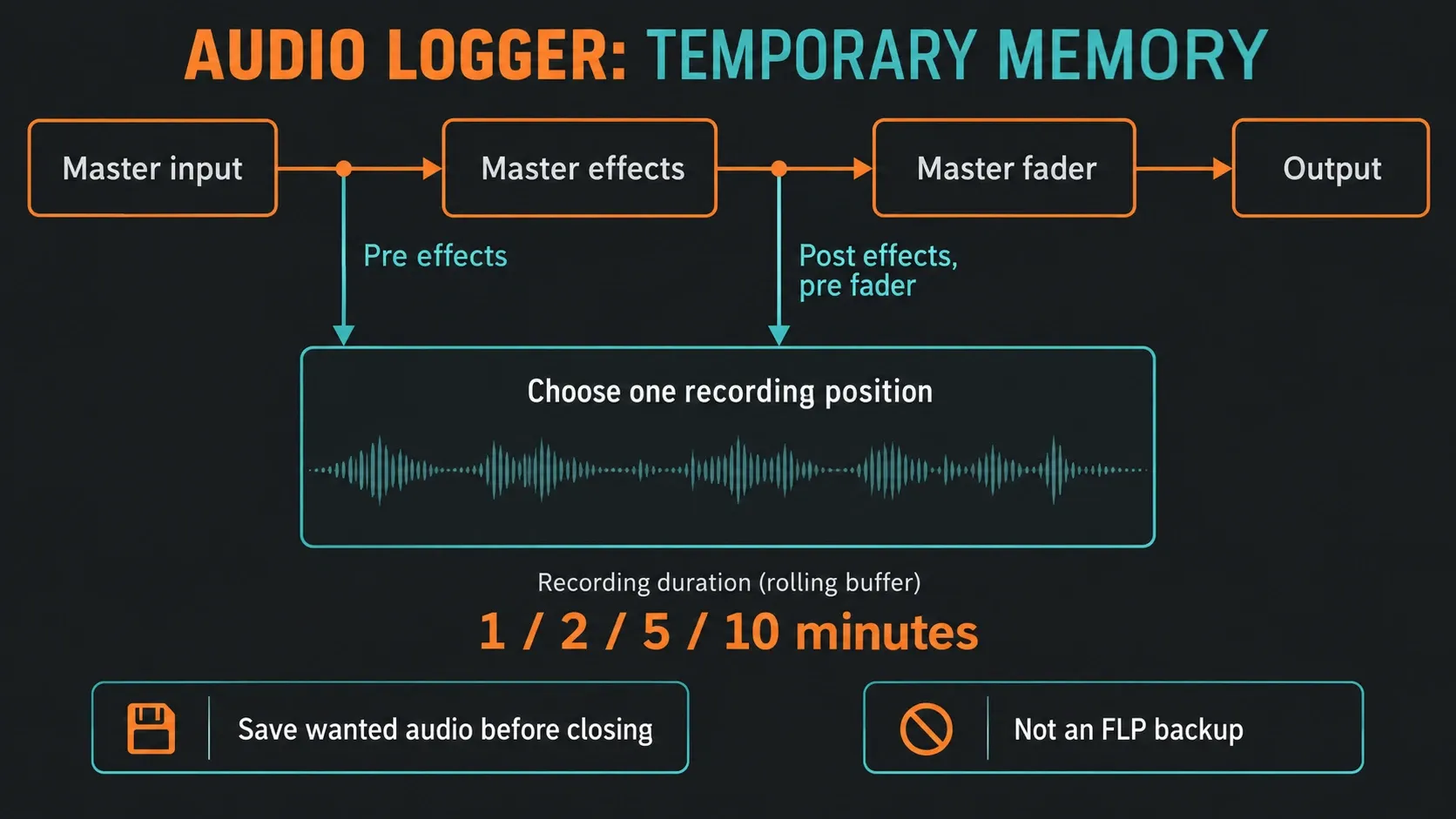
The log disappears when FL Studio closes and is not stored in the FLP. Save wanted audio explicitly before closing. A monitored microphone can be included if it is routed through the Master; the logger is not a separate raw-input recorder. Keep normal recording and project backups in place. For example, it can help preserve a synth gesture you just heard, but not recover the editable notes and routing that made it.
Gopher is experimental, so give it bounded work
The Gopher control manual calls project control experimental. It can perform supported tasks such as renaming channels or changing routing; plugin control depends on the parameters the plugin exposes. Requests needing project access require your approval. A confident answer is not proof that the resulting edit is correct.
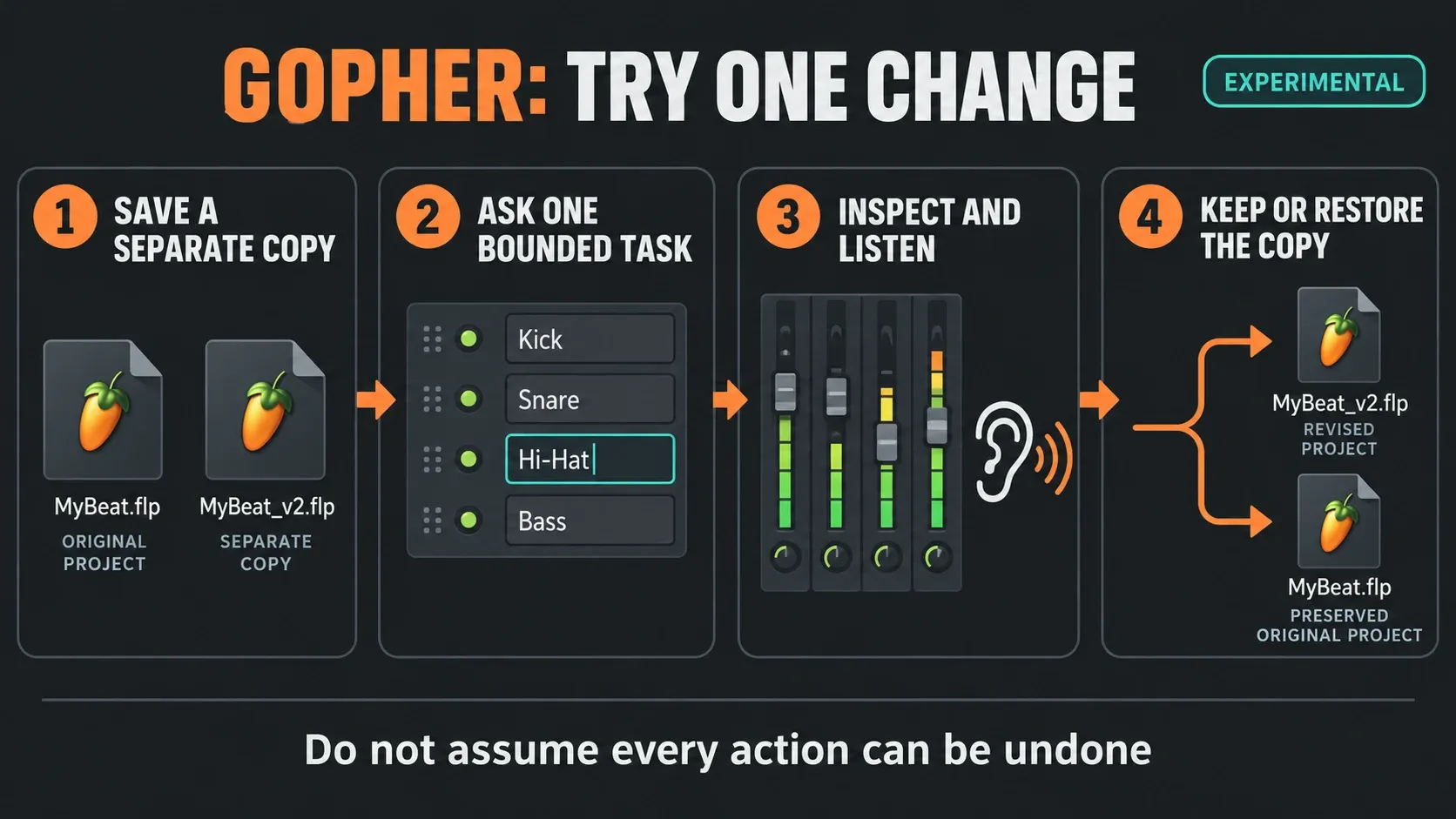
Save a separate copy first. Ask for one small change, such as renaming one identified channel. Inspect the affected channel or Mixer route and listen before keeping it. If the result is wrong, restore the preserved copy; do not assume every action has a complete Undo path. Keep generated scripts away from the only copy of an important project until you understand their effects.
Chord tools shorten navigation without making the musical decision
Chord Detection identifies notes played through MIDI, the typing keyboard or a Piano Roll selection, with a documented maximum of ten notes. Chord Stamp and Chord Progression are separate tools, not later automatic stages of detection. The 2026 update adds top-down and bottom-up stamp modes with voice leading, plus editable key labels in the Piano Roll.
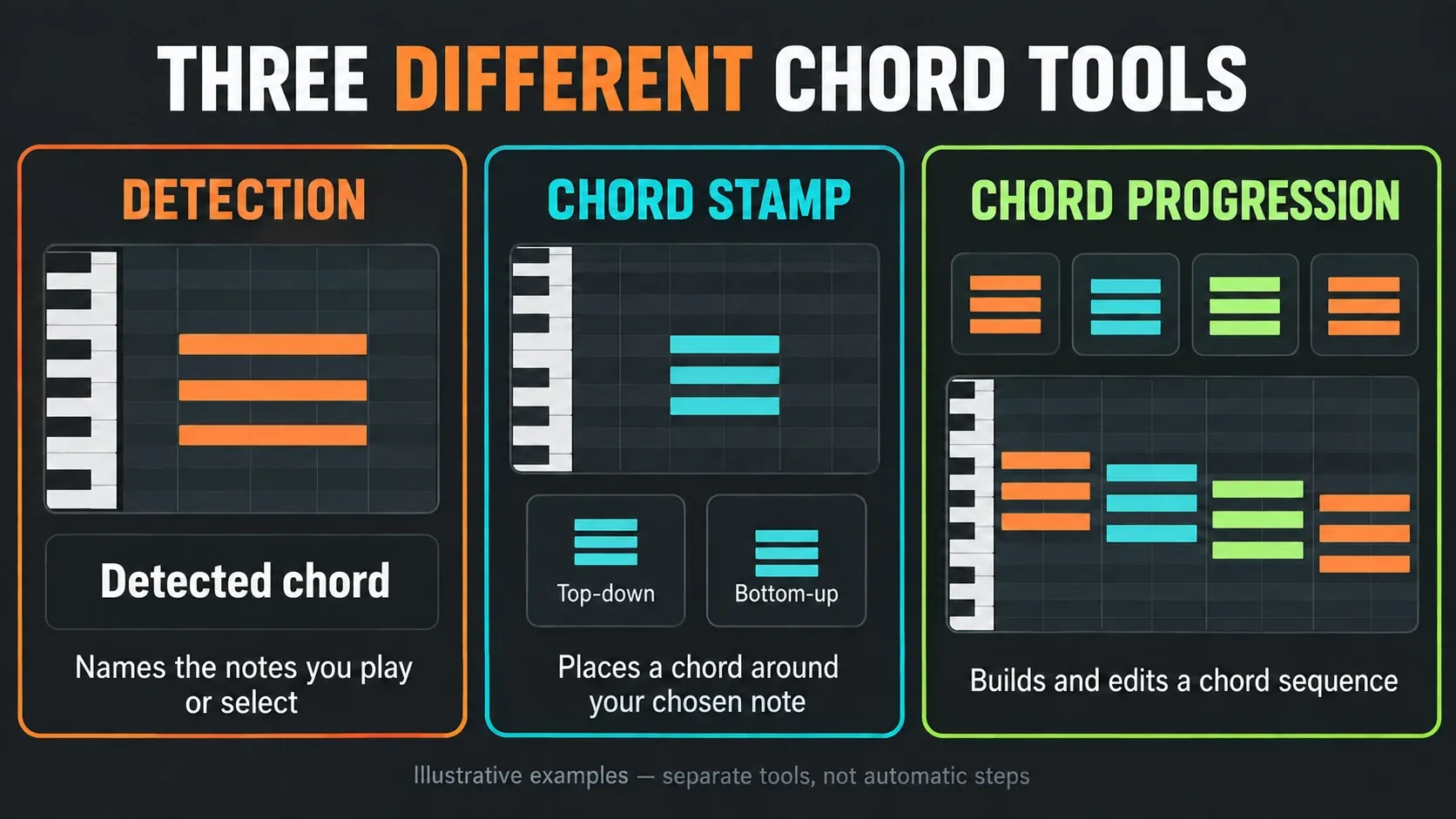
Use detection when you want a name for the notes already present. Use a stamp to place a chord around a chosen note, or the progression tool to explore a sequence. Then edit the notes yourself. A chord label does not tell you whether the bass clashes with it or whether the voicing leaves room for the vocal.
The Chord Stamp instructions explain the distinction: top-down uses the clicked note as the top of the chord; bottom-up chooses a chord for the pitch area, and that clicked note need not be included. The Piano Roll guide explains editing; the MIDI recording guide handles capture. The update does not replace checking your controller and listening to the recorded phrase.
Remix a Song accelerates separation, not permission
Tools → Remix a song opens a workflow that loads and separates a track into the Playlist. Use your own recording or material you have permission to work with. It can provide editable starting material, but it does not turn the source into clean, original multitrack recordings.
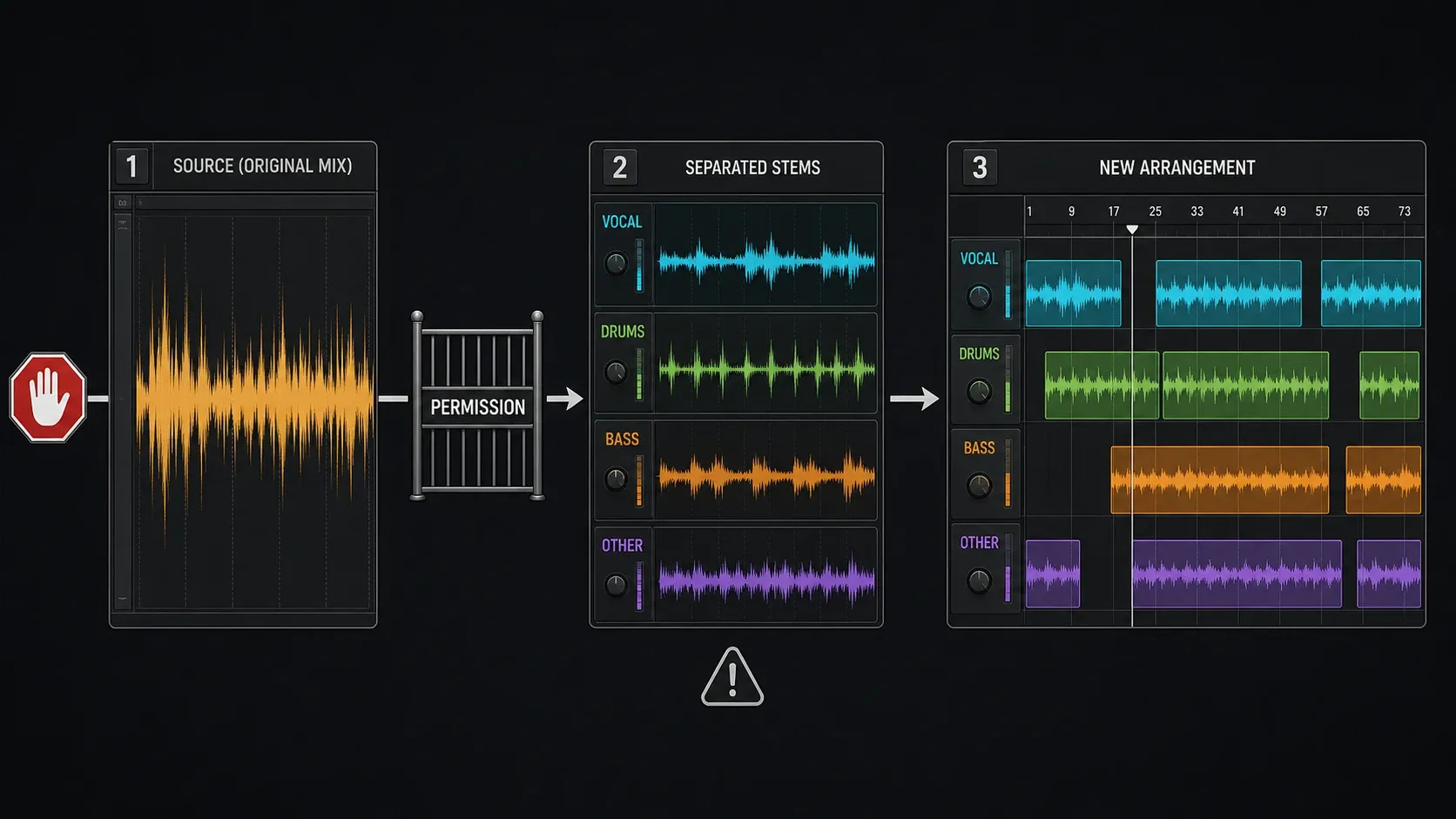
Separation quality depends on the source and overlap between sounds. A vocal with strong reverb may leave material in other stems; distorted guitars may share energy with drums or bass. More importantly, technical access is not a license. Separating a commercial recording does not give you the right to distribute the original performance, samples or derivative remix.
Use the stem separation guide for extraction and cleanup. When you are delivering your own production to another mixer, follow the stem export workflow instead. Pulling components out of a finished mix and exporting your existing tracks are different jobs.
Clip gain, normalization and Luxeverb are practical quality-of-life changes
The Audio Clip Gain controls offer individual and group normalization. Individual mode treats each clip by its own peak; group mode applies a change relative to the loudest peak while preserving the group’s level balance. The Clip Properties window also has pan and selection-dependent controls. Check which clips are selected before changing them.
Neither normalization mode balances a mix or masters it to a streaming loudness target. A quiet breath or room noise can become more obvious when raised. Listen in context and check the peak level afterward. The Playlist guide, Mixer guide and audio settings guide cover the next checks.
LuxeVerb gains Pitch Feedforward and 100 presets in the 2026 release. Its Pitch section documentation distinguishes feedforward from a feedback loop. Try a preset at a sensible listening level, then check pre-delay, decay, bass buildup and the dry/wet balance instead of treating the preset name as a mix decision.
Which edition includes Transmitter?
The Transmitter manual describes independent transient and sustain processing. Try it on a drum sound when you want different treatment for the attack and body. If you use its separate output routing, check the direct path too: an unintended duplicate path can change the level and invalidate the comparison.
Transmitter is included in All Plugins Edition. Check your account and current product offer before paying for access; installing the update alone does not unlock every plugin. The FL Studio editions guide compares bundles, while the stock plugins guide helps you see what you already have.
Free update, edition feature and FL Cloud service are separate access layers
A software update, an edition upgrade and a Cloud subscription are different purchases. The same FL Studio installer serves the editions, and your licence determines what is unlocked. Updating Fruity does not turn it into Producer, Signature or All Plugins. Use the edition and trial documentation to check access rather than counting installed plugin names.
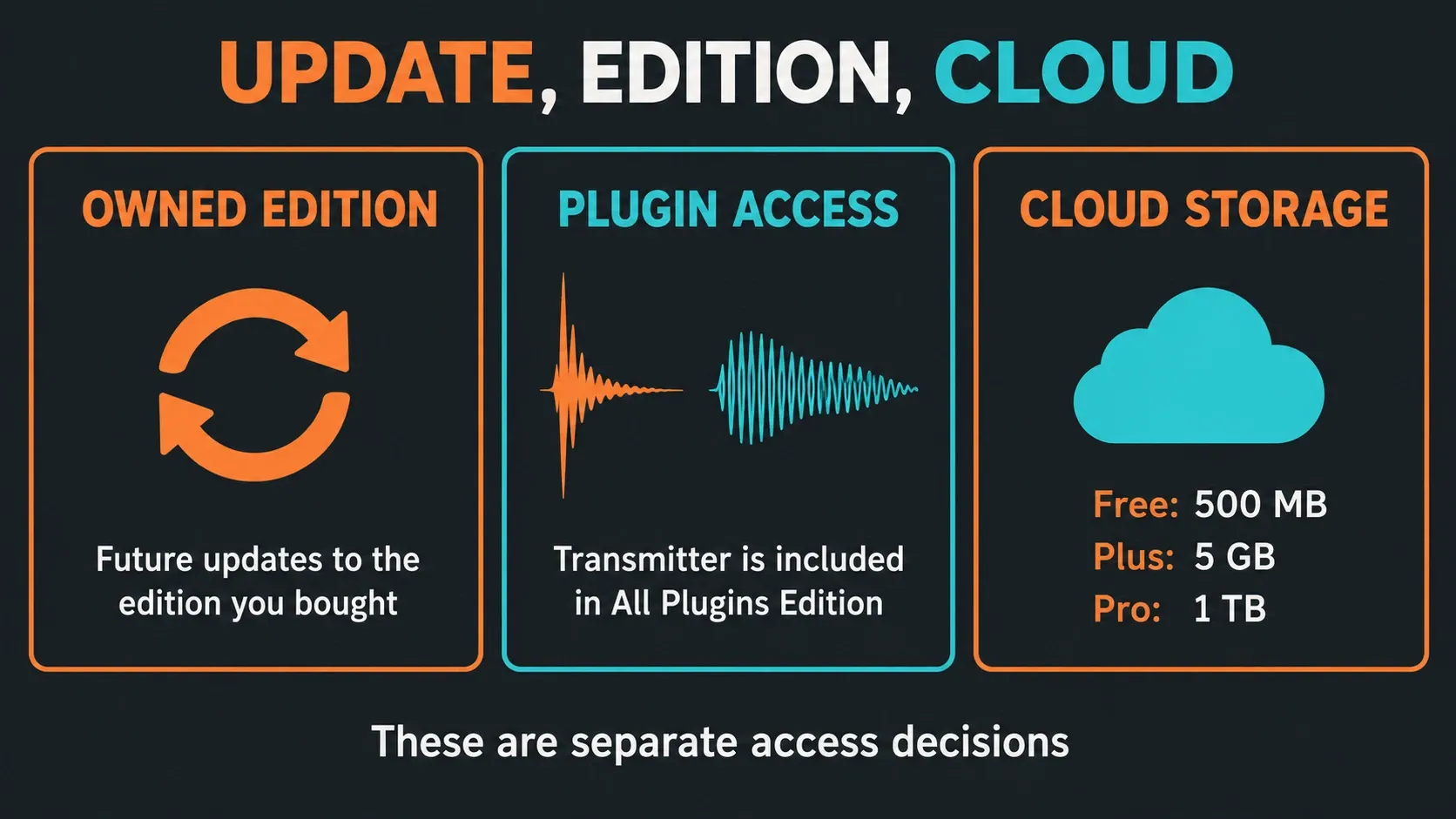
Audio recording starts with Producer Edition. FL Cloud Plus and Pro are optional services, not FL Studio application licences; subscribing will not unlock the FL Studio trial. Match the licence to the task before you start a project that depends on a paid tool.
New buyers should list the recording and editing work they need. Existing owners should open the discount guide only after identifying a missing feature. A reduced price is not a reason to buy a bundle you will not use.
What changed for plugins and Apple Silicon?
FL Studio 2026 improves Plugin Manager speed for large lists, adds a warning before “Rescan all,” and offers a Waves re-verification option. Those changes can make maintenance clearer. They do not guarantee that every VST3, Audio Unit, authorization manager or old preset will work after an operating-system or architecture change.
On macOS, FL Studio adds separate input and output selectors in Audio Settings. It also uses Apple’s Audio Workgroups API on Apple Silicon to reduce underrun risk during sudden CPU increases. “Reduce risk” is the honest boundary; it is not a promise that every crackle, driver issue or heavy plugin chain disappears.
Before updating, make a list of essential plugins and their versions. The plugin installation guide covers scan locations; the missing-plugin checklist handles failed scans. Use the Apple Silicon compatibility guide when native versus Rosetta mode is part of the problem.
Should existing owners update now?
Try the update when one feature solves a current problem and you have time to check a copied session. A FLEX pack you use, a specific fixed bug or the Audio Logger may be a better reason than the year on the splash screen. Confirm that your essential plugins and interface support the intended environment first.
Wait until after a deadline if you have no recoverable backup or depend on a plugin you cannot readily reinstall. Preserve the pre-update project and working setup. A test copy that opens is useful evidence for that copy—not a guarantee that every older session will behave the same way.
For a new installation, check the system requirements, follow the installation guide, then make the first-project tutorial. The trial can save and export, but cannot reopen saved projects until purchase. Choose a trial edition that supports the tasks you want to try.
Update FL Studio 2026 in eight controlled steps
Follow Image-Line’s installation and update instructions without uninstalling first. Important Mac exception: personal files inside the FL Studio app bundle can be deleted when the bundle is replaced. Move those files outside it before updating. If you need a parallel installation, follow the platform-specific method in that manual rather than assuming every installer preserves the older app.
- Record your setup. Note the installed build, audio device, sample rate, buffer, plugin versions and custom media paths.
- Back up originals. Copy the original FLPs, user data, recordings and required external libraries to a separate location. Keep the pre-update project untouched.
- Get the official installer. Download the current supported installer from Image-Line, check its build and close FL Studio before installing.
- Install and unlock. Follow the platform-specific update instructions and unlock with your account. Do not store personal data inside the Mac app bundle.
- Open a duplicate. Use a copied project to check audio, MIDI, automation and routing. Stop if essential media or plugins are missing.
- Check plugins and media. Verify the required licences and sounds before resaving. Do not overwrite the original when trial plugins are missing; their settings can be lost after resaving.
- Render and reopen. Export and listen to a reference. In an unlocked installation with the required plugins, close and reopen the test copy. The standard trial cannot perform this reopening check.
- Keep the original. Retain the pre-update project and backup after adopting the new build. A newly saved FLP may not open in an older version; use the preserved original if returning to the older setup.
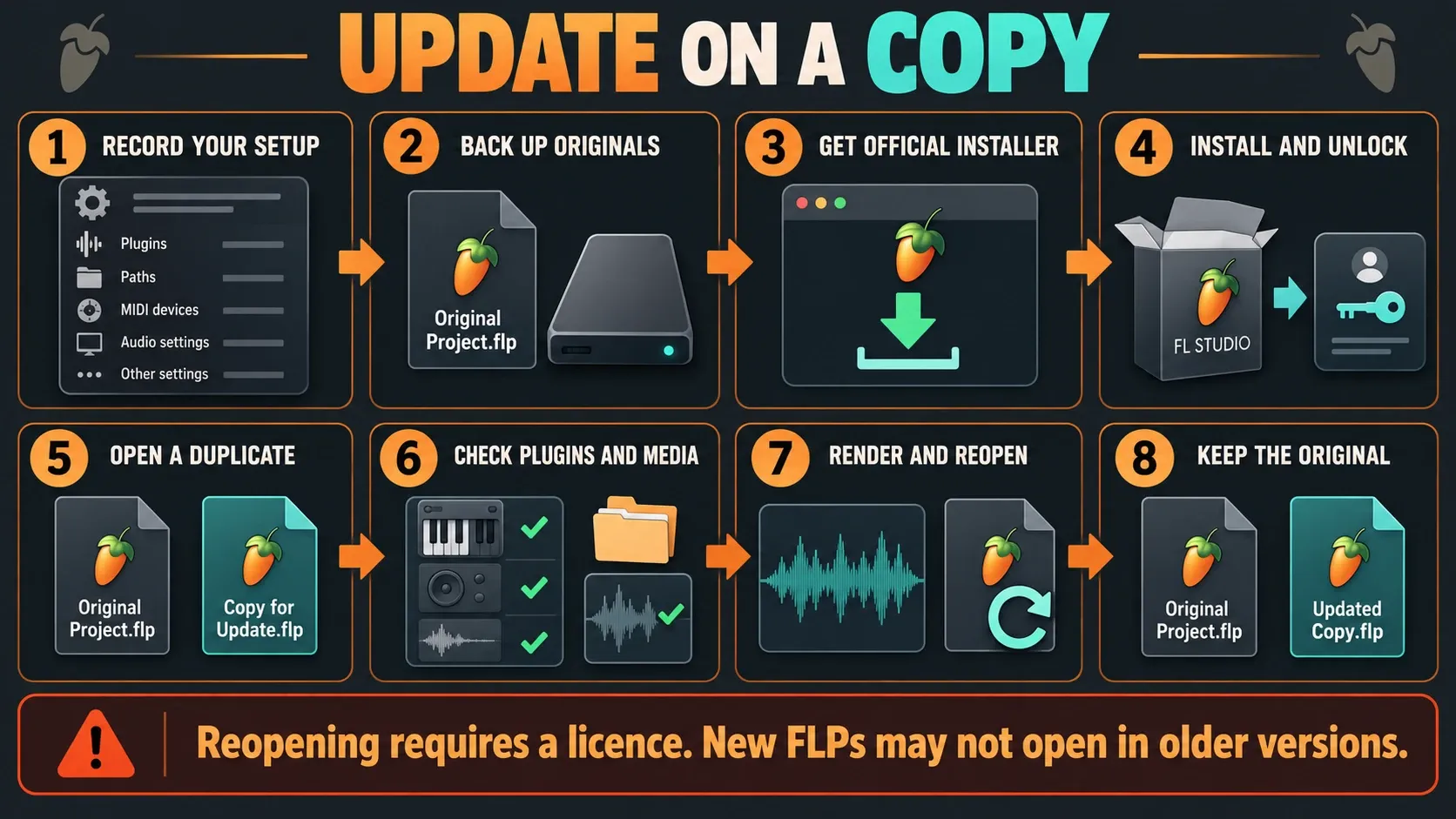
Image-Line warns that resaving while trial plugins are missing can lose their settings. Separately, its project compatibility notes warn that projects saved in newer versions may not work in older ones. Keep both the original and updated copy until you are satisfied with the result.
FL Studio 2026 FAQ
What is the latest version of FL Studio 2026?
Checked September 12, 2026, the official installers are 26.1.6.5639 for Windows and 26.1.6.5406 for macOS. Check the official download page again before installing; patch numbers can change.
Is FL Studio 2026 a free update?
Licensed owners receive updates to the edition they bought under Lifetime Free Updates. Higher editions, optional paid plugins and paid FL Cloud services are separate. A Cloud subscription does not unlock the FL Studio trial.
Do I need to uninstall FL Studio before updating?
No. Follow the current official installer instructions without uninstalling first. Back up user files, move any personal data out of the Mac app bundle, and unlock after updating. Test a copied project rather than overwriting the original.
What is new in FLEX for FL Studio 2026?
FLEX has a rebuilt engine and interface with revised browsing. Image-Line announced more than 200 presets in eight new Core Series packs. Its claim of up to 50% lower CPU use applies to second-generation packs, not every preset or project.
Is Gopher safe to use on a real project?
Gopher project control is experimental. Save a separate copy, ask for one bounded change, inspect and listen, then keep the result or restore the copy. Do not assume every action can be undone or that every plugin exposes the required controls.
Does FL Cloud Project Backup replace local backups?
No. Uploads depend on saving, quotas apply, and a project with the same name overwrites its previous cloud copy. Keep local and separately versioned backups, plus the required plugins and libraries. Check a downloaded copy before relying on it.
What does Audio Logger record?
Audio through the Master, at either a pre-effects or post-effects/pre-fader position, into a rolling memory buffer with a maximum of 1, 2, 5 or 10 minutes. Save wanted audio before closing FL Studio. It does not preserve FLP project state.
Which FL Studio edition includes Transmitter?
Transmitter is included in All Plugins Edition. It separates transient and sustain processing. Check your account and the current offer before paying for access; downloading FL Studio 2026 does not automatically unlock every installed plugin.
Should you update to FL Studio 2026?
Update for a feature you will use or a fix relevant to your work, with enough time to test a duplicate. Keep the limits in view: temporary audio is not a project backup, Cloud storage is not unlimited version history, and an experimental assistant still needs inspection.
If you are still choosing a DAW, compare FL Studio and Ableton Live, Logic Pro or REAPER using the work you actually do. Return to Compare & Buy for the edition decision, or Start Here when you are ready to set up the first project.