FL Studio
Vocodex needs two signals before it can make one useful sound. The modulator supplies the changing spectral shape, usually from speech or singing. The carrier supplies the pitch and timbre, usually from a bright synth. Vocodex analyzes the modulator in frequency bands and uses that movement to open corresponding parts of the carrier. That is how a sustained chord can appear to speak.
The plugin is included in FL Studio Producer Edition and higher in Image-Line’s current edition comparison. The difficult part is rarely loading it. Most failures come from one of three decisions: the wrong signal reaches MOD or CAR, the carrier does not contain enough useful frequency content, or the settings erase the consonants that make words recognizable.
Carrier and modulator in plain language
Think of the modulator as a moving stencil and the carrier as the material pushed through it. A spoken phrase changes the stencil continuously. A synth chord supplies a steady, pitched texture. You hear the carrier, but its frequency balance moves according to the voice.
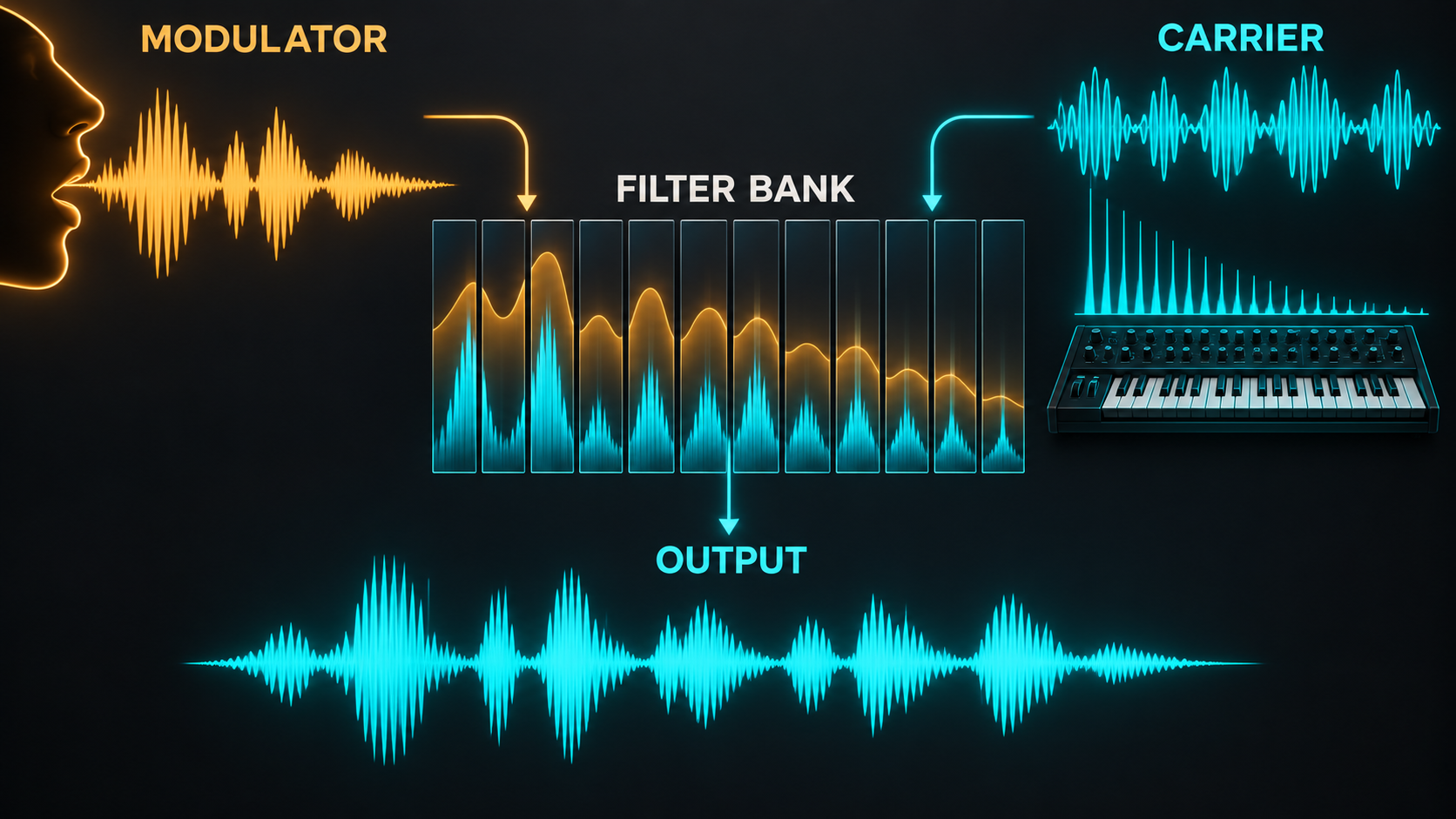
Image-Line’s Vocodex manual describes the engine as a bank of band-pass filters. Each band responds to energy detected in the same region of the modulator. If the voice contains energy in a band but the carrier has nothing there, the opened band has little material to pass. This is why a thin sine-like carrier can produce less readable speech than a bright, harmonically dense sound.
Read Vocodex as a signal path
The interface looks dense because several systems share one window. Read it from input and mix controls, through the envelope follower and band distribution, into the mapping display and output character controls.
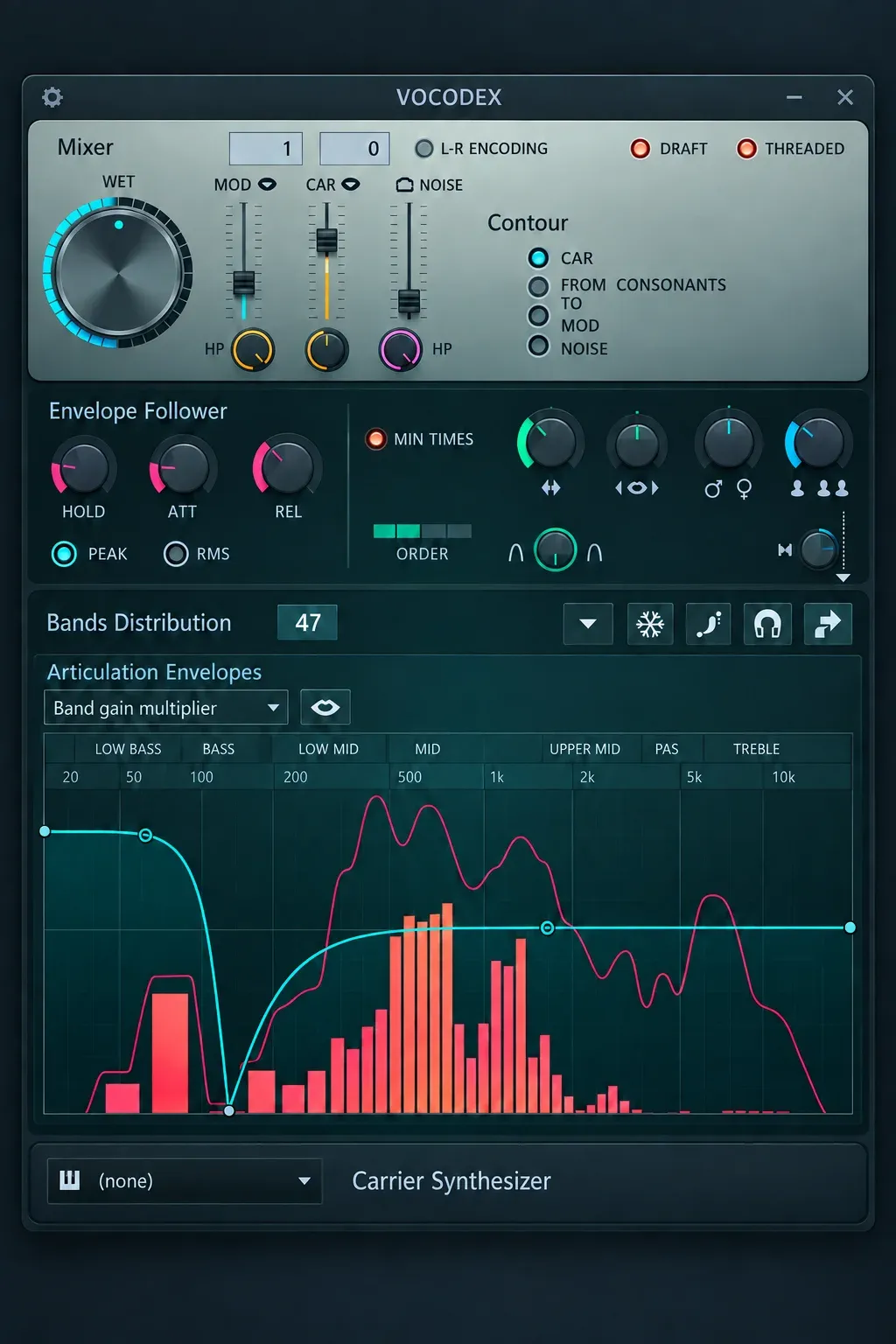
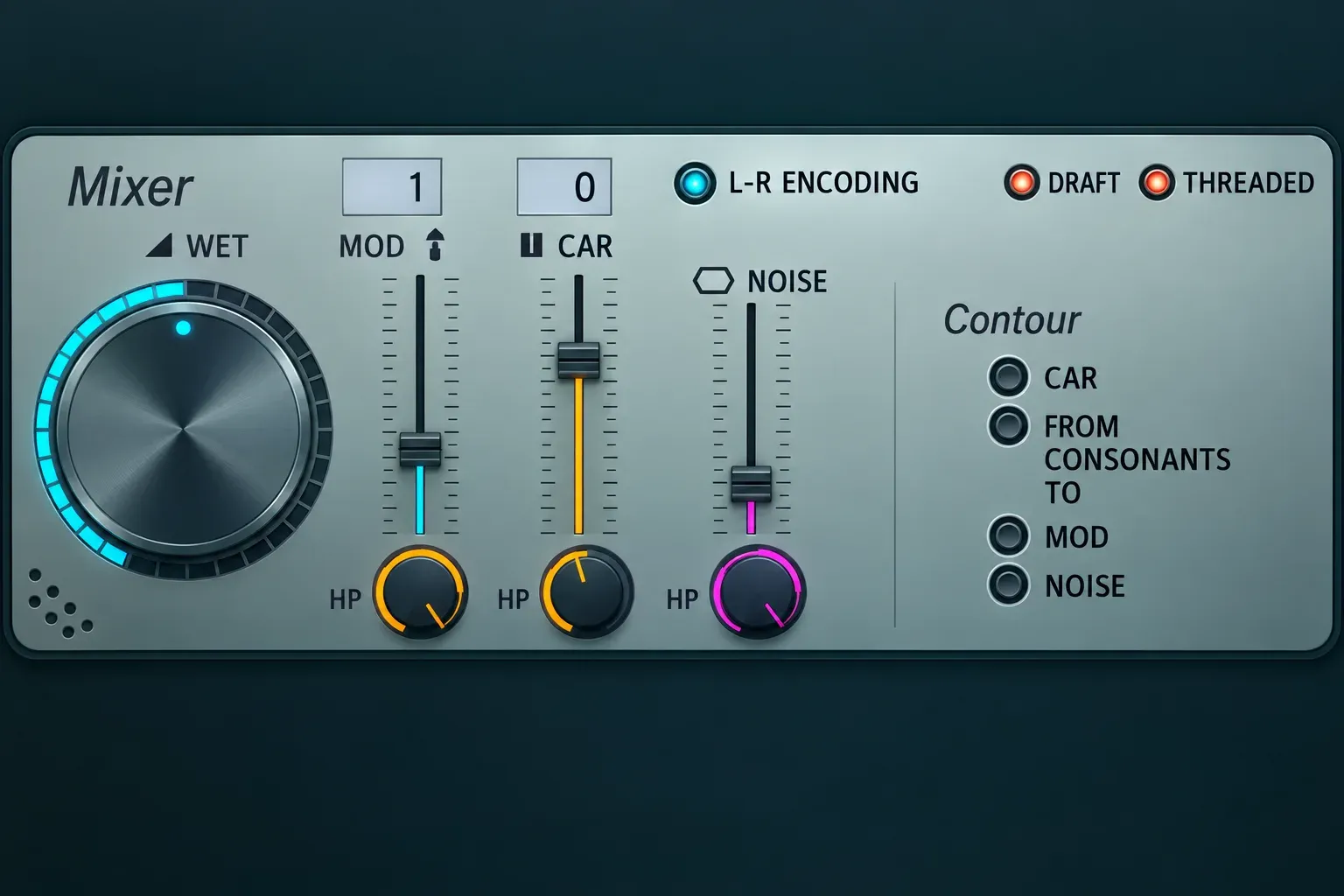
- WET sets the vocoded effect level.
- MOD and CAR select incoming Mixer sources and also provide pass-through controls.
- NOISE adds broadband material to the carrier path.
- Contour can make MOD pass-through or noise respond to the carrier envelope or detected consonants.
- Envelope Follower sets how quickly band levels react and recover.
- Band Distribution controls band count, filter behavior and analysis width.
- Modulation Mappings shape behavior across the spectrum instead of applying one setting equally to every band.
Do not start by drawing mapping envelopes. First prove that the right modulator and carrier reach the plugin. A sophisticated mapping cannot repair an empty input.
Use the internal carrier for a fast orientation
Vocodex includes an internal carrier synthesizer. Image-Line positions it mainly as a live demonstration method. Load Vocodex on a Mixer insert other than Master, send a voice or microphone to that insert, choose an Immediate preset, select an internal carrier sound and play the on-screen keyboard or a MIDI controller while the voice runs.
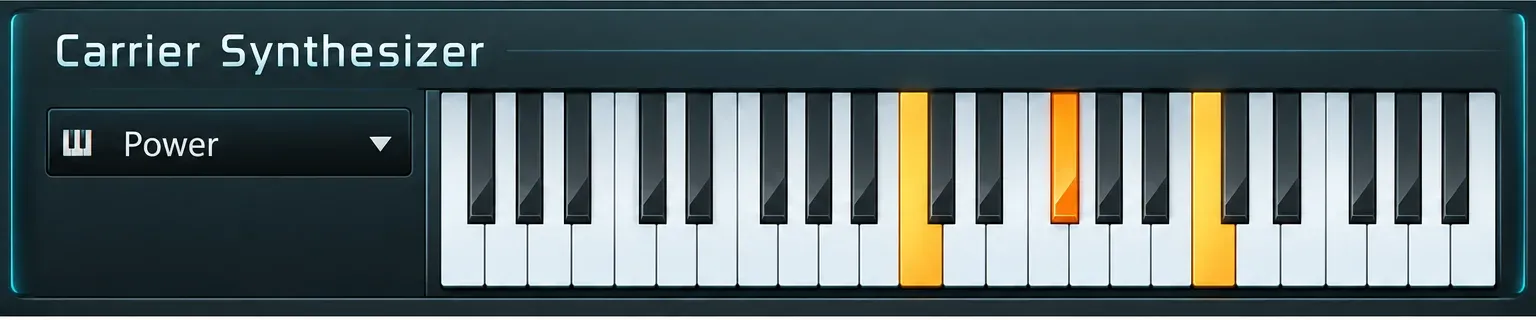
This method is useful for learning the relationship: one spoken phrase can produce different results when the latched carrier chord changes. It is less useful for arranging a project because Vocodex is loaded as an effect. The internal carrier does not receive Piano Roll notes through the normal generator path.
My rule is simple: use the internal carrier to confirm what vocoding does, then move to an external synth for an arrangement you need to edit. The official Vocodex input guide makes the same production distinction.
Build the external production route
The production method gives the carrier its own Channel and Piano Roll pattern. It also keeps the dry voice from leaking to Master unless you deliberately pass some of it through Vocodex. If the route still feels abstract, the FL Studio Mixer guide explains how inserts, sends and destinations relate before you trace the same path inside Vocodex.
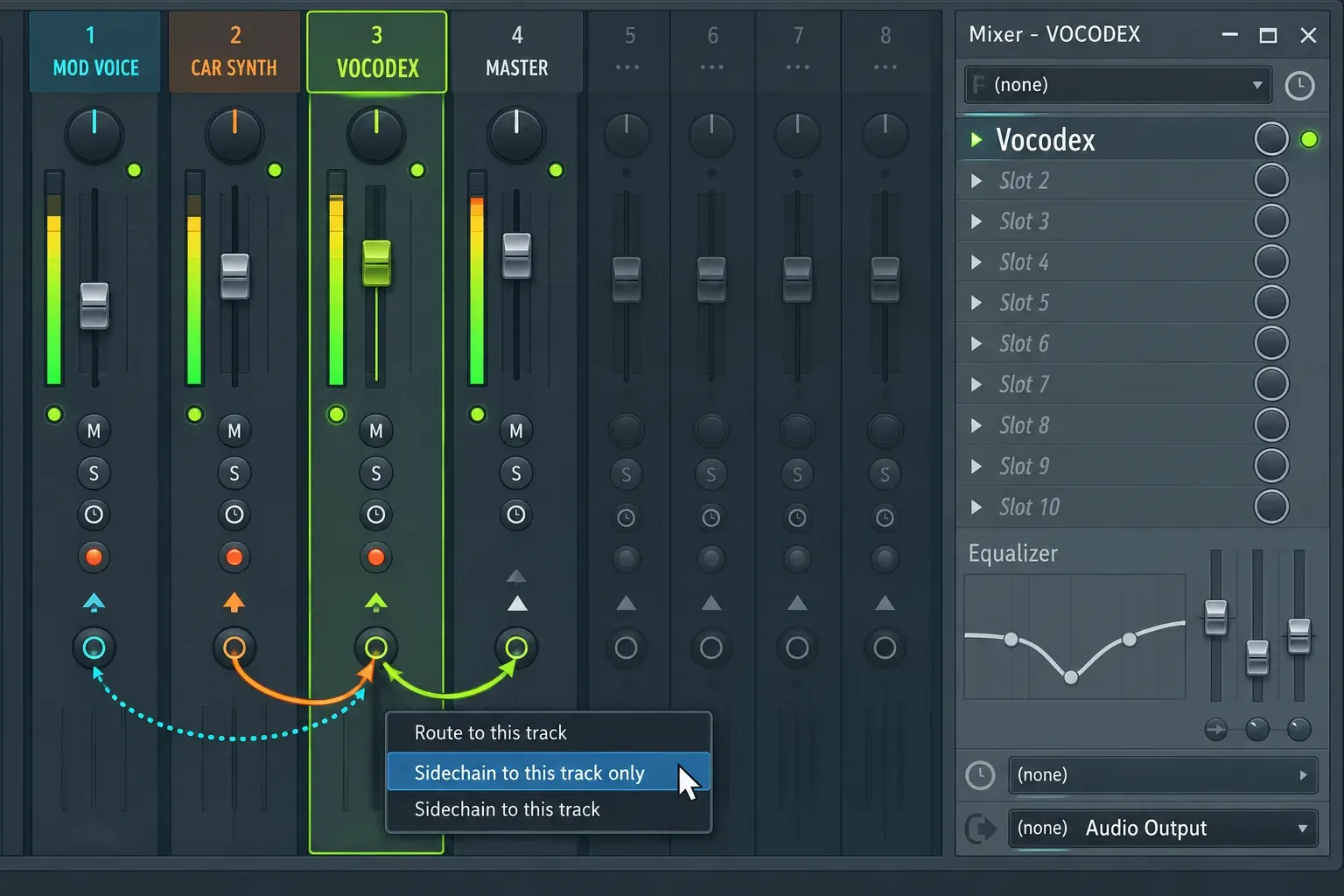
- Create three named Mixer inserts: MOD, CAR and VOCODEX. Naming them prevents the input selector list from becoming guesswork.
- Put Vocodex on the VOCODEX insert. Keep it away from Master so the rest of the project does not become part of either input.
- Send the voice to MOD. Select MOD, right-click the send switch below VOCODEX and choose Sidechain to this track only. This removes the MOD track’s direct Master path while keeping a control input available to Vocodex.
- Route the synth carrier to VOCODEX. Assign the carrier generator to the VOCODEX insert or create the required Mixer route.
- Open Vocodex and select the correct sources. Confirm MOD and CAR from the plugin’s own selectors instead of assuming the first available sidechain is correct.
The broader FL Studio sidechain guide explains source-to-destination routing in detail. Here the sidechain carries actual modulator audio for Vocodex analysis rather than only driving a compressor detector.
Understand 0, numbered inputs and ---
Vocodex’s input labels are offsets among Mixer tracks routed or sidechained to its own insert. Right-click a selector to see the available source tracks. Clear Mixer names make that menu much safer.
- 0: use audio passing through the same Mixer insert that hosts Vocodex.
- A numbered or named sidechain: use that routed Mixer source.
- ---: disable the external input. Immediate presets use this for CAR when the internal carrier is active.
A common production route places the external carrier directly on the VOCODEX insert, so CAR can remain at 0, while MOD points to the separate sidechained voice track. Another valid route sidechains both sources and selects each inside the plugin. The useful configuration is the one you can trace without ambiguity.
Choose a carrier that can speak
A carrier needs energy across the regions that contain intelligibility cues. Bright pads, saw-based chords and harmonically rich stacks are dependable starting categories because they give the filter bank material to reveal. A dark or narrow patch can lose whole parts of the phrase even when routing is correct.
Stereo carriers remain stereo through Vocodex; a mono carrier remains mono. Width can make the result feel larger, but it does not fix missing consonants or an unsuitable spectrum. Start with a stable, broad sound, confirm the words, then add movement and width.
If you want to build the source rather than browse presets, the 3xOSC guide gives a simple harmonic starting point, while the Sytrus guide explains richer detuned carrier design. Keep that synthesis work separate from Vocodex troubleshooting: first prove the route with a predictable carrier.
Set bands and bandwidth for the words you need
Vocodex supports 5 to 100 bands. More bands create finer spectral slices, but Image-Line explicitly warns that more is not always better and increases CPU use. Classic vocoder effects often use roughly 8–16 bands, which is useful evidence that low counts are a character choice rather than a defective setup.
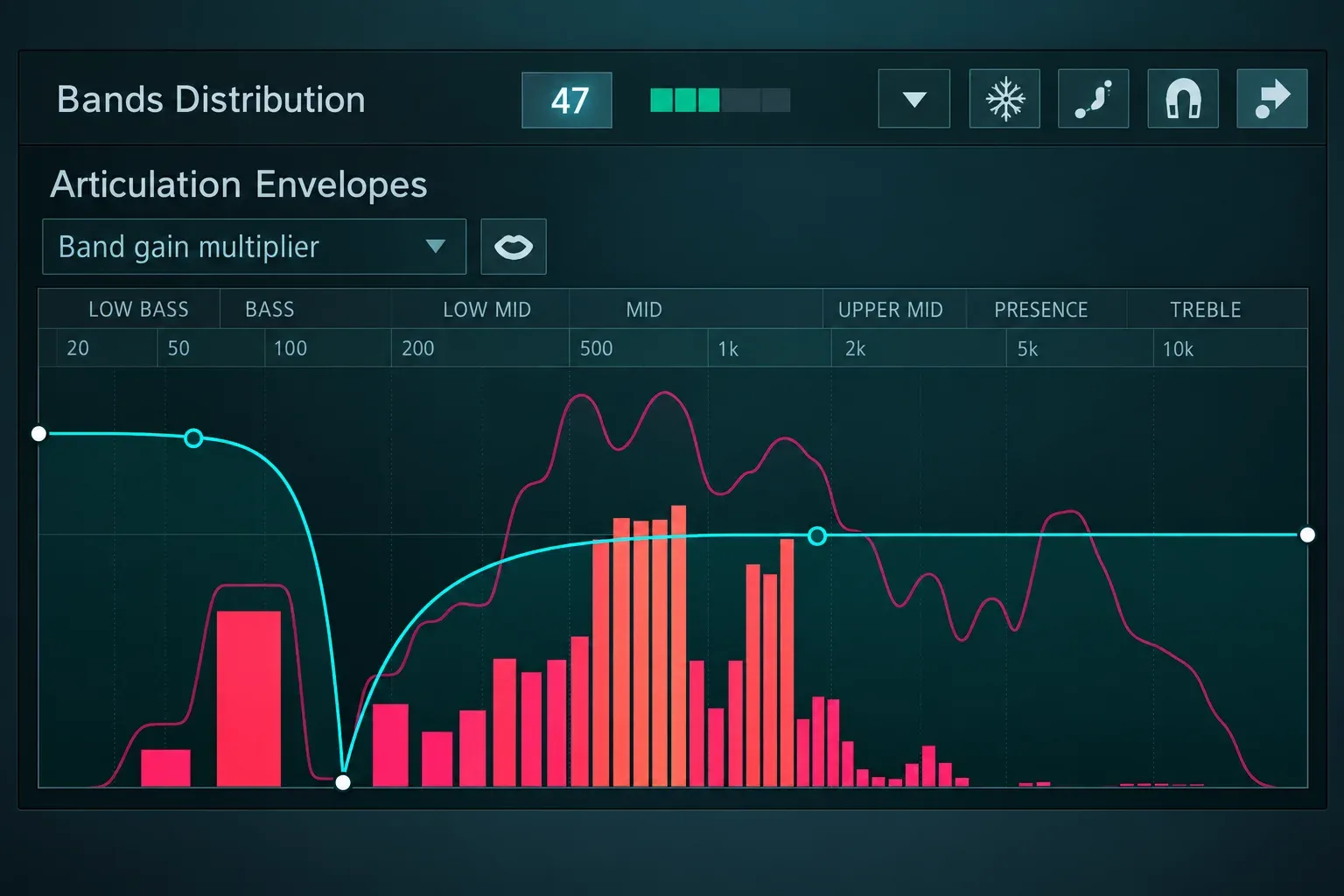
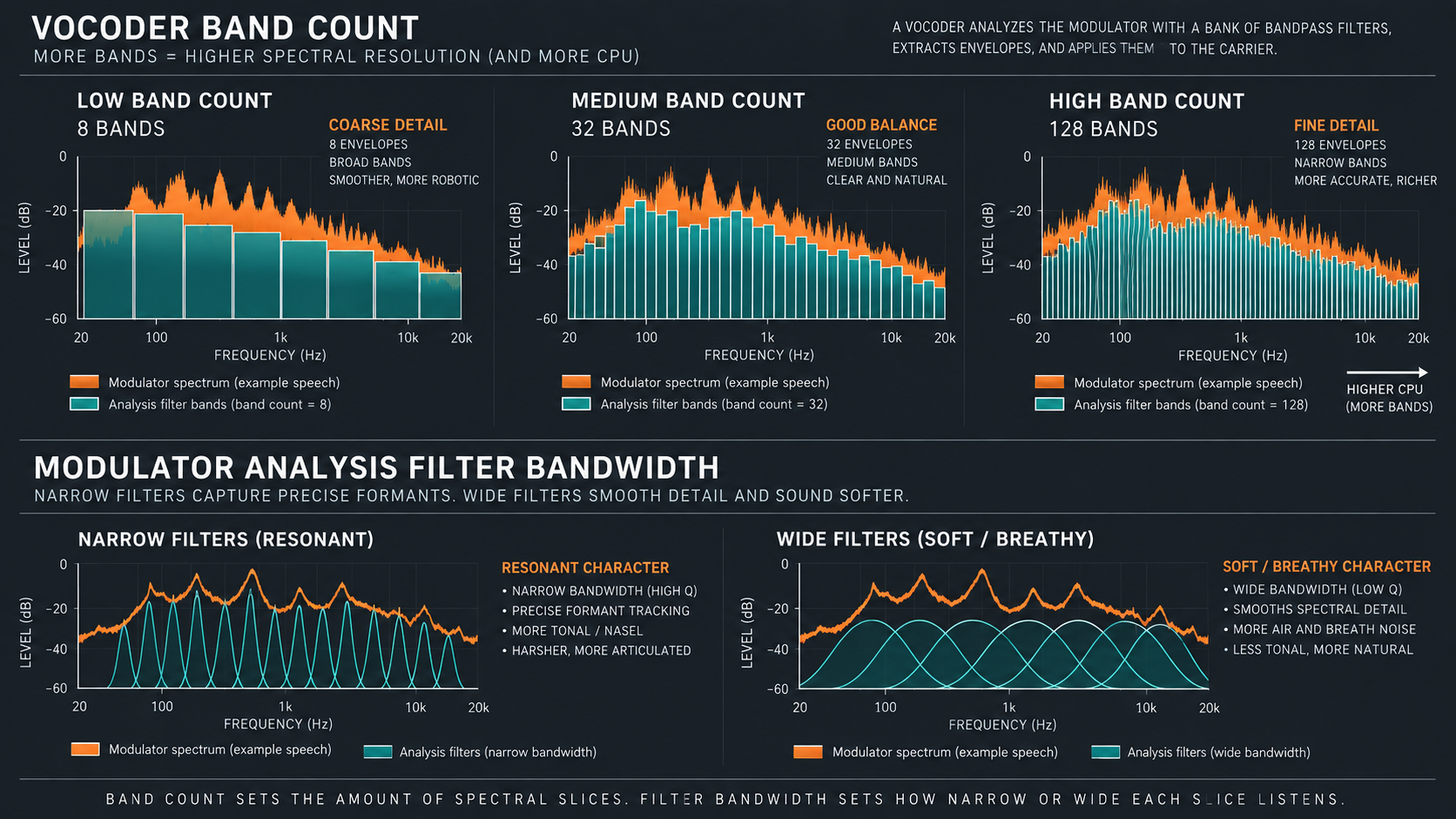
Start at a moderate count. Increase it when syllables smear together because broad regions are moving as one. Reduce it when the sound becomes too literal, thin or computationally heavy. Then adjust Modulator bandwidth: narrower detection filters produce a more resonant character; wider filters produce a softer, breathier result.
Order changes the steepness around each detection band. Band Width changes the vocoder bands themselves, while Filter Flatness changes whether their peaks are pointed or flatter. Do not read the display as a score to maximize. Change one control, speak the same phrase, and listen for one named difference.
Tune articulation with the envelope follower
The envelope follower decides how quickly each band responds to the modulator. Fast movement keeps consonants and short syllables defined. Slower movement can make the result smoother, but too much hold or release turns one phoneme into the next.
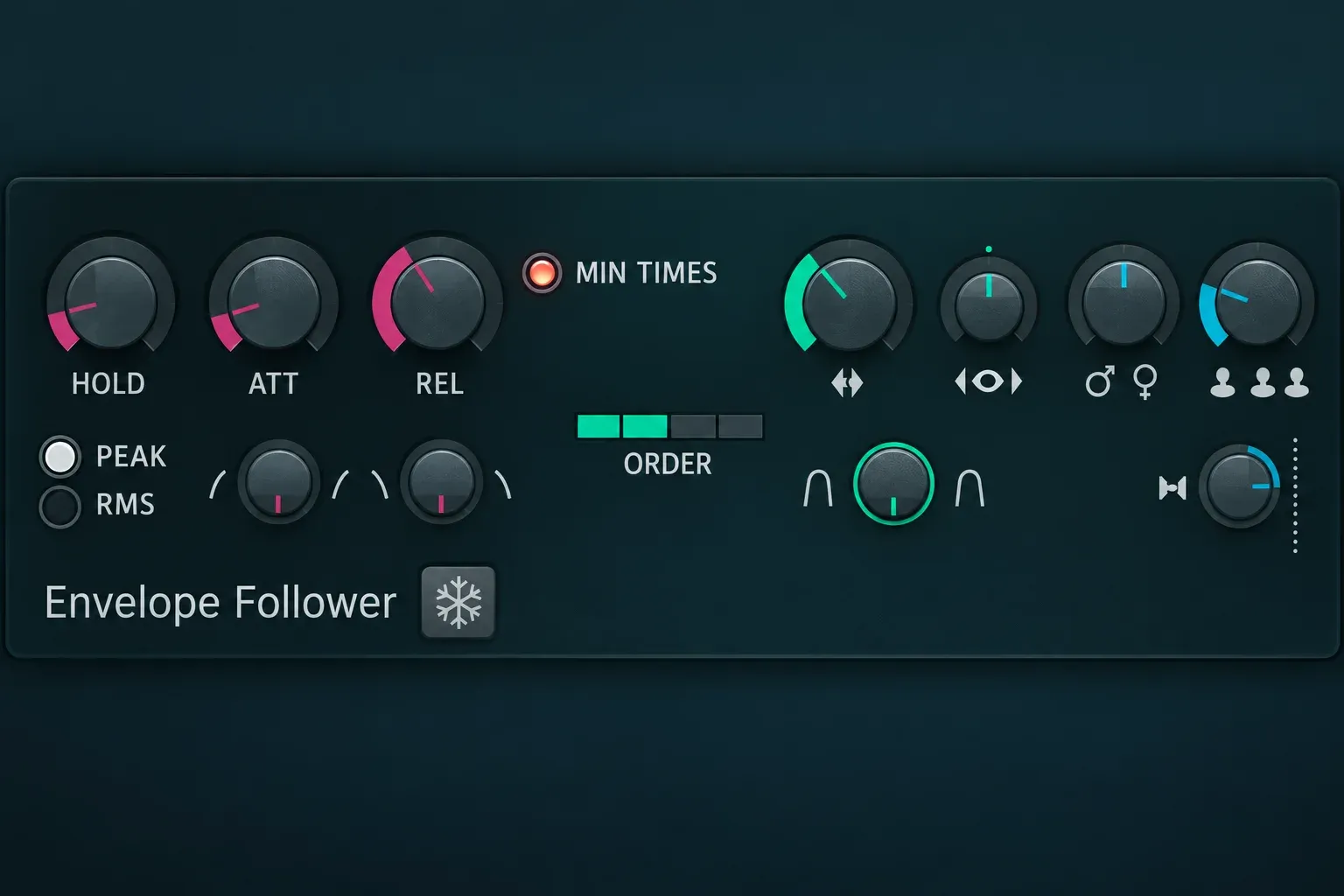
- Attack: faster settings track new band energy more closely; slower settings soften the opening.
- Release: longer settings keep bands open and create a lagging or reverberant character.
- Hold: sustains detected levels in Peak mode and changes the integration window in RMS mode.
- Peak/RMS: Peak can sound more stepped; RMS is smoother and may use less CPU in this section.
- Min Times: keeps bands open for a minimum duration to reduce glitching.
Begin with the default behavior and fix obvious problems in order. If the first consonant arrives late, shorten attack. If words blur together, shorten release or hold. If the result chatters, increase Min Times before redesigning the entire band map.
Restore s, t and other unvoiced consonants
Many consonants are noisy rather than strongly pitched. A tonal carrier may have plenty of harmonic body for vowels but little broadband energy for s, t and similar sounds. Vocodex’s NOISE control adds that missing material to the carrier path.
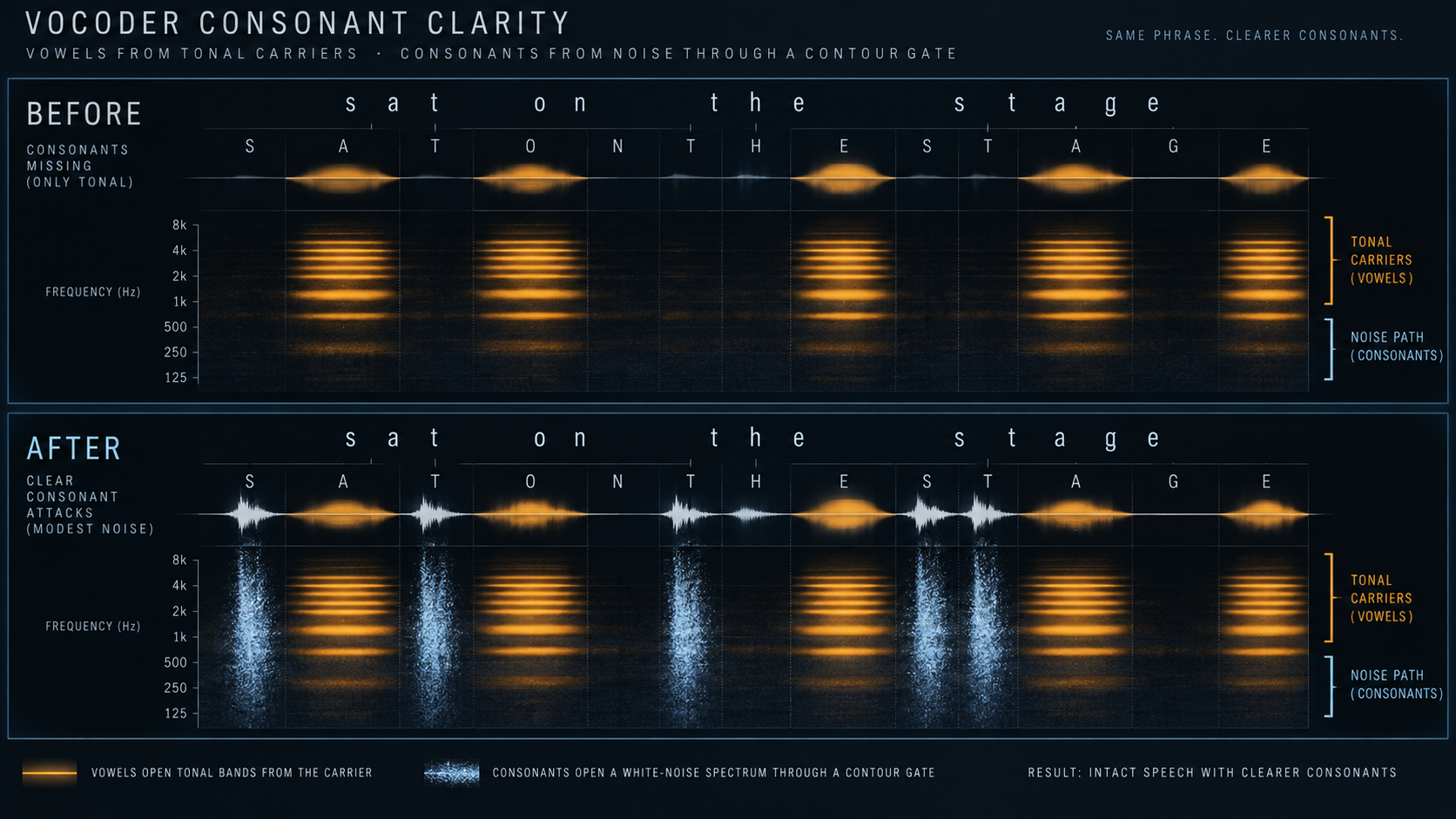
Raise NOISE until the ends and attacks of words return, then back it down. Constant hiss is not the goal. The Contour section can make noise respond to detected consonants: select FROM CONSONANTS and TO NOISE. Vocodex requires at least one FROM and one TO switch for Contour to do anything.
You can also pass some original modulator through the MOD control and use its high-pass filter so mostly high-frequency articulation reaches the output. CAR has its own low-pass-filtered pass-through path for retaining some carrier tone without letting its upper range mask the consonants. These are blend tools, not repairs for a wrong input source.
Prepare the voice without turning this into a vocal chain
The modulator does not need a polished lead-vocal chain, but its level should be stable enough for the band detector to follow quiet syllables. Image-Line recommends compression as a way to bring quieter speech forward and improve detection. Use enough control to reduce large level gaps, then let Vocodex handle the spectral transfer.
Room noise and headphone bleed can open bands when the intended phrase is silent. Vocodex can analyze a representative quiet section for about two seconds and create a modulator noise-level map. Its subtractive denoising option either subtracts that map or uses it as a threshold, depending on the setting.
For recording, cleanup, EQ, compression and ambience after the vocoder, use the FL Studio vocal-mixing workflow. Keeping that work separate helps you tell whether a word is unclear because of the source, the carrier or Vocodex itself.
Use unison after intelligibility works
Vocodex can create one to five modulation unison voices, with pitch shift and panning controls. The result resembles chorus: copies are detuned and spread. CPU use rises with the voice count.
Unison is a character stage. If the single-voice result is already muddy, extra copies usually make diagnosis harder. Establish one centered, readable voice first. Then add a second or third voice, set a small shift and widen the panning while checking whether the phrase remains understandable.
The carrier itself can provide width too. Decide where the movement belongs. A wide carrier plus high Vocodex unison can create an impressive solo sound that collapses inside a busy mix.
Balance WET, pass-through and output level
WET controls the vocoder output. MOD and CAR in the Mixer section are direct pass-through levels, shaped by HP and LP filters. They are not the same as choosing input sources with the selectors.
Start with WET carrying the result and both pass-through levels low. Add high-passed MOD only when the vocoded path needs more articulation. Add low-passed CAR only when the tonal body needs support. This order keeps each blend decision audible.
SG applies Soundgoodizer-style maximization to the vocoder output and can constrain unpredictable peaks. Leave it at zero while building the sound, then use it only if the output behavior needs that character. Match the final level when comparing changes; louder is not clearer.
A practical speech-to-synth workflow
- Choose a dry, intelligible phrase. Keep doubles, long reverb and heavy background noise out of the modulator while routing.
- Create MOD, CAR and VOCODEX inserts. Sidechain MOD only to VOCODEX and route the external carrier into it.
- Select the inputs inside Vocodex. Confirm that MOD follows the voice and CAR follows the synth.
- Use a bright sustained carrier chord. Hold one simple voicing so pitch movement does not hide routing mistakes.
- Set a moderate band count. Adjust only after the complete phrase produces output.
- Tune attack and release. Keep openings clear and prevent one syllable from smearing into the next.
- Add NOISE for consonants. Use Contour when you want it to appear mainly with detected consonants.
- Stabilize the voice if needed. Apply modest compression or the documented noise mapping rather than forcing every problem through band controls.
- Add unison and pass-through last. Protect clarity before adding size.
- Compare at a fair level in the full mix. Keep the simplest route that communicates the phrase.
Vocodex vs Pitcher, NewTone and normal vocal effects
Vocodex is not a pitch-correction tool. It imposes the modulator’s spectral movement on another sound. Pitcher corrects or redirects pitch in real time and can create harmonies from the original vocal signal. NewTone edits detected notes and timing offline.
- Choose Vocodex when a synth or other carrier should speak with the voice’s articulation.
- Choose Pitcher when the vocal should remain the sound while pitch is corrected, targeted or harmonized during playback.
- Choose NewTone when a recorded performance needs visible note-by-note pitch or timing edits.
- Choose normal EQ, compression, delay and reverb when the goal is a clear natural vocal rather than spectral resynthesis.
The FL Studio stock-plugin guide helps place these tools in the larger native set, but the choice here comes down to signal identity: preserve the voice, edit the voice, or make another sound follow it.
Troubleshoot Vocodex by signal flow
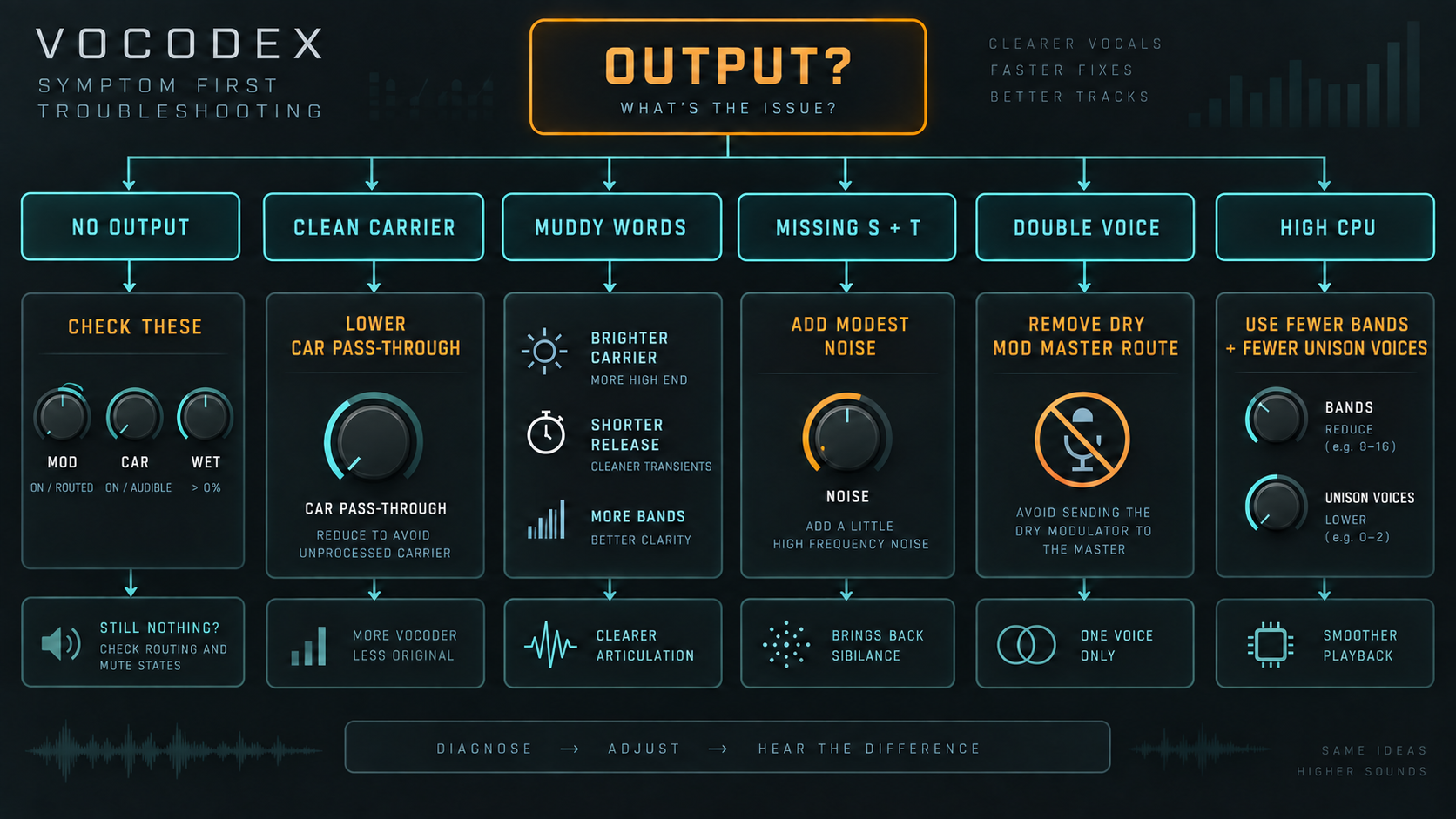
No output
Confirm that both sources are playing, the VOCODEX insert reaches Master, WET is raised and neither required selector is set to ---. Check whether CAR points to the synth and MOD points to the voice. A carrier alone or modulator alone is not enough.
You hear only the clean carrier
Lower CAR pass-through and confirm WET is active. Then check that the modulator produces level inside Vocodex. The carrier may be bypassing the vocoder through CAR or another Mixer path.
The words are muddy
Use a brighter carrier, stabilize the modulator level, shorten excessive release or hold, and compare a higher band count. Change one cause at a time. A hundred bands cannot fix a carrier with no useful upper spectrum.
S and T disappear
Add NOISE, try FROM CONSONANTS → TO NOISE, or blend a small high-passed MOD path. Keep checking for constant hiss between words.
The dry voice is doubled
The MOD track probably still reaches Master while a second path comes through Vocodex. Use sidechain to this track only for the modulator, or disable its direct Master route manually.
The result is thin or painfully bright
Adjust the carrier first, then Band Width, Filter Flatness and modulator bandwidth. Use CAR low-pass pass-through only when a controlled amount of low tonal body helps.
CPU use rises sharply
Reduce band count and unison voices, compare RMS with Peak behavior, and use Draft only when its quality tradeoff is acceptable. Image-Line documents THREADED for multi-core processing and notes that Draft can be disabled during rendering when HQ for all plugins is active.
Feedback or unstable monitoring appears
Trace every audible send. A live microphone should not return to speakers through both the dry route and the vocoder chain. Use headphones, remove duplicate Master paths and keep the input route explicit before raising gain.
A compact Vocodex checklist
- Name the MOD, CAR and VOCODEX Mixer inserts.
- Keep the dry modulator away from Master unless you deliberately pass it through.
- Use an external carrier for Piano Roll control in project work.
- Confirm MOD and CAR inside Vocodex; do not trust route order.
- Start with a bright carrier and a moderate band count.
- Tune attack, hold and release for articulation before adding size.
- Use noise or high-passed MOD to recover unvoiced consonants.
- Add unison, pass-through and SG only after the phrase is readable.
- Reduce bands and voices when CPU cost exceeds the benefit.
- Compare the final result at a fair level in the arrangement.
Vocodex becomes manageable when every control answers one signal-flow question. Which sound supplies articulation? Which sound supplies pitch and timbre? Which frequency regions are available to pass? Solve those three questions in order, and the larger interface stops behaving like a collection of unrelated knobs.